
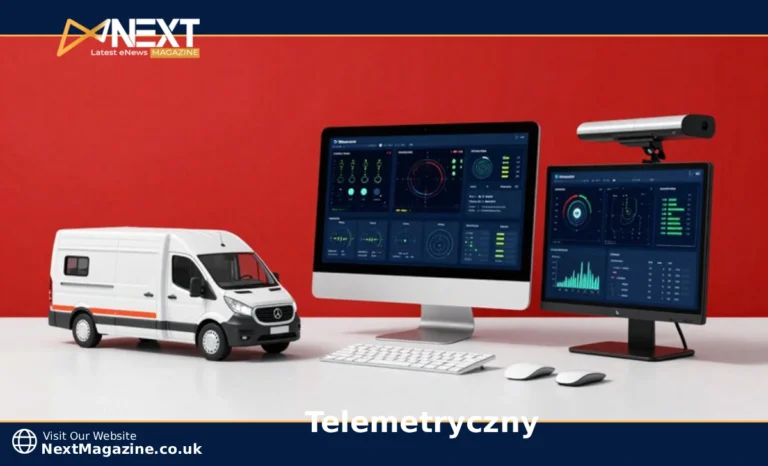
Telemetryczny (telemetric) systems collect data from sensors and transmit it remotely for monitoring and analysis. Used in vehicles, healthcare, and industry, they improve efficiency, safety, and cost control through real-time tracking and predictive insights.
What Does Telemetryczny Mean
Telemetryczny is the Polish adjective form of telemetry, describing systems that measure and transmit data over distance. The word combines Greek roots: “tele” (distance) and “metron” (measure). In English, we call these telemetric or telemetry systems.
These systems work without human intervention. Sensors collect information, transmission modules send it to a server, and software analyzes the data. You can monitor anything from vehicle location to patient heart rate to industrial equipment temperature.
The technology started in the 1960s with space programs. NASA used telemetry to track spacecraft conditions from Earth. Today, it’s mainstream. Businesses use it to monitor fleets, hospitals track patients remotely, and factories optimize production lines.
Modern telemetryczny systems are affordable and accessible. Cloud computing reduced infrastructure costs. Wireless networks (4G, 5G, LoRa) made installation simple. Small businesses can now deploy systems that only large corporations could afford 15 years ago.
How Telemetry Systems Work
Telemetry starts with data collection. Sensors measure physical conditions like speed, temperature, pressure, or location. A delivery truck might have GPS sensors for location, accelerometers for driving behavior, and OBD-II modules for engine diagnostics.
Transmission happens next. Modules use GSM, GPRS, or 5G networks to send data to cloud servers. This works like sending a text message. Data packets travel through cellular networks to reach their destination. Encryption protects information during transit.
Processing occurs on the server side. Algorithms analyze incoming data streams in real time. They detect patterns, flag anomalies, and generate alerts. If a vehicle exceeds speed limits, the system notifies fleet managers immediately. If equipment temperature spikes, maintenance teams get warnings.
Users access insights through dashboards or mobile apps. Fleet managers see vehicle locations on maps. Healthcare providers view patients’ vital signs. Factory supervisors monitor production metrics. Reports can be automated daily, weekly, or monthly.
Here’s a real example. A logistics company tracks 100 delivery vans. Sensors monitor fuel consumption, route efficiency, and driver behavior. The system detects that 15 drivers are idling engines excessively, wasting 200 liters of fuel weekly. After driver training, fuel costs drop by $800 monthly.
Key Applications of Telemetryczny Technology
Fleet management represents the largest telemetry market. Companies track vehicle location, optimize routes, and monitor driver performance. GPS data shows where vehicles are in real time. Speed sensors detect aggressive driving. Fuel monitoring reveals inefficiencies.
Transportation firms report 15-25% fuel savings after implementing telemetry. Route optimization cuts travel time by 10-20%. Maintenance costs drop because systems predict failures before breakdowns occur. Insurance premiums often decrease when companies prove safer driving habits.
Healthcare uses telemetry for remote patient monitoring. Wearable devices track heart rate, blood pressure, and oxygen levels. Data is transmitted to medical teams continuously. This matters for chronic disease patients who need constant observation but prefer staying home.
Cardiac telemetry monitors heart rhythm 24/7. If irregularities appear, alerts go to cardiologists immediately. Studies show remote monitoring reduces hospital readmissions by 30-40% for heart failure patients. It also cuts healthcare costs by catching problems early.
Industrial automation relies on telemetry for predictive maintenance. Sensors on machinery monitor vibration, temperature, and performance. Algorithms predict when components will fail. Maintenance happens during scheduled downtime, not mid-production.
Manufacturing plants using predictive telemetry report 20-30% less unplanned downtime. Equipment lifespan extends 15-25% because problems get fixed before causing damage. One automotive factory saved $2 million annually by preventing unexpected production line failures.
Agriculture adopts telemetry for precision farming. Soil sensors measure moisture, pH, and nutrients. Weather stations track temperature and rainfall. GPS systems guide automated tractors. Farmers optimize irrigation, reduce water waste, and improve crop yields by 10-20%.
Types of Telemetry Systems
GPS-based systems track location and movement. They use satellite signals to determine precise coordinates. Fleet management relies heavily on GPS telemetry. Accuracy ranges from 3-10 meters under normal conditions. Systems update positions every 5-60 seconds, depending on configuration.
GSM/GPRS modules transmit data over cellular networks. They work anywhere with mobile coverage. These modules are cost-effective and easy to install. Data transmission happens in packets, similar to the mobile internet. Battery-powered units can operate 2-3 years on scheduled transmissions.
CAN bus systems read data directly from vehicle computers. Modern cars have dozens of sensors feeding information to the onboard network. OBD-II ports provide standardized access. These systems capture engine RPM, fuel consumption, brake status, and 100+ other metrics.
Wearable telemetry devices monitor human health. Heart rate straps use Bluetooth to send data to smartphones. Holter monitors record cardiac activity continuously for 24-48 hours. Sleep trackers measure rest quality through movement and heart rate patterns.
IoT sensor networks connect multiple devices. A warehouse might have 500 temperature sensors monitoring storage conditions. A smart building could have sensors for HVAC, lighting, and occupancy. All devices communicate through a central hub, creating comprehensive monitoring ecosystems.
Satellite telemetry serves remote areas without cellular coverage. Ships at sea, Arctic research stations, and desert mining operations use satellite communication. It’s more expensive but provides global coverage. Data transmission costs $0.50-$5 per message, depending on volume.
Benefits of Using Telemetryczny Systems
Cost reduction happens through multiple channels. Fuel savings typically range from 10-20% in fleet operations. Maintenance costs drop 15-30% with predictive monitoring. Labor efficiency improves when managers have real-time data. Insurance premiums decrease by 5-15% when safe driving is proven.
Safety improvements are measurable. Fleet telemetry reduces accidents by 20-30% through driver behavior monitoring. Industrial telemetry prevents equipment failures that could injure workers. Healthcare telemetry catches medical emergencies early, potentially saving lives.
Efficiency gains come from optimization. Route planning software reduces travel distance by 10-25%. Real-time tracking eliminates time wasted searching for vehicles or equipment. Automated reporting saves managers 5-10 hours weekly on paperwork.
Data-driven decisions replace guesswork. You see exactly where problems occur. If certain routes consistently cause delays, you adjust. If specific equipment fails frequently, you replace it. If driver training improves performance, you expand the program.
Compliance becomes easier. Electronic logging devices (ELDs) automatically track driver hours, ensuring legal limits. Temperature sensors prove cold chain compliance for food transport. Emission monitoring helps meet environmental regulations.
Customer satisfaction improves through better service. Accurate delivery time estimates come from real-time tracking. Faster response times happen when you know the exact locations. Proactive maintenance prevents service disruptions.
Cost and Implementation Considerations
Basic GPS tracking systems start at $15-30 monthly per vehicle. This includes hardware, cellular data, and basic software. Entry-level solutions track location and mileage. They suit small businesses with 5-20 vehicles needing simple monitoring.
Advanced fleet management platforms cost $40-80 monthly per vehicle. These include driver behavior monitoring, fuel tracking, maintenance scheduling, and detailed analytics. Hardware installation adds $200-500 per vehicle initially. Midsize companies with 50-200 vehicles typically choose this tier.
Enterprise solutions run $80-150+ monthly per unit. They offer AI-powered analytics, video telematics, integration with ERP systems, and dedicated support. Custom development can add $10,000-50,000 to initial costs. Large corporations with 500+ vehicles need this sophistication.
Industrial telemetry varies widely. Simple temperature monitoring for a warehouse might cost $2,000-5,000 for sensors and software. Complex predictive maintenance for a manufacturing plant could require $50,000-200,000 investment. Costs depend on sensor quantity, system complexity, and integration requirements.
Choosing the Right Telemetry Solution
Define your needs first. What problems are you solving? Reducing fuel costs differs from improving safety or meeting compliance requirements. List your top 3-5 priorities. This guides vendor selection and prevents paying for unused features.
Consider scalability. If you have 10 vehicles now but plan to reach 50 within two years, choose systems that scale easily. Per-unit pricing should decrease with volume. Cloud-based platforms handle growth better than on-premise solutions.
Evaluate integration capabilities. Can the telemetry system connect to your existing software? Fleet systems should integrate with dispatch, accounting, and maintenance platforms. Healthcare systems need EHR compatibility. Industrial systems require SCADA or ERP connections.
Check data ownership and access. You should fully own your data. Avoid vendors with restrictive export policies. Look for standard API access. Confirm you can download historical data if you switch providers later.
Future of Telemetryczny Technology
Artificial intelligence transforms telemetry from reactive to predictive. Machine learning algorithms detect subtle patterns humans miss. AI predicts equipment failures 2-4 weeks earlier than traditional methods. Automated recommendations suggest specific actions, not just alerts.
Edge computing processes data at the source rather than in the cloud. This reduces latency from seconds to milliseconds. Critical for autonomous vehicles that need instant decisions. It also cuts bandwidth costs by 40-60% since only important data is transmitted to servers.
5G networks enable massive telemetry expansion. Current 4G networks handle 10,000 devices per square kilometer. 5G supports 1 million devices in the same space. Ultra-low latency (1-5 milliseconds) makes real-time control possible. Smart cities will deploy millions of sensors tracking everything from traffic to air quality.
Vehicle-to-everything (V2X) communication connects vehicles with infrastructure, pedestrians, and each other. Cars will share data about road conditions, traffic, and hazards. This improves safety and enables autonomous driving. By 2030, analysts expect 30% of new vehicles to have V2X capability.
Digital twins create virtual replicas of physical assets. Telemetry data feeds real-time information into simulation models. Engineers test scenarios virtually before applying changes. This approach reduces downtime and optimizes performance. Manufacturing and energy sectors adopt digital twins rapidly.
