
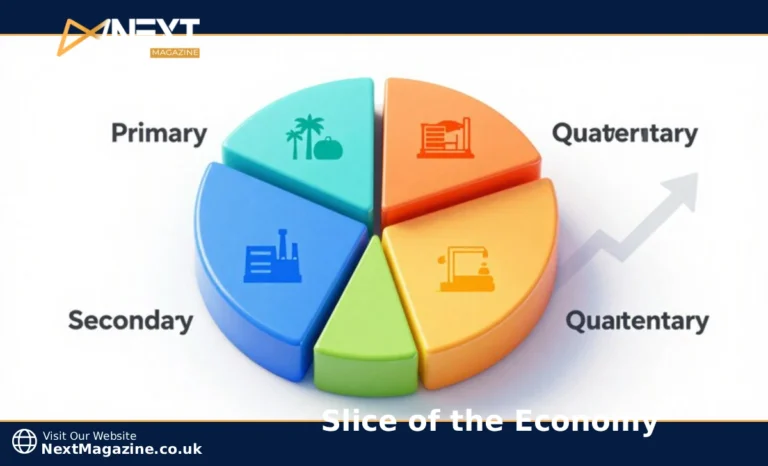
A slice of the economy refers to an economic sector—a distinct category of businesses and industries that perform similar functions within the economic system. The answer to this common crossword clue is “SECTOR,” representing how economists divide GDP into segments like primary (extraction), secondary (manufacturing), tertiary (services), and quaternary (knowledge work).
Each sector transforms resources differently. The primary sector pulls raw materials from nature. The secondary sector converts those materials into finished goods. The tertiary sector delivers services to consumers and businesses. Understanding these divisions reveals where jobs emerge, which industries drive growth, and how economies develop over time.
The Crossword Clue That Reveals Economic Truth
You’ve probably seen “slice of the economy” in the New York Times crossword. The answer—SECTOR—points to a fundamental concept in economics that affects your career, investments, and daily life.
This isn’t just wordplay. When economists measure GDP, track employment, or analyze growth, they divide economic activity into sectors. China’s manufacturing sector produces 30% of global manufactured goods. The U.S. service sector generates 79% of American GDP. India’s agricultural sector employs 42% of workers but contributes only 18% of GDP.
These numbers tell stories about development, productivity, and opportunity. Recognizing which sector you work in, which sectors grow fastest, and how sectors interact gives you an edge in planning your career and allocating your money.
What Does Slice of the Economy Actually Mean?
Economic sectors classify businesses by how they create value and what they produce. Think of sectors as the major departments of a national economy.
Economists developed this classification system to track development patterns and measure productivity. When you read that “Germany’s service sector accounts for 73% of GDP,” that’s sector analysis revealing economic structure.
The sector framework shows economic maturity. Poor nations rely heavily on agriculture and mining. Wealthy nations concentrate on services and knowledge work. This progression isn’t automatic—China maintains massive manufacturing while building tech capabilities. Your economy’s sector mix reflects resources, education levels, trade relationships, and policy choices.
The distinction between sectors and industries matters. Agriculture and mining belong to the primary sector but represent different industries. They share the same sector because both extract natural resources. The specific activities differ significantly, making them separate industries within the broader sector.
The Four Main Economic Sectors
Primary Sector: Extracting Raw Materials
The primary sector pulls resources directly from nature. Farmers grow wheat, miners extract lithium, fishermen catch tuna, and drillers pump oil. This sector provides raw materials for every other economic activity.
In 2026, the primary sector employs roughly 26% of the global workforce but generates only 6-8% of total global GDP. This gap reveals something critical—extracting raw materials creates less economic value than transforming them into finished products.
Developing countries lean heavily on this sector. Across sub-Saharan Africa and parts of South Asia, 40-70% of workers farm, fish, or mine. Ethiopia’s economy depends substantially on agriculture, employing most workers in primary activities.
Developed nations show different patterns. The United States employs less than 2% of workers in agriculture and mining combined. The United Kingdom’s primary sector accounts for roughly 3% of economic activity. Technology and mechanization mean fewer workers produce more output.
Modern primary sector examples extend beyond traditional farming:
- Solar energy harvesting operations
- Commercial fishing fleets using satellite tracking
- Lithium mining for electric vehicle batteries
- Precision forestry with drone monitoring
- Deep-sea mining for rare earth elements
Climate change reshapes this sector. Water stress affects farming in California and Australia. Declining fish stocks force fleet reductions worldwide. Demand for minerals needed in batteries, chips, and renewable energy drives new projects in Chile, Indonesia, and the Democratic Republic of Congo.
The primary sector faces a productivity paradox. One farmer with modern equipment produces vastly more food than ten farmers using hand tools. This productivity gain reduces employment in the sector even as output increases. The United States produced record corn yields in 2025, with just 1.3% of the workforce farming.
Secondary Sector: Manufacturing and Building
The secondary sector transforms raw materials into finished goods and builds infrastructure. This sector takes wheat and makes bread, converts iron ore into steel beams, and assembles smartphones from hundreds of components.
Manufacturing historically drove economic development. The Industrial Revolution began when Britain mechanized textile production. Post-war economic miracles in Japan and South Korea centered on building manufacturing capacity. China’s rise came from becoming the world’s factory.
In 2026, manufacturing contributes differently across economies. China produces roughly $4.5 trillion in manufactured goods annually. The United States generates about $2.3 trillion. Germany’s manufacturing sector, though smaller than its service sector, still exports $1.6 trillion in machinery, vehicles, and chemicals.
The secondary sector encompasses:
- Traditional manufacturing (automobiles, appliances, textiles)
- Construction (buildings, roads, infrastructure)
- Food processing (turning crops into packaged foods)
- Electronics assembly (phones, computers, semiconductors)
- Energy production (refining oil, generating electricity)
- Pharmaceutical manufacturing
- Shipbuilding and aerospace
Automation reshapes this sector dramatically. Factories in wealthy nations employ fewer workers while producing more goods. A modern automobile plant might employ 1,000 workers, whereas a similar 1980s plant needed 5,000. Robots weld frames, AI systems check quality, and automated vehicles move parts.
This creates economic tension. Manufacturing remains vital for GDP and trade balances, but no longer provides mass employment in developed nations. The United States lost millions of manufacturing jobs since 2000, yet manufacturing output increased. Technology made workers more productive while reducing headcount.
The secondary sector also includes construction, which employs more workers than other manufacturing activities. Building infrastructure, homes, and commercial structures requires significant labor that automation hasn’t fully replaced. In the United States, construction employs roughly 7.5 million workers—more than automobile manufacturing, textile production, and electronics assembly combined.
How Different Sectors Drive Modern Economies
The tertiary sector delivers services rather than physical goods. Teachers educate students, nurses treat patients, truck drivers transport goods, and retail workers sell products made in the secondary sector.
This sector dominates wealthy economies. Services account for 79% of U.S. GDP, 73% of German GDP, and 71% of British GDP. Even in China, services now represent 54% of economic output, surpassing manufacturing for the first time in 2013.
Tertiary sector activities span an enormous variety:
- Retail and wholesale trade
- Healthcare and medical services
- Education at all levels
- Financial services and banking
- Transportation and logistics
- Hospitality and restaurants
- Entertainment and media
- Legal and consulting services
- Real estate and property management
The sector’s expansion reflects rising incomes. When people earn more, they spend less on basic goods and more on services. Middle-class families eat at restaurants, hire accountants, pay for streaming services, and take vacations. Poor families spend 60-70% of their income on food and basic goods. Wealthy families might spend 10-15% on food and 70% on services.
Technology disrupts this sector differently from manufacturing. Some services automate away—ATMs replaced bank tellers, self-checkout reduced cashiers, and chatbots handle customer service. Other services explode—app developers, data analysts, and digital marketers didn’t exist 30 years ago.
The gig economy complicates traditional classification. An Uber driver provides transportation services (tertiary sector). But they use a smartphone app (quaternary sector technology) and rely on automobile manufacturing (secondary sector). Modern economies blur sector boundaries constantly.
The quaternary sector emerged as economists recognized that knowledge-based work doesn’t fit neatly into service categories. This sector focuses on intellectual activities—research, development, information processing, and innovation.
Quaternary sector activities include:
- Research and development
- Information technology and software development
- Data science and analytics
- Financial consulting and analysis
- Scientific research
- Higher education and specialized training
- Media production and content creation
This sector drives competitive advantage in 2026. Countries investing heavily in R&D, education, and technology infrastructure outperform those that don’t. The United States spends over $700 billion annually on R&D. China invests more than $600 billion. These investments yield patents, new products, and productivity improvements.
Silicon Valley epitomizes the quaternary sector. Companies like Google, Apple, and Meta create value primarily through intellectual work—writing code, designing experiences, analyzing data, and developing algorithms. Their products are digital or rely heavily on embedded software.
The quaternary sector correlates with high wages. Software engineers earn median salaries above $120,000. Data scientists command similar pay. Research scientists at pharmaceutical companies or aerospace firms earn well above national averages. This wage premium reflects the specialized knowledge required and the value created.
Sector Distribution Across Countries in 2026
Global GDP in 2026 exceeds $105 trillion. The distribution breaks down roughly as follows:
- Primary sector: 6-8% of global GDP
- Secondary sector: 26-28% of global GDP
- Tertiary sector: 58-62% of global GDP
- Quaternary sector: 6-8% of global GDP (often counted within tertiary)
Employment distribution differs significantly from GDP contribution:
- Primary sector: ~26% of global workers
- Secondary sector: ~23% of global workers
- Tertiary sector: ~51% of global workers
This gap between employment and GDP reveals productivity differences. One farmer using modern equipment produces vastly more food than ten farmers using hand tools. One factory worker with robots produces more goods than twenty workers in a manual facility.
The United States shows extreme service dominance. Roughly 80% of American workers hold service-sector jobs. Manufacturing employs about 8% of workers, while agriculture and mining combined account for less than 2%. The service sector generates 79% of GDP, manufacturing contributes 11%, and primary activities account for less than 2%.
China presents a transitional case. Manufacturing still employs 28% of workers but produces about 38% of GDP. Services employ 48% of workers and generate 54% of GDP. The agricultural sector employs 24% of workers but contributes only 8% of GDP. China actively pushes workers from farms into factories and service jobs.
Germany maintains strong manufacturing despite advanced development. The secondary sector employs 27% of workers and contributes 26% of GDP. Services employ 72% of workers and generate 73% of GDP. Germany’s manufacturing strength comes from high-value production—precision machinery, automobiles, and chemicals—rather than low-cost assembly.
India reflects developing economy patterns. Agriculture employs 42% of workers but contributes just 18% of GDP. The industry employs 26% of workers and contributes 25% of GDP. Services employ 32% of workers yet generate 57% of GDP. This mismatch shows India’s development challenge—moving hundreds of millions of workers from low-productivity farming into higher-value activities.
Economic development typically follows predictable patterns. Poor countries rely on primary sectors. Growing economies build manufacturing capacity. Wealthy nations shift toward services and knowledge work. This progression explains growth rates in 2026.
India projects 6.2% GDP growth, driven by expanding manufacturing and services as workers leave agriculture. Indonesia grows at 4.9%, following a similar path. Vietnam’s 6.5% growth reflects rapid industrialization. These countries add value by moving workers from low-productivity primary activities into higher-productivity secondary and tertiary sectors.
Contrast this with developed economies. Germany grows at 0.9%, Japan at 0.6%, the United States at 2.1%. These nations already completed their sector transitions. They employ tiny fractions of workers in agriculture, maintain significant manufacturing, and rely heavily on services and knowledge work. Growth rates stay lower because they’re already wealthy and productive.
Why Knowing Your Economic Sector Matters
Understanding sectors helps you make better career and investment decisions in 2026.
For career planning, identify growing sectors in your economy. In developed nations, quaternary sector jobs grow fastest. Healthcare services expand as populations age. Traditional manufacturing jobs decline in number but require higher skills. Primary sector employment continues to shrink except in specialized areas like renewable energy resources or precision agriculture.
Ask yourself these questions:
- Does my career path align with growing or declining sectors?
- Am I developing skills relevant to expanding industries?
- Should I retrain for a different sector with better prospects?
- Which sectors offer the highest wage growth in my country?
The data shows clear patterns. In the United States, healthcare employment grew 16% from 2019 to 2024. Technology sector employment grew 12%. Manufacturing employment stayed flat. Retail employment declined 3% as e-commerce replaced physical stores. These trends guide smart career choices.
For investors, sector analysis guides allocation decisions. Growth investors emphasize quaternary sector companies developing AI, biotech, or clean energy. Value investors find opportunities in undervalued secondary sector manufacturers. Diversification across sectors reduces portfolio risk.
Watch how sector shifts create opportunities. The transition to electric vehicles disrupts the automotive secondary sector while creating opportunities in lithium mining (primary sector) and battery technology development (quaternary sector). The aging population in developed nations drives healthcare service demand (tertiary sector) and pharmaceutical innovation (quaternary sector).
Investment flows follow sector growth. In 2026, technology investments (primarily quaternary sector) exceed $500 billion in the U.S. alone. Clean energy investments (spanning primary, secondary, and quaternary sectors) topped $1.8 trillion globally in 2025. Investors betting on growing sectors capture outsized returns.
For business owners, understanding your sector’s position reveals competitive dynamics. Primary sector businesses face commodity pricing and weather risks. Secondary sector companies deal with automation pressures and global competition. Tertiary sector businesses navigate technological disruption and changing consumer preferences. Quaternary sector firms compete for educated talent and race to innovate.
Recognize that sectors increasingly overlap. A modern farm business operates in the primary sector but uses quaternary sector technology—GPS-guided tractors, data analytics for crop optimization, and drone monitoring. A manufacturing company (secondary sector) may generate significant revenue from maintenance services (tertiary sector) and develop proprietary software (quaternary sector).
The global economy continues evolving. Artificial intelligence may create entirely new sector classifications or transform existing ones. Climate change reshapes primary sector activities worldwide. The boundary between manufacturing and services blurs as products become smart through embedded software.
Understanding which slice of the economy you operate in—and where that slice is heading—gives you a competitive advantage. Whether you solve crossword puzzles or build businesses, knowing that sectors divide the economic pie helps you grab a bigger piece.
