
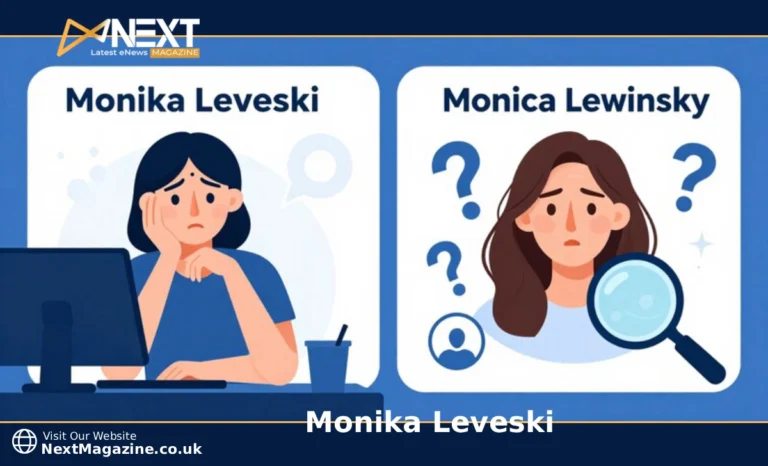
“Monika Leveski” is not a real person. This name appears online as a misspelling of Monica Lewinsky, the former White House intern known for her 1990s relationship with President Bill Clinton. Search results often show fabricated content from low-quality websites using this variation for SEO purposes.
Understanding the Name Confusion
You searched for “Monika Leveski” and landed here. You probably want to know who this person is. Here’s the truth: this name doesn’t belong to any notable public figure.
“Monika Leveski” is a misspelling of Monica Lewinsky. The confusion comes from two sources. First, people sometimes spell “Monica” as “Monika” (the K is common in Eastern European countries). Second, “Leveski” appears to be a corrupted version of “Lewinsky.”
Search results for this misspelling often lead to low-quality websites. These sites create fictional biographies and claim “Monika Leveski” is an artist, entrepreneur, or innovator. None of this is true. These are SEO content farms that generate fake articles to attract traffic.
The surname “Leveski” does exist. Actress Nina Dobrev’s mother is Michaela Leveski Dobreva, an artist. But “Monika Leveski” as a specific person does not exist in any verifiable records.
If you’re looking for information about Monica Lewinsky, you’re in the right place. Let’s clear up the confusion and give you the real story.
Who Monica Lewinsky Actually Is
Monica Samille Lewinsky was born on July 23, 1973, in San Francisco, California. She’s now 52 years old. She gained international attention in 1998 when details of her relationship with President Bill Clinton became public.
Lewinsky worked as a White House intern during Clinton’s first term. The scandal that followed became one of the most significant political events of the 1990s. It led to Clinton’s impeachment by the House of Representatives, though the Senate acquitted him.
Today, Lewinsky is a social activist, public speaker, and producer. She advocates against cyberbullying and public shaming. Her work focuses on the damage caused by online harassment, drawing from her own experiences.
She has rebuilt her life and career after years of struggle. Her transformation from scandal subject to respected advocate represents a remarkable personal journey.
The Clinton-Lewinsky Scandal Explained
The relationship between Monica Lewinsky and President Bill Clinton began in November 1995. Lewinsky was 22 years old and working as an unpaid intern in the White House Chief of Staff’s office. Clinton was 49 and serving his first term as president.
The affair continued intermittently until March 1997. During this time, Lewinsky confided in Linda Tripp, a coworker at the Pentagon where Lewinsky had been transferred. Tripp secretly recorded their phone conversations.
In January 1998, the story exploded into public view. Independent Counsel Kenneth Starr, who was already investigating Clinton for other matters, obtained Tripp’s recordings. The news broke on January 21, 1998, when the Drudge Report published details of the relationship.
Clinton initially denied the allegations. His famous statement, “I did not have sexual relations with that woman, Miss Lewinsky,” became one of the most quoted lines of his presidency. He later admitted to an “inappropriate relationship” after months of denials.
The scandal consumed American politics for most of 1998. Clinton faced accusations of perjury and obstruction of justice related to his testimony in a separate sexual harassment lawsuit filed by Paula Jones.
Key Events That Shaped the Scandal
The grand jury testimony became a pivotal moment. In July 1998, Lewinsky testified before Starr’s grand jury after receiving immunity. She provided detailed accounts of her relationship with Clinton.
Clinton testified in August 1998. He admitted to the relationship but claimed his earlier denials were technically accurate based on his interpretation of what constituted “sexual relations.”
Kenneth Starr, the independent counsel, released his report in September 1998. The Starr Report contained explicit details that were made public. This level of disclosure was unprecedented and contributed to the media frenzy.
The House of Representatives impeached Clinton on December 19, 1998, on charges of perjury and obstruction of justice. He became only the second U.S. president to be impeached.
The Senate trial took place in early 1999. On February 12, 1999, the Senate voted to acquit Clinton on both charges. He remained in office and completed his second term.
Public Aftermath and Personal Impact
The media coverage was relentless. Lewinsky’s name, face, and personal details became known worldwide. She faced intense public scrutiny, ridicule, and harassment.
The psychological toll was severe. Lewinsky has spoken openly about her struggles with depression and thoughts of suicide during this period. The public humiliation affected every aspect of her life.
Finding employment proved nearly impossible. The notoriety made it difficult for her to build a career. She worked briefly as a television personality and handbag designer, but these ventures didn’t provide long-term success.
In a 2015 TED Talk, Lewinsky identified herself as “patient zero” of online harassment. While the internet was still relatively new in 1998, the scandal coincided with its growth. She became one of the first people to experience mass cyberbullying on a global scale.
The experience isolated her socially as well. Friends distanced themselves. She struggled to form new relationships. The scandal defined her identity for years.
Financial pressures added to her difficulties. Legal fees from the investigation were substantial. She later said she considered leaving the country to escape the constant attention.
Lewinsky’s Career Reinvention and Activism
For over a decade, Lewinsky largely stayed out of the public eye. She pursued graduate studies in social psychology at the London School of Economics. Her thesis focused on social media and public perception.
In 2014, she made a deliberate decision to reclaim her narrative. She wrote an essay for Vanity Fair titled “Shame and Survival.” In it, she reflected on the scandal and its aftermath with a new perspective.
This marked the beginning of her transformation into an anti-bullying advocate. She began speaking publicly about her experiences. Her focus shifted to helping others who face public shaming and online harassment.
Her 2015 TED Talk, “The Price of Shame,” has been viewed millions of times. In it, she discussed the culture of humiliation and the real consequences of cyberbullying. The talk resonated with audiences worldwide.
Lewinsky joined organizations dedicated to fighting bullying. She became a spokesperson for Bystander Revolution, an anti-bullying organization. Her advocacy work gave her a new purpose and platform.
In 2021, she served as a producer on “American Crime Story: Impeachment,” the FX series about the scandal. She provided insight and perspective on the events. The show examined the scandal through a modern lens.
Current Work and Public Speaking
Lewinsky continues her advocacy work through Alt Ending Productions, her production company. She develops projects that explore themes of public shaming, power dynamics, and social change.
Her social media presence is active and thoughtful. She uses platforms like Twitter (X) to comment on current events, particularly those involving public shaming or abuse of power.
In 2025, she launched a podcast called “Reclaiming with Monica Lewinsky.” The show features conversations with others who have faced public scrutiny and rebuilt their lives.
She speaks regularly at conferences and events. Her topics include digital harassment, mental health, and the importance of empathy in online interactions.
Her writing appears in major publications. She contributes essays and opinion pieces that draw on her experiences while addressing broader social issues.
How the #MeToo Era Changed the Narrative
The #MeToo movement, which gained momentum in 2017, brought new context to the Clinton-Lewinsky scandal. Conversations about power imbalances in relationships shifted public perception.
Many began to view the relationship differently. The 27-year age gap and the president-intern power dynamic came under new scrutiny. What was once framed as a consensual affair between adults now looked more problematic.
Lewinsky herself addressed this evolution in her thinking. In a 2018 Vanity Fair essay, she wrote about how her perspective had changed. She described the relationship as a “gross abuse of power” on Clinton’s part.
She clarified that she had always maintained the relationship was consensual. However, she now recognized that true consent is complicated when such a significant power imbalance exists.
Clinton’s responses to these evolving views have been mixed. In some interviews, he has expressed regret for his actions. In others, he has been defensive when questioned about the power dynamics.
The cultural reassessment continues. Documentaries and series examining the scandal through a contemporary lens have emerged. These productions often focus on how Lewinsky was treated by the media and the public.
The shift represents a broader change in how society views workplace relationships, power, and accountability. Lewinsky’s experience became a case study in these discussions.
Why Accurate Information Matters
The existence of fake articles about “Monika Leveski” highlights a real problem. Misinformation spreads easily online. Content farms create false narratives to game search engines.
When you search for information, you need reliable sources. This is especially true for public figures and historical events. Fabricated content serves no one’s interests.
How can you verify information? Start with established news organizations. Look for multiple sources that corroborate the same facts. Check publication dates to ensure information is current.
For Monica Lewinsky specifically, credible sources include her own writings in Vanity Fair, her TED Talk, and interviews with major news outlets. Documentaries like “The Clinton Affair” (2018) provide a comprehensive historical context.
Be skeptical of websites that seem to exist solely for SEO purposes. If an article makes grand claims without sources, that’s a red flag. If the writing is vague and generic, question its accuracy.
The “Monika Leveski” misspelling demonstrates how easy it is for false information to populate search results. Taking a few extra minutes to verify what you read makes a difference.
Digital literacy matters more than ever. Teaching ourselves and others to distinguish between reliable and unreliable sources helps combat misinformation.
Monica Lewinsky’s real story is compelling enough without fabrication. Her transformation from scandal subject to respected advocate offers lessons about resilience, power, and redemption. Stick with the facts, and you’ll find a much more interesting and valuable story than any invented “Monika Leveski” narrative could provide.
