
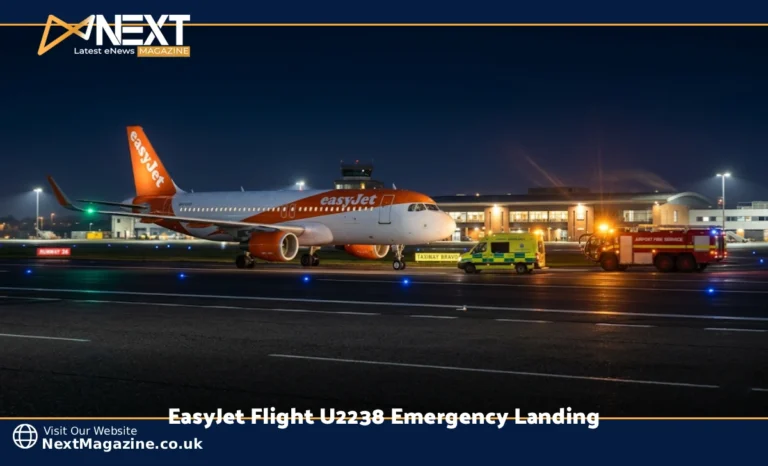
Medical emergencies occur on approximately 1 in every 604 commercial flights, with around 10% of those leading to an early diversion for medical attention. It is one of the most common reasons for unplanned landings in commercial aviation globally.
At first glance, it looked like an ordinary Monday evening flight.
Around 178 passengers had settled into their seats aboard an Airbus A320 at Copenhagen Airport, headphones on, bags stowed, expecting to land in Manchester a little over two hours later. EasyJet Flight U2238 — running about 28 minutes behind schedule — finally lifted off at 22:13 CET on October 27, 2025.
Then, somewhere over the North Sea, the flight diverted to Newcastle Airport, and everything changed.
A passenger fell seriously ill. What followed in the next 40 minutes is one of the clearest real-world examples of aviation safety working exactly as it should — fast, calm, and without hesitation.
What Happened to EasyJet Flight U2238?
The situation developed quickly, necessitating immediate coordination with medical services on arrival. Cabin crew noticed a passenger in serious distress and immediately shifted into emergency response mode. First aid was administered using the aircraft’s onboard medical kit. Oxygen support was provided. Crew members checked whether any medical professionals happened to be travelling on flight U22238.
At the same time, the pilots were informed of the developing situation. The captain had to make one central decision under real pressure: continue the remaining flight to Manchester, or divert immediately to the nearest suitable airport.
Within roughly 15 minutes of the emergency starting, the answer was clear regarding the journey to Manchester. The aircraft transmitted Squawk 7700 — the universal aviation distress code — alerting all air traffic control facilities in the area that the flight now required priority handling.
The plane turned toward Newcastle to ensure the unwell passenger received timely medical attention.
Why Did the Aircraft Land in Newcastle?
Newcastle was the logical choice, not a random one.
When a pilot declares an in-flight emergency, the diversion airport is chosen based on several real-time factors: distance, weather conditions, runway capacity, available emergency services on the ground, and crucially, proximity to hospital care.
Newcastle Airport met all of those criteria. It operates around the clock, can handle wide-body and narrow-body jets at a moment’s notice, and has direct coordination with the North East Ambulance Service. Most importantly, it sits close to the Royal Victoria Infirmary (RVI) — one of the UK’s leading Level 1 trauma and emergency care centres, crucial for any flight diverted to Newcastle after a medical emergency.
Choosing Newcastle over continuing to Manchester wasn’t a failure of planning. It was exactly the right call. When someone needs urgent medical help, every minute on the tarmac waiting matters, especially during a passenger medical emergency.
The aircraft landed safely at Newcastle Airport shortly before 11 PM local time. Paramedics from the North East Ambulance Service were already positioned at the runway before the wheels touched down for the flight continued to Manchester.
Were Passengers Safe?
Yes — entirely.
The unwell passenger was met by medical services immediately upon landing and transferred without delay to the Royal Victoria Infirmary for treatment. Neither easyJet nor NHS trusts disclosed the patient’s identity or diagnosis, which is standard under UK medical confidentiality rules. No life-threatening outcome was publicly reported.
For the remaining passengers on board, the experience was disorienting but safe throughout. Cabin crew kept the atmosphere calm with clear, regular updates over the intercom. The captain explained the situation directly, emphasising the need for an emergency landing due to a medical emergency onboard. Once the aircraft was on the ground, passengers were looked after while the airline managed the next steps.
After approximately 70 minutes on the ground, EZY2238 departed Newcastle at 00:02 GMT on 28 October and landed at Manchester Airport at 00:28 GMT — meaning most passengers reached their original destination before 1 AM.
The aircraft — registered G-EZPB — was inspected post-landing and returned to service the same night. Post-incident checks confirmed no technical fault with flight Ezy2238 from Copenhagen, which was diverted to Newcastle Airport after a medical emergency. The diversion was entirely driven by the medical emergency, not any problem with the aircraft itself, as the flight was forced to divert to Newcastle.
easyJet’s Approach to Onboard Emergencies
EasyJet, like all major European carriers, trains its cabin crew extensively in in-flight medical response. That training covers administering first aid, using onboard defibrillators and oxygen equipment, communicating with the flight deck under pressure, and managing a cabin full of concerned passengers simultaneously.
The crew on Flight U2238 did exactly what they were trained to do: identify the emergency early, escalate quickly, and keep the situation contained without allowing fear to spread through the cabin during the medical emergency onboard.
This is worth emphasising because headlines involving the words “emergency landing” tend to suggest chaos, especially when the flight diverted to Newcastle. In reality, medical diversions are among the most rehearsed scenarios in commercial aviation, especially for flights like Ezy2238 from Copenhagen to Manchester. Every major airline has a detailed emergency operations playbook, and crews run through these procedures regularly.
Newcastle Airport’s Emergency Response
Newcastle International Airport played a precise and well-executed role in the outcome of this incident.
When air traffic control received the Squawk 7700 signal from EZY2238, the airport’s operations team immediately activated. A landing slot was cleared. Other air traffic in the area was rerouted to give the incoming flight priority. Ground crews, ambulance services, and airport emergency staff were all in position before the aircraft arrived.
This kind of ground coordination is practised rather than improvised, particularly for flights diverted to Newcastle Airport. Major airports run emergency response drills specifically so that when a flight like U2238 declares an emergency, every person on the ground already knows their role.
Families travelling with young children — and in fact any passenger catching a connecting service — would have been supported by easyJet ground staff at Newcastle while waiting for the onward flight. If you’re travelling with a young family and want to prepare for the unexpected during your journey to Manchester, the flight to Manchester is a reminder of the importance of being ready. guide to choosing the right pram for travel covers gear and logistics that make disrupted journeys considerably easier to manage.
How Emergency Landings Actually Work
The term “emergency landing” sounds dramatic. The reality is usually far more structured and calm than the phrase implies.
When a pilot decides to divert, a clear sequence follows for addressing a passenger welfare issue.
1. Emergency declaration: The pilots either broadcast a Pan-Pan call (serious but not immediately life-threatening) or a Mayday (critical, life at risk). They also activate Squawk 7700 on the transponder, which makes the aircraft immediately visible as a priority contact on every ATC screen in range.
2. ATC coordination: Air traffic control clears the aircraft’s path. Other flights in the area are re-sequenced or held in a holding pattern to allow the diverted aircraft a direct descent. This happens quickly — within seconds of the emergency code being received during the flight diverted to Newcastle Airport.
3. Airport preparation. The destination airport is notified due to a medical emergency. Fire crews, ambulances, and ground handlers move into position. The aircraft is given a direct approach with no delays.
4. Landing and handoff: The aircraft lands, and emergency responders board immediately to assist with the medical emergency on board. In the case of a medical diversion, the unwell passenger is transferred to professional care as quickly as possible after being handed over to emergency services.
For an overview of how travel disruptions affect passenger rights — including what airlines owe you after an unplanned diversion — this guide on flight Disruption and traveller entitlements was discussed in light of the emergency landing in Newcastle. covers the essentials worth knowing before your next trip, including what to do in case of a medical emergency onboard.
5. Post-incident inspection. Before the aircraft returns to service, it undergoes a safety inspection. In this case, G-EZPB was cleared with no faults and departed Newcastle for Manchester later the same night.
A Note on the Flight Number Confusion
Several readers searching for updates on this story encountered different versions of the flight number across apps, social media posts, and news reports.
To clarify: U2238, U22238, and EZY2238 all refer to the same service — the scheduled Copenhagen-to-Manchester route that diverted to Newcastle on 27 October 2025. easyJet uses “U2” as its IATA code on schedules and booking systems, while operational radar systems display “EZY.” The numbers appear with and without spaces depending on the platform displaying them, especially for the flight that continued to Manchester. All three refer to the same aircraft, the same flight, and the same incident.
What This Incident Shows About Modern Aviation Safety
Statistics often get ignored when emotions are running high, but they tell an important story here.
Medical emergencies occur on roughly 1 in every 604 commercial flights worldwide. Of those, approximately 10% result in diversions — meaning the vast majority are managed successfully in the air without landing early. When a diversion does happen, it is typically the result of a conservative and correct decision by the flight crew, not a sign that something went catastrophically wrong.
More than 12,000 flight diversions were recorded globally in 2024, averaging around 30 per day across all airlines and routes, including cases like the EasyJet Flight U22238 on October 27 diverted to Newcastle. Most passengers will never experience one, especially on a flight travelling from Copenhagen to Manchester in October. But for those who do, the consistent outcome — particularly on medical diversions — is that the system works to manage medical emergencies on board.
EasyJet Flight U2238’s emergency landing at Newcastle reinforces rather than undermines confidence in commercial air travel, especially since the flight continued afterwards. A passenger became seriously ill at altitude. Within 40 minutes, they were in a hospital. The other passengers were in Manchester before 1 AM. The aircraft was back in service before dawn.
That is not luck. That is years of standardised training, global aviation protocols, and coordinated ground response working in real time.
For those who want to understand more about how airlines are monitored and regulated between incidents — including the role of the UK Civil Aviation Authority in routine safety oversight — this breakdown of UK aviation standards and incident reporting puts the regulatory picture into plain language.
Latest Updates
- Aircraft status: G-EZPB returned to service on the night of 27–28 October 2025 after post-incident checks confirmed no technical faults.
- Passenger condition: The affected passenger was transferred to the Royal Victoria Infirmary in Newcastle due to a medical emergency onboard. No life-threatening outcome was publicly disclosed after the passenger’s medical emergency was handed over to emergency services.
- Onward flight: EZY2238 departed Newcastle at 00:02 GMT on 28 October and landed in Manchester at 00:28 GMT.
- Official investigation: As with all declared aviation emergencies in the UK, the incident falls within standard reporting to the UK Civil Aviation Authority. No formal safety investigation was opened, consistent with a medical-only diversion.
Conclusion
EasyJet Flight U2238’s emergency landing at Newcastle Airport on 27 October 2025 is exactly the kind of story that gets misread by its headline, especially considering the flight continued afterwards.
“Emergency landing” sounds alarming, particularly when it involves a plane travelling from Copenhagen. But strip away the dramatic framing and what you have is this: a passenger fell ill, a trained crew responded immediately, a captain made the right call within minutes, air traffic control cleared a path, paramedics were waiting at the runway, and the patient reached a hospital in under an hour.
The other passengers reached Manchester before 1 AM. The aircraft flew the same night again.
That is what aviation safety looks like when it works. Not the absence of problems — but a system built to handle them cleanly, every time.
FAQs
What caused the EasyJet Flight U2238 emergency landing at Newcastle?
A passenger onboard suffered a serious medical emergency during the easyJet flight from Copenhagen to Manchester. The captain diverted to Newcastle Airport as the closest suitable airport with immediate access to medical services on arrival after the flight was diverted to Newcastle Airport.
What is Squawk 7700?
Squawk 7700 is the universal aviation emergency code used when a flight must make an emergency landing. When a pilot activates it on the aircraft’s transponder, it immediately signals to all air traffic control facilities in range that the flight is in an emergency and requires priority handling.
Were all passengers safe on EasyJet Flight U2238?
Yes. The affected passenger was transferred to the Royal Victoria Infirmary in Newcastle. The remaining passengers were unharmed and continued to Manchester later the same night, arriving before 1 AM.
Why Newcastle and not another airport?
Newcastle was the closest suitable airport at the time the emergency was declared. It has 24-hour operations, immediate ambulance access, and proximity to the Royal Victoria Infirmary — factors that made it the fastest route to hospital care for the unwell passenger.
Is U2238 the same as EZY2238?
Yes. U2 is easyJet’s IATA code, while EZY is the ICAO code used by radar and air traffic control systems. The flight numbers U2238, U22238, and EZY2238 all refer to the same easyJet flight from Copenhagen to Manchester.
How often do medical emergencies cause flight diversions?
Medical emergencies occur on approximately 1 in every 604 commercial flights, with around 10% of those leading to an early diversion. It is one of the most common reasons for unplanned landings in commercial aviation globally.
