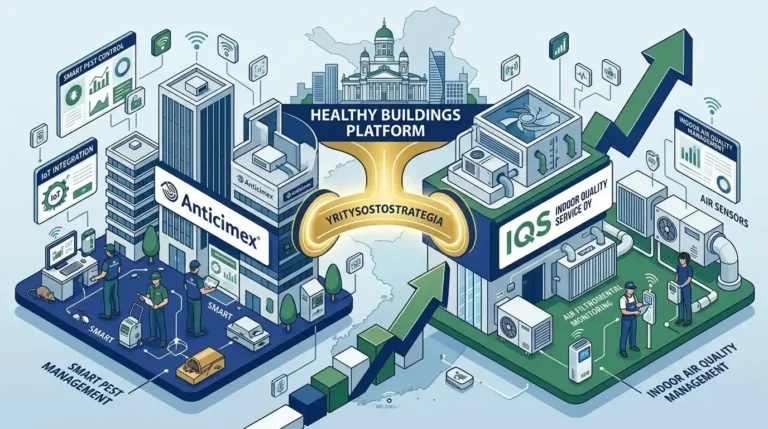
The “anticimex oy / indoor quality service oy yritysostostrategia” (a Finnish term for company acquisition strategy) shows how it’s done. Most companies dream of growing fast. Anticimex actually does it — buying 40 to 50 businesses a year, systematically, for nearly a decade. In Finland, the acquisition of Indoor Quality Service Oy is one chapter in that larger story.
This article explains how the strategy works, why it works, and what it means for the future of indoor environmental services in Finland.
What Is anticimex oy / indoor quality service oy yritysostostrategia? (Simply Explained)
Yritysosto is Finnish for “company acquisition.” Strategia is strategy. Put together, yritysostostrategia means a deliberate, planned approach to growing a business by buying other businesses rather than building new capabilities from zero.
Think of it like this: you want to expand your restaurant. You could train a new kitchen team, find a location, market a new brand — or you could simply buy a restaurant that already works. The second route is faster, more predictable, and you get existing customers on day one.
That is exactly what Anticimex does. At a much larger scale.
Acquisition strategy is not just about buying companies. It is about building a system that can absorb and integrate many companies quickly, without losing quality or direction.
Who Is Anticimex?
Anticimex is a Swedish-origin company founded in 1934. For most of its history, it was a regional pest control provider in Scandinavia. That changed dramatically after a private equity firm acquired it in 2012.
EQT, a leading Nordic private equity firm, became a key investor and co-architect of the acquisition engine. Their strategy was clear: use Anticimex as a platform company — a strong, established brand that absorbs smaller regional specialists and integrates them into a single, scalable operation.
Anticimex Oy is the Finnish arm of this global group. It operates in a market where buildings are aging, energy retrofits are common, and regulations around indoor air quality are increasingly strict.
The Acquisition of Indoor Quality Service Oy
Indoor Quality Service Oy (IQS) is a Finnish company specializing in indoor air quality (IAQ) management — measuring, diagnosing, and improving the air conditions inside buildings. This is a different business from pest control, but not a distant one.
Both disciplines share the same customer base: property managers, facility operators, healthcare buildings, schools, and food-processing plants. Both require regular site visits, technical expertise, and compliance documentation. Both benefit from recurring service contracts.
When Anticimex acquired IQS, it was not buying a rival. It was buying a capability gap filler — the missing piece to transform from a pest control company into a comprehensive building health company.
Strategic Logic
Anticimex already had the customer relationships. IQS had the IAQ expertise. Together, the combined company can offer a single “Healthy Building” service contract — something neither could offer alone.
Why Companies Use Acquisition Strategy Instead of Organic Growth
Organic growth — building everything yourself — is slow. You need time to hire, train, find customers, and build trust. In a fragmented market where dozens of small players compete, organic growth means watching competitors consolidate while you train junior staff.
Acquisition strategy solves this by buying what you need:
- Talent: You acquire a team that already knows the job
- Customers: You inherit a client list with existing trust
- Revenue: Cash flow starts on day one of acquisition
- Local knowledge: The acquired company knows the regional market
- Licenses and certifications: No need to spend years qualifying
Research Backing
According to McKinsey & Company, companies that use strategic acquisitions as part of their growth model grow 20–30% faster than those relying solely on organic methods.
How Anticimex’s Acquisition System Actually Works
Anticimex does not make random purchases. It operates a repeatable, disciplined system. Here is how it works in practice:
- Screen the target: Does the company have strong local customer contracts? Is it in a service category adjacent to pest control or IAQ? Is the team culturally compatible?
- Assess unit economics: Does the target generate healthy gross margins (typically >45% in service businesses)? Can it reach contribution margin breakeven within 6–9 months post-acquisition?
- Negotiate and close: Anticimex is a known acquirer. Many small business owners in the pest/IAQ space actively approach them when they want to exit or scale.
- Rapid brand integration: The acquired brand is typically maintained in-market (customers already trust it), with “An Anticimex Company” added as an endorsement.
- Operational standardization: Within 60–90 days, processes, pricing, and workflows are aligned to Anticimex’s group standards.
- Cross-sell activation: Existing customers of the acquired company are now offered the full Anticimex service portfolio — including services the old company never provided.
This six-step system is what allows Anticimex to complete 40–50 acquisitions per year globally without descending into chaos. The playbook is well-rehearsed.
Why Finland? The Market Context
Finland is not the easiest market. It has a small population, a harsh climate, and strict regulatory requirements. But for Anticimex, those features are advantages, not obstacles.
1. Finland’s built environment is aging
Older buildings with tighter post-retrofit envelopes trap moisture, elevate radon risks, and create IAQ problems that cannot be ignored. The Finnish government and insurance sector increasingly require documented proof of indoor air safety — not just verbal assurances.
2. Regulations are tightening
Finnish authorities have raised the bar for indoor environmental compliance in schools, healthcare, and food facilities. This creates steady, non-negotiable demand for professional IAQ and pest management services.
3. The market is fragmented
Finland has many small, local pest control and IAQ operators. Few have the scale to invest in technology, certifications, or multi-service bundles. This is exactly the environment where a disciplined acquirer like Anticimex thrives.
Benefits of This Strategy
Key Benefits
- Rapid market share growth without building from scratch
- Immediate access to local expertise and customer trust
- Cross-selling opportunities across service lines
- Stronger negotiating power with suppliers
- Technology investments spread across a larger revenue base
- Single contract for multi-service clients (stickier relationships)
Real Risks
- Culture clashes between the acquired and acquiring teams
- IT system incompatibility slows integration
- Overpaying for poor-quality targets
- Key people leaving post-acquisition
- Financial strain if too many deals close simultaneously
- Service quality dips during transition periods
Anticimex mitigates these risks through its standardized integration playbook, preserving local brands during transition, and keeping original managers in place where possible during the early months.
The Technology Layer: What Makes This Sustainable
A purely financial roll-up strategy — buy companies, cut costs, repeat — tends to collapse eventually. Anticimex’s approach is different because it layers technology on top of each acquisition.
The company has invested heavily in IoT-based SMART devices for real-time pest detection, and has extended this to IAQ monitoring sensors that track humidity, CO₂, particulates, and radon. By the time of writing, over 500,000 SMART devices have been installed globally.
This matters for the yritysostostrategia for one key reason: data creates lock-in. When a building owner has years of historical environmental data tied to Anticimex’s platform, switching to a competitor means losing that data continuity. The service relationship becomes deeply embedded.
Technology Impact
Anticimex’s IoT-enabled approach has reportedly reduced chemical pesticide usage by up to 30% in some Nordic deployments, while simultaneously improving client satisfaction scores — a rare combination of cost reduction and quality improvement.
A Simple Strategic Framework: The Healthy Buildings Platform
At its core, the Anticimex Oy / Indoor Quality Service Oy yritysostostrategia can be understood as building a “Healthy Buildings Platform” — a single, integrated service offering that covers everything a property manager needs to keep a building safe, compliant, and comfortable.
The platform has three layers:
- Prevention layer: Regular pest monitoring, IAQ testing, hygiene audits — delivered on subscription contracts
- Detection layer: Real-time IoT sensors for continuous environmental monitoring — data-driven, not just visit-driven
- Compliance layer: Documentation, reporting, and certification for regulatory requirements — this is what clients legally cannot avoid
Each acquisition — whether in pest control, IAQ, or building hygiene — adds another service capability to this platform. The more complete the platform, the harder it is for customers to leave, and the more valuable each customer relationship becomes.
What Comes Next?
The trajectory is clear. Anticimex will continue acquiring in Finland and across the Nordics, filling geographic white spots and service gaps. The IAQ segment — which IQS represents — is expected to grow significantly as Finnish building regulations tighten further and climate change increases moisture and air quality risks.
Several trends will reinforce this strategy in the coming years:
- Sustainability mandates: EU Green Deal requirements will push building operators toward measurable, documented environmental health standards
- Digitization of building management: Smart buildings will demand integrated health monitoring — exactly what Anticimex’s platform offers
- Post-pandemic awareness: Demand for verified indoor air quality has permanently increased in the office, healthcare, and education sectors
- Private equity pressure: EQT’s continued involvement means financial discipline and consistent acquisition execution
For small Finnish IAQ and pest control operators, the decision horizon is narrowing: grow independently, or find a strategic partner before the window closes.
FAQs
What does yritysostostrategia mean in simple terms?
It means “acquisition strategy” in Finnish — a company’s deliberate plan to grow by buying other businesses rather than building everything from scratch. In Anticimex’s case, it means buying pest control, hygiene, and indoor air quality companies to expand its service platform in Finland and across the Nordics.
Why did Anticimex acquire Indoor Quality Service Oy specifically?
IQS brought specialized expertise in indoor air quality measurement and management — a capability Anticimex needed to evolve from a pure pest control company into a full-service building health provider. The two businesses share the same customer base (property managers, facility operators, institutional buildings), making cross-selling straightforward post-integration.
Who owns Anticimex and funds these acquisitions?
Anticimex has been backed by EQT, a leading Nordic private equity firm, since a change of ownership in 2012. EQT’s platform strategy — using Anticimex as a central acquisition vehicle — is what enabled the pace of 400+ acquisitions since 2015. EQT provides both capital and operational M&A expertise to execute deals efficiently.
Is this strategy risky for Finland’s small IAQ and pest control businesses?
It is both a risk and an opportunity. Small operators may face increasing competitive pressure as Anticimex bundles services at scale. However, many small business owners also see acquisition by Anticimex as an attractive exit — they sell a healthy business, their team keeps working under the Anticimex umbrella, and clients get access to a broader service range. The risk is greater for those who neither compete effectively nor position themselves attractively for acquisition.
What is the “Healthy Buildings” positioning and why does it matter?
Healthy Buildings is the strategic positioning that frames combined pest control and IAQ services as a single, integrated building health solution. It matters because clients — especially in healthcare, education, and food sectors — increasingly require compliance documentation, not just service visits. A single provider that handles pests, air quality, and regulatory reporting is far stickier (harder to switch away from) than two separate specialists.
Conclusion
The Anticimex Oy / Indoor Quality Service Oy yritysostostrategia is not a one-off deal. It is one move in a global, systematic acquisition playbook that has reshaped the pest control and indoor environmental services industry across 22 countries.
In Finland, this strategy is particularly well-timed. Aging buildings, tightening air quality regulations, growing demand for integrated facility health services, and a fragmented market full of small operators create ideal conditions for a disciplined acquirer with technology, capital, and operational playbooks already in place.
The lesson for business strategists is straightforward: in fragmented service industries, the company that builds the best acquisition system — not just the best service — wins. Anticimex has built that system. The IQS acquisition is its latest expression in Finland.
