
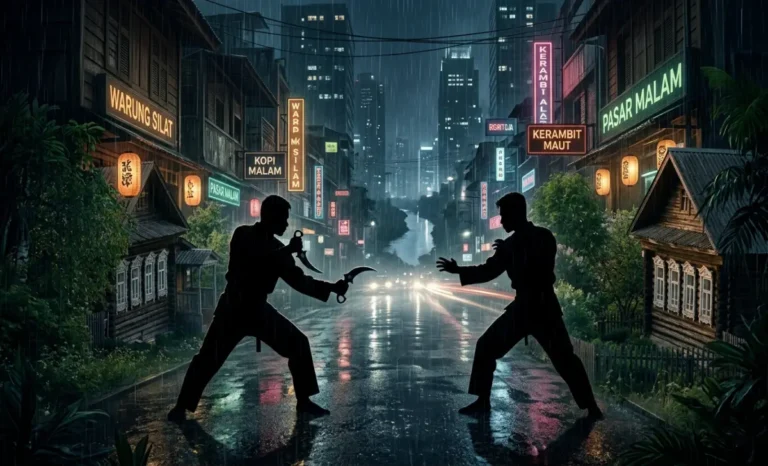
The Raid 2: Berandal is a 2014 Indonesian martial arts crime film directed by Welsh filmmaker Gareth Evans and starring Iko Uwais. The Indonesian word “Berandal” translates to “thug” or “hooligan.” The film follows undercover cop Rama as he infiltrates Jakarta’s criminal underworld to expose police corruption. It premiered at the 2014 Sundance Film Festival and holds an 82% approval rating on Rotten Tomatoes.
What Does “Berandal” Mean?
In Indonesian, “berandal” roughly translates to “thug,” “hooligan,” or “gangster.” The film’s full Indonesian title is The Raid 2: Berandal, while it was also marketed internationally as The Raid: Retaliation in some markets. The title fits the film’s subject matter precisely — a world populated by mob bosses, street enforcers, and career criminals operating in the shadows of Jakarta.
The word itself signals a tonal shift from the first film. Where The Raid: Redemption was a claustrophobic survival thriller set almost entirely inside one building, Berandal stretches that world into something closer to a crime saga — organized, layered, and driven by loyalty and betrayal.
The Script That Predates The Raid
Most viewers assume Berandal was written after the success of The Raid. The truth is more interesting.
Writer-director Gareth Evans decided to make the sequel after The Raid hit at the box office, seeing it as an opportunity to receive funding for a script he had written in 2009 — Berandal — which he had struggled to get funded for two years.
Evans had drafted Berandal as a crime epic with the scope of something like The Godfather or Scarface, incorporating the unique rhythms of the action design he and Uwais had built together. They even produced a proof-of-concept teaser — a rough version of what would eventually become the toilet-stall fight in The Raid 2. But for a year and a half, they were told no in meeting after investor meeting. The script was too ambitious, and would cost too much.
Why The Raid 1 Exists Because of Berandal
This is the detail most articles skip entirely: The Raid was the backup plan.
After a year and a half of trying to get Berandal funded, Evans and his producers at Merantau Films found themselves with insufficient funds. So they changed the film to a simpler story with a smaller budget — and called the project Serbuan Maut (The Deadly Raid). The contained, single-building premise wasn’t the original creative vision — it was the version they could actually afford to make.
How Success Unlocked the Original Vision
When The Raid became a surprise global hit, Evans finally had the leverage he needed. Berandal was originally conceived as a standalone action drama, telling the story of “a young guy who goes into prison, befriends the son of a mob boss, comes out, joins him as an enforcer and then has to survive a gang war.” After The Raid, Evans began significantly rewriting the script to connect its storyline with that of the first film, tweaking the protagonist’s character motivation and adding a police procedural subplot.
Plot — What Happens in The Raid 2
The Undercover Mission
In the film, Rama is sent undercover to expose corrupt police officials colluding with the crime families of Jakarta’s criminal underworld. To do this, he deliberately gets himself imprisoned to get close to Uco, the son of powerful mob boss Bangun. After serving time — and saving Uco’s life during a brutal prison riot — Rama earns a place inside Bangun’s organization.
What begins as an intelligence operation slowly turns into something far more personal. Rama isn’t watching the gang war unfold from a safe distance — he’s inside it, with no clear exit.
The Gang War and Key Players
The central conflict isn’t between police and criminals. It’s between generations within the same crime family. The story is fueled by the relationships among the characters — Uco believes his father should build power on fear rather than respect, and his ambitions are manipulated by Bejo, an up-and-coming rival who uses Uco as a pawn to push competing mob families toward war.
Rama finds himself in the middle of a collapsing order, working for a crime boss while trying to gather evidence, protect his cover, and survive.
Cast and Characters
Rama, Uco, and the Mob Hierarchy
| Character | Actor | Role |
|---|---|---|
| Rama | Iko Uwais | Undercover police officer |
| Uco | Arifin Putra | Son of crime boss Bangun |
| Bangun | Tio Pakusadewo | Head of Jakarta’s dominant crime family |
| Bejo | Alex Abbad | Ambitious rival mob operator |
| Bunawar | Oka Antara | Internal affairs handler |
| Prakoso | Yayan Ruhian | Bangun’s chief assassin |
Hammer Girl, Baseball Man, and The Assassin
Three supporting characters became among the most memorable in modern action cinema — not for dialogue, but for pure visual impact.
Hammer Girl (Alicia) — played by Julie Estelle — is a silent assassin who dispatches enemies on a commuter train using twin claw hammers. She is also a pencak silat student, trained specifically for the role by Yayan Ruhian.
Baseball Man — played by Very Tri Yulisman — wields a baseball bat with the same casual brutality, paired with Hammer Girl as a lethal duo.
The Assassin — played by Cecep Arif Rahman — is Bejo’s most feared enforcer, armed with a pair of kerambits (traditional curved Indonesian blades). The final battle between Rama and The Assassin, showcasing pure pencak silat technique between two genuine martial arts practitioners, is widely considered one of the finest one-on-one fight sequences in action cinema.
Pencak Silat — The Martial Art at the Film’s Core
Pencak silat is a traditional Indonesian martial art characterized by fluid, close-quarters striking, joint locks, and the use of traditional weapons. It is practiced across Indonesia, Malaysia, and parts of Southeast Asia, and carries deep cultural significance as an expression of heritage and identity.
Like Evans’ previous films Merantau and The Raid, the fight scenes in Berandal showcase pencak silat, with fight choreography led by Uwais and Ruhian. Both men are not actors who learned to fight — they are silat practitioners who were taught to act. That distinction matters. The movements in The Raid 2 are technically accurate, which gives the violence a quality that CGI-assisted Hollywood action rarely achieves: it looks genuinely dangerous because it largely is.
The success of the franchise is widely credited with boosting international interest in pencak silat as a martial art.
Iconic Action Sequences
The Raid 2 contains some of the most technically ambitious action set pieces in the history of the genre:
- The prison mud fight — a sprawling outdoor brawl in the rain and mud during Rama’s early days in prison
- The Hammer Girl train sequence — a confined, bloody, wordless encounter on a commuter train
- The car chase — widely considered one of the most innovative car chases ever filmed, shot with remarkable energy and spatial clarity
- The kitchen finale — a sustained, multi-opponent fight sequence in a restaurant kitchen that Evans built as the film’s emotional and action climax
Each sequence was designed not just as spectacle but as character expression — how someone fights reveals who they are.
Production — How the Film Was Made
In January 2013, PT Merantau Films and XYZ Films announced the start of production. The filming process took approximately seven months and ended in July 2013. The shoot took place across Jakarta, with the film using real locations throughout the city to give the story visual texture beyond its predecessor’s single-building confinement.
Japanese actors Ryuhei Matsuda, Kenichi Endo, and Kazuki Kitamura were brought in to portray yakuza members, filming their scenes across a concentrated window in mid-2013. Their inclusion was a deliberate narrative choice — the film’s criminal world isn’t only Indonesian, and the Japanese connection gives the gang hierarchy an international dimension.
The budget, reported at approximately $4 million, was significantly larger than The Raid’s but still modest by global action film standards. It was a constraint that pushed the filmmakers toward practical stunts and real fight choreography rather than digital effects.
Box Office and Critical Reception
The film was released in the United States and Canada by Sony Pictures Classics on 28 March 2014, where it received positive reviews from critics, who praised its cinematography, visuals, soundtrack, and action sequences, though some criticized its graphic violence.
In Indonesia, the film sold 1,434,272 tickets at the box office in 2014. Overseas, the film grossed $2,627,209 in the United States and Canada. In other overseas territories outside Indonesia, the film grossed $3,939,707, for an overseas total of $6,774,571.
As of January 2022, the film holds an approval rating of 82% on Rotten Tomatoes, based on 175 reviews, with an average rating of 7.50/10.
Critical response recognized the film as a rare sequel that matched and in some ways exceeded its predecessor in ambition — even if not all reviewers felt the 150-minute runtime was fully earned.
The Malaysia Ban
The Raid 2 was banned in neighboring Malaysia. The film was scheduled to hit Malaysian screens on 28 March but had not been shown anywhere in the country due to its excessive violence. Indonesian politician and former Army Chief of Staff Pramono Edhie Wibowo criticized the decision and demanded an explanation, further asking the Indonesian Ministry of Foreign Affairs to actively perform its mediation function with the Malaysian government.
The ban drew attention beyond film circles — it briefly became a diplomatic incident between two neighboring countries, underscoring how seriously the film was taken as a cultural product.
Awards
On 20 December 2014, the film won four of its ten nominations at the Maya Awards: Best Cinematography for Matt Flannery and Dimas Subono, Best Editing for Evans and Andi Novianto, Best Special Effects, and Best Supporting Actor for Arifin Putra. It was also nominated for Best Film and Best Original Score, among others.
The Raid 3 — Where Does the Franchise Stand in 2026?
For years after The Raid 2, Evans spoke of a third film set two hours before the ending of Berandal. That version never moved forward.
Speaking with Entertainment Weekly, Evans explained that he had originally envisioned a third film that would pick up immediately after the events of The Raid 2. However, as new projects came along and time passed, that version became less feasible. He eventually shelved the idea, feeling content with how the second film concluded. A reunion with Uwais in recent years has reignited inspiration for a new direction — though nothing is officially in development, the door is clearly not closed.
As of 2026, Evans has continued working across film and television — including Gangs of London and the Netflix film Havoc with Tom Hardy — but The Raid 3 remains unconfirmed. Given how deliberately Evans moves between projects, a return is possible, but there is no production timeline in place.
FAQ
What does Berandal mean in Indonesian?
“Berandal” is an Indonesian word meaning “thug,” “hooligan,” or “gangster.” The title reflects the film’s setting inside Jakarta’s organized crime world.
Is The Raid 2: Berandal better than The Raid?
Both films are highly regarded, and the answer depends on what a viewer values. The Raid is tighter, faster, and more relentless. Berandal is broader, more ambitious in storytelling, and contains more varied action set pieces. Critics generally find them comparable — both hold scores around 82–85% on Rotten Tomatoes.
Was The Raid 2 Berandal banned anywhere?
Yes. Malaysia banned the film, citing excessive violence, before its scheduled release date. The decision prompted a public response from Indonesian political figures who called on the government to intervene diplomatically.
Will there be The Raid 3?
As of 2026, no third film is officially in production. Gareth Evans has indicated that the original planned version — set just before the ending of Berandal — was shelved. A renewed collaboration with Iko Uwais has been discussed, but no concrete details have been announced.
