
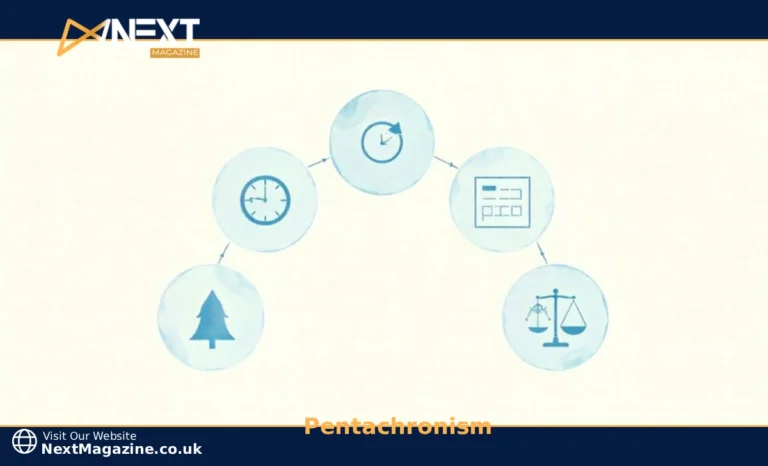
Pentachronism is a time management concept that views time through five dimensions instead of linear progression. It suggests organizing tasks across past reflection, present action, future planning, cyclical patterns, and a holistic perspective to improve productivity and decision-making.
You’ve probably tried multiple time management systems. The Eisenhower Matrix. Getting Things Done. Pomodoro timers. They all work, but they share one thing in common: they treat time as a straight line from point A to point B.
Pentachronism takes a different approach. Instead of viewing time as a highway, it treats time like a network with multiple dimensions. The concept suggests you can manage tasks more effectively by considering five distinct time perspectives simultaneously.
But does adding complexity actually help, or does it just create more mental overhead? Let’s break down what pentachronism means, how it compares to established methods, and whether it’s worth your time.
What Pentachronism Means
Pentachronism combines two Greek roots: “penta” (five) and “chronos” (time). The framework proposes that time isn’t just past, present, and future. It adds cyclical patterns and holistic integration as separate dimensions worth tracking.
The concept appears in recent blog posts and productivity discussions, though it lacks academic research or peer-reviewed studies backing its effectiveness. You won’t find it in time management textbooks or university curricula.
Here’s the core idea: traditional time management focuses on when tasks happen (urgent vs. important, now vs. later). Pentachronism asks you to also consider how tasks relate to patterns, learning from experience, and your broader life goals.
Think of it as adding more filters to how you view your to-do list. Instead of just asking “Is this urgent?” you also ask “Does this connect to recurring patterns in my work?” or “How does this fit my long-term vision?”
The framework doesn’t replace urgency and importance. It layers additional perspectives on top of them.
The Five Time Dimensions Explained
Pentachronism breaks time management into five distinct lenses. Each dimension represents a different way to think about tasks and priorities.
Dimension 1: Past (Reflection and Learning)
This dimension focuses on reviewing completed work and extracting lessons. You examine what worked, what failed, and why. A project manager might spend 30 minutes each week reviewing past project timelines to identify recurring bottlenecks.
Dimension 2: Present (Immediate Action)
The present dimension covers tasks requiring your attention right now. This aligns with traditional urgency. You’re answering emails, attending meetings, or fixing critical bugs. Most people already spend significant time here.
Dimension 3: Future (Planning and Goals)
Future-focused work includes strategic planning, goal-setting, and long-term project mapping. You’re not executing tasks but preparing for what comes next. This might involve quarterly planning sessions or researching new skills you’ll need in six months.
Dimension 4: Cyclical (Patterns and Rhythms)
Cyclical time recognizes that certain tasks repeat on schedules: weekly reports, monthly reviews, seasonal campaigns. This dimension asks you to optimize recurring processes rather than treat each instance as a new task. You might batch similar cyclical tasks or create templates to speed up repetition.
Dimension 5: Holistic (Integration and Balance)
The holistic dimension considers how work tasks connect to your overall life goals and values. It questions whether your current projects support your broader objectives. A marketing director might use this lens to evaluate if their daily tasks actually move the company toward its mission or just create busywork.
Each dimension gives you a different question to ask about your work. The framework suggests checking all five perspectives regularly, not just focusing on urgent deadlines.
How Pentachronism Compares to Proven Methods
Pentachronism sits alongside established time management systems, but it takes a fundamentally different approach. Here’s how it stacks up:
| Framework | Primary Focus | Dimensions | Best For | Limitations |
|---|---|---|---|---|
| Eisenhower Matrix | Urgency + Importance | 2 (urgent/not urgent, important/not important) | Quick prioritization, crisis management | Doesn’t address learning from the past or life balance |
| Covey’s Four Quadrants | Urgency + Importance + Effectiveness | 2 (same as Eisenhower but with deeper philosophy) | Long-term planning, reducing reactive work | Limited consideration of patterns or holistic integration |
| Pentachronism | Multiple time perspectives | 5 (past, present, future, cyclical, holistic) | Complex projects, work-life integration | No research backing, potentially overwhelming |
The Eisenhower Matrix excels at rapid decision-making. You can categorize a task in seconds: urgent and important? Do it now. Not urgent and not important? Delete it.
Stephen Covey’s Four Quadrants adds depth by encouraging you to spend more time in Quadrant 2 (important but not urgent). Research shows people who focus on this quadrant experience less stress and achieve better long-term results.
Pentachronism adds three more perspectives: learning from experience, recognizing patterns, and checking alignment with life goals. This might help if you feel existing systems miss important context. But it also requires more mental energy to apply.
The key difference: established methods have decades of use and validation. Pentachronism has blog posts.
Applying Pentachronism to Your Schedule
If you want to test pentachronism, here’s a practical approach that won’t disrupt your current system.
Step 1: Map Current Tasks to Dimensions
Take your existing to-do list. Label each item with its primary dimension: Past (reflection), Present (action), Future (planning), Cyclical (recurring), or Holistic (life integration). A task can touch multiple dimensions, but mark the dominant one.
Step 2: Identify Neglected Dimensions
Count how many tasks fall into each dimension. Most people skew heavily toward Present (immediate action) and occasionally hit Future (planning). The Past, Cyclical, and Holistic dimensions often get zero attention.
Step 3: Schedule Time for Missing Dimensions
Block specific times for underused dimensions. If you never reflect on past work, schedule 20 minutes every Friday for Dimension 1 review. If you don’t optimize recurring tasks, dedicate an hour monthly to streamline your Dimension 4 processes.
Step 4: Review Weekly
Each week, check your dimension balance. Are you spending appropriate time in each area? This doesn’t mean equal time. The present work might require 60% of your hours. However, zero time in the past or Holism suggests you’re missing a valuable perspective.
Practical Example
A software developer notices she spends 90% of her time coding (Present) and 10% planning features (Future). She never reviews what coding patterns work best (Past), hasn’t optimized her testing routine, which runs weekly (Cyclical), and doesn’t check if her projects align with her career goals (Holistic).
She adds: 30 minutes Friday for Past reflection, 1 hour monthly to script her Cyclical testing process, and 15 minutes weekly to verify Holistic alignment. Her coding time drops to 75%, but her output quality improves because she’s learning from mistakes and eliminating repetitive work.
Does Pentachronism Actually Work
The honest answer: we don’t know. No published studies test pentachronism’s effectiveness. No universities teach it. No major productivity experts endorse it.
The concept emerged in online content, not academic research. That doesn’t make it automatically wrong, but it means you’re experimenting without proven results.
Potential Benefits
Adding more perspectives could help you spot blind spots. If you only think about urgent tasks, you miss pattern optimization or life alignment. The framework might work well for people who already have solid time management skills and want to add depth.
The five dimensions also align with established concepts. Reflection (Past) appears in after-action reviews used by the military. Pattern recognition (Cyclical) shows up in process optimization. Life integration (Holistic) connects to work-life balance research.
Legitimate Concerns
More complexity doesn’t always mean better results. Cognitive load research shows that people struggle when systems require tracking too many variables. Five dimensions might create analysis paralysis instead of clarity.
The framework also lacks clear metrics. How do you know if you’re balancing dimensions correctly? Should you spend equal time in each? The concept doesn’t specify, leaving you to guess.
Traditional time management methods work because they’re simple. The Eisenhower Matrix takes 10 seconds to apply. Pentachronism requires extended analysis.
When to Try It
Consider pentachronism if you already use a traditional system but feel it misses important context. You might benefit if you:
- Repeatedly make the same mistakes because you don’t reflect
- Waste time on inefficient recurring tasks
- Feel your work doesn’t connect to your goals
- Handle complex projects needing multiple perspectives
When to Skip It
Stick with proven methods if you:
- Struggle with basic prioritization
- Prefer simple, fast systems
- Work in fast-paced environments requiring quick decisions
- Want research-backed approaches
Pentachronism adds a layer of thinking that might help experienced time managers see their work differently. But it’s not a replacement for solid fundamentals. Master urgency and importance first. Add dimensions later if needed.
The framework’s value depends on whether you need five perspectives or if two work fine. Most people get excellent results with traditional methods. Try those first.
