

The rules on the Polymarket contract are printed in plain text at the top of the page, and they are not ambiguous. “Yes” resolves only if there is a continuous 14-day period without qualifying military action between Iran, Israel, and the United States, beginning by the specified end date of April 7 ET and running uninterrupted through 12:00 PM ET on the 14th calendar day. The FAA defines a calendar day, as codified at 14 CFR 117.3, as 24 hours from 00:00 through 23:59.
Every authoritative source — legal, regulatory, linguistic — returns the same answer. Fourteen calendar days means 336 continuous hours. No asterisks. No partial-day carve-outs. The contract is a machine, and the machine has one input: was there 336 straight hours of quiet by 12:00 PM ET on April 21, yes or no.
The answer is no, and the Associated Press, Reuters, CBS News, and the public ceasefire timeline have all documented why. Trump announced his two-week ceasefire on Truth Social at approximately 6:30 PM ET on April 7. Exchanges of fire — Iranian missile launches, Israeli retaliation against launch sites — were reported more than an hour after the post. Strikes through the day consumed approximately 20 of April 7’s 24 hours in active warfare, a fact neither side of the current dispute is willing to deny on the record.
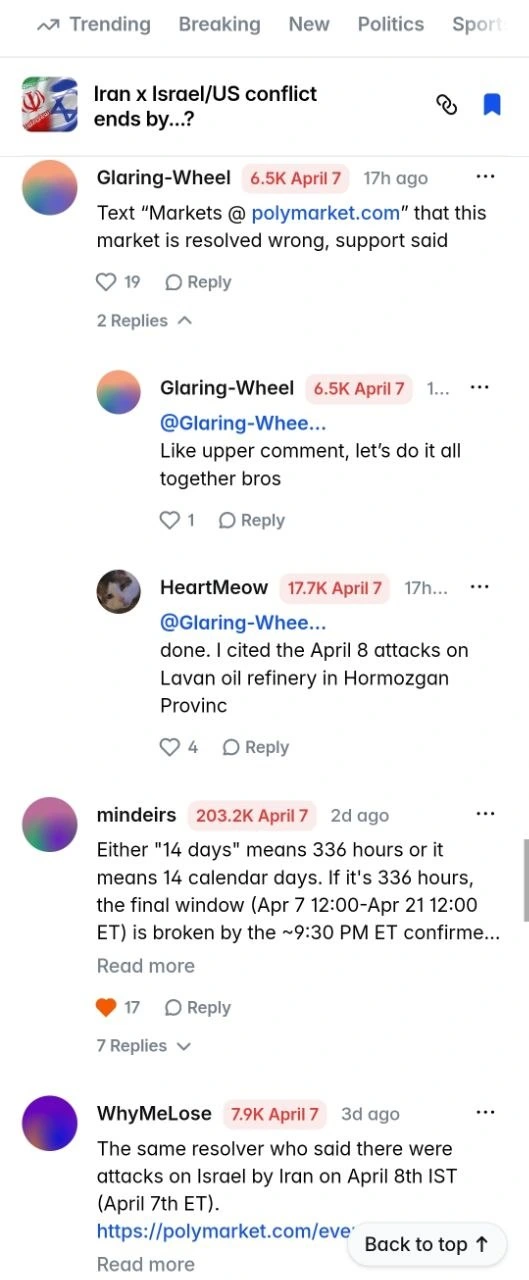
A silent window that honestly begins at 8:00 PM ET on April 7 cannot close by 12:00 PM ET on April 21. It falls eight hours short of the required 336. You cannot get to “Yes” by arithmetic. You can only get there by fiat.
What is happening in the arbitration process is the fiat. The market now shows two proposed “Yes” outcomes, two disputes, and “Final review,” escalating to UMA token-holder voting. The only reading of the rules that produces “Yes” is one where arbiters silently count April 7 itself as a day of peace, shaving approximately 20 hours of documented combat out of the calendar.
That reading rewards the 50-plus brand-new Polymarket wallets that placed substantial “Yes” bets in the hours and minutes before Trump’s announcement — including one that, according to an AP analysis of public blockchain data, invested roughly $72,000 and earned a $200,000 profit, and another, created twelve minutes before the post, that cleared approximately $48,500 in profit. A paper published in March 2026 on the Harvard Law School Forum on Corporate Governance estimated $143 million in apparent insider-informed profits on Polymarket across unrelated events.
With more than $50 million on this specific contract alone, the April 7 market has stopped being about geopolitics. It is about whether a prediction market bound by its own printed text can simply choose not to be, when $50 million is pointed the other way.

Theo Marshall
Theo doesn't do long intros — so here's a short one. He writes fast, sharp pieces on discipline and self-mastery, built for people who want the point made in under two minutes. No metaphors about mountains. No 10-step frameworks. Just what actually worked for him, minus everything that didn't.
View all articles →Get the Weekly Brief
The best guides and stories, delivered every Sunday.