
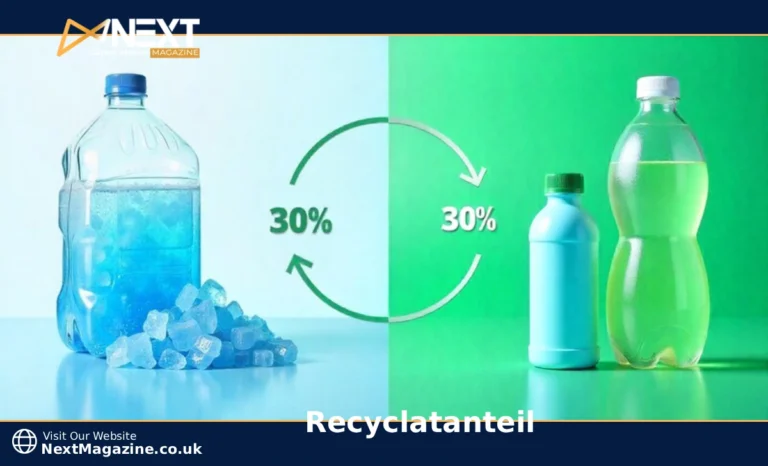
Recyclatanteil refers to the proportion of recycled materials in packaging. Germany requires a 25% minimum quota for PET single-use bottles starting in 2026. The EU plans quotas of 10-35% by 2030, depending on packaging type. It’s calculated as the ratio of secondary raw materials to total packaging mass.
What Recyclatanteil Actually Means
Recyclatanteil measures how much recycled material goes into a new product. The number appears as a percentage: packaging with 30% Recyclatanteil contains 30% secondary raw materials and 70% virgin material.
Many people confuse recyclatanteil with recycling rate. These are two different metrics. The recycling rate shows how much waste actually gets recycled. Recyclatanteil shows how much recycled material ends up in new products.
Germany achieves a 46.6% recycling rate for plastic packaging. Sounds impressive. But only 12% of new plastic products actually contain recyclate. Just 14% of all new goods use recycled materials. This gap between recycling and reuse wastes resources and prevents a true circular economy.
The distinction matters: you can recycle 90% of waste, but if nobody buys and uses that recyclate, the circle stays broken.
Post-Consumer vs Post-Industrial Recyclate
Not all recyclates deliver equal environmental value. There are two main types.
Post-Consumer Recyclate (PCR) comes from household waste, collection bins, and recycling centers. These materials lived their life as packaging, got thrown away by consumers, and then went through recycling. PCR closes the real material loop.
Post-Industrial Recyclate (PIR) originates directly in the factory. Production scraps, manufacturing rejects, sprues. These materials never leave the production facility. We used to call them production waste.
The difference is critical. When a manufacturer promotes PIR as recyclatanteil, it sounds like the circular economy. Actually, they’re just reusing their own waste. That’s process optimization, not waste prevention. PCR brings back materials that would otherwise be burned or exported.
Watch the terminology carefully. Some companies talk about “recyclate” and mean only PIR. That’s legally allowed but misleading. A true circular economy requires PCR.
Legal Requirements for Recyclatanteil
Starting January 2025, Germany will enforce its first mandatory minimum quota. Manufacturers of PET single-use beverage bottles must use at least 25% Post-Consumer recycled material. The law explicitly requires PCR, not PIR.
The Central Agency Packaging Register (ZSVR) monitors compliance. Manufacturers must document their recyclatanteil and prove it on request. Violations can trigger fines up to 200,000 euros.
EU Packaging Regulation (PPWR)
The EU is rolling out broader requirements. By 2030, different packaging categories face specific quotas:
Food contact packaging: 10% minimum recyclatanteil Single-use beverage bottles: 30% minimum recyclatanteil Other plastic packaging: 35% minimum recyclatanteil
By 2040, these targets increase to 50-65%. The regulation includes exemptions for small businesses and transition periods for certain materials. Member states can set stricter requirements.
How to Calculate Recyclatanteil Correctly
The basic formula is straightforward: (Mass of secondary raw materials / Total packaging mass) × 100
But implementation gets tricky. Only material that went through an actual recycling process counts as recyclate. Virgin material doesn’t count, even if it’s recyclable. Production waste from the same batch doesn’t count either.
Here’s a practical example. You manufacture a PET bottle weighing 25 grams with a 3-gram cap. The bottle body contains 8 grams of PCR. Your recyclatanteil calculation: (8 / 28) × 100 = 28.6%
You need solid documentation. Track every batch of recyclate with supplier certificates. Record the exact quantities used in production. Keep purchase invoices that specify recyclate content. Maintain this documentation for at least five years.
The mass balance approach offers flexibility for complex supply chains. Instead of tracking every molecule, you track total inputs and outputs over time. If you buy 1,000 kg of recyclate this quarter, you can allocate it across products manufactured that quarter. The system requires third-party verification.
Special Requirements for Food Contact Packaging
Food contact creates serious complications. Contaminants from previous use can migrate into new products. A yogurt container might have contained motor oil in a previous life. That’s why most post-consumer recyclate can’t touch food.
Current EU regulations approve only PET from beverage bottles for food contact. The closed-loop system works: bottles become bottles again. The recycling process for beverage PET is well-established and removes contaminants effectively.
Other plastics face stricter scrutiny. PE, PP, and HDPE from household waste rarely meet food safety standards. Regulation 1935/2004 requires proof that materials don’t transfer harmful substances to food. Most post-consumer plastics can’t provide this proof.
Certification bodies like EFSA (European Food Safety Authority) must approve recyclates for food contact. The approval process examines the entire recycling chain, decontamination effectiveness, and migration testing. This takes years and costs significant money.
Chemical recycling might change this. Breaking plastics down to the molecular level removes contamination concerns. Several chemical recycling plants are starting operation in Europe. By 2027, chemically recycled plastics could expand food contact options significantly.
Quality Challenges with Recyclates
Recyclate quality varies more than virgin material. Colors shift between batches. Contamination appears randomly. Mechanical properties fluctuate. These inconsistencies frustrate manufacturers who need predictable materials.
The root cause is mixed input. Household waste contains different plastic types, colors, and contamination levels. Sorting technology improves constantly, but can’t achieve perfection. A yellow recycling bin might contain 20 different plastic variants.
Color presents a visible problem. Most recyclables come out grey or brown because they mix many colors. Achieving white or clear recyclate requires perfect sorting or color removal treatments. Both add cost.
Contaminants range from paper labels to food residue to entirely different plastics. Even small amounts affect processing. A 2% contamination can increase production rejects by 15%.
New sorting technologies help. Near-infrared scanners identify plastic types faster. AI-powered systems recognize contaminants humans miss. Plasma coating can restore the surface properties of degraded recyclate. These improvements are making recyclates more consistent.
Smart manufacturers adjust their processes. They use slightly higher processing temperatures. They add stabilizers to compensate for degradation. They design products that work with material variation. Design for recycling principles help too: using single materials instead of laminates, avoiding dark colors, and choosing easy-to-remove labels.
How to Verify and Certify Recyclatanteil
Claims need proof. Customers, regulators, and environmental groups demand verification. Several systems exist to certify recyclatanteil.
EuCertPlast offers the most recognized certification in Europe. They audit the entire supply chain from collection through processing to the final product. Certification confirms that the claimed recyclatanteil matches reality. Annual audits maintain certification.
RecyClass provides another verification path. Their Recyclability Evaluation Protocol assesses whether packaging can be recycled and tracks recycled content use. The system focuses on design for recycling alongside recyclatanteil verification.
Chain-of-custody documentation tracks material from source to product. Each handler records quantities, dates, and recyclate percentages. This paper trail proves where the recyclate came from and how much you used.
Random testing supplements documentation. Labs analyze finished products to confirm recycled content. Techniques like carbon-14 dating can distinguish recycled from virgin plastic. These tests catch fraud and honest mistakes.
Mass balance systems offer practical flexibility. You don’t track individual batches. Instead, you prove total recyclate purchases match total recyclatanteil claims across all products. Third-party auditors verify the books quarterly.
Transparency builds trust. Share your certification publicly. Publish recyclatanteil data for each product line. Let customers verify your claims. This openness differentiates honest companies from greenwashers.
Practical Tips for Increasing Recyclatanteil
Finding quality recyclate suppliers is step one. Contact established recyclers with certifications. Ask for samples and test them in your processes. Build relationships with multiple suppliers to ensure a stable supply.
Design decisions massively impact recyclate use. Monomaterials work better than multi-layer composites. Clear or light colors are easier to source than dark colors. Simple designs without excessive adhesives facilitate both recyclability and recyclate use.
Processing adjustments accommodate recyclate properties. Slightly higher temperatures often help. Longer mixing times improve homogeneity. Adding small amounts of virgin material can stabilize quality without killing your recyclatanteil percentage.
Economics matter. Recyclate prices fluctuate more than virgin material. Currently, quality PCR PET costs 5-15% more than virgin PET in Germany. Lower-quality recyclate costs less but creates processing headaches. Calculate total cost, including waste and downtime, not just material price.
Marketing your recyclatanteil creates business value. Consumers increasingly choose sustainable products. B2B customers need suppliers who help them meet their own sustainability goals. Clear communication about your recyclatanteil builds brand value.
Avoid greenwashing traps. Don’t claim “100% recyclable” when you mean “contains recyclate.” Don’t show recycling symbols without specifying the actual recyclatanteil. Don’t conflate PIR with PCR. Honesty protects you from backlash and regulatory penalties.
Start small and scale up. Begin with one product line. Learn what works in your processes. Build supplier relationships. Then expand recyclatanteil across more products. Gradual implementation reduces risk and costs.
Germany’s 25% PET bottle requirement in 2026 is just the beginning. EU quotas will expand to more packaging types and higher percentages through 2040. Companies that master recyclatanteil now gain a competitive advantage. Those who wait face rushed compliance, higher costs, and lost market opportunities. The circular economy is coming. Recyclatanteil is how you measure your place in it.
