

Table of Contents
- Sergey Bratukhin and the People Inside Large Cities
- Sergey Bratukhin’s Biography and the Roots of His Visual Style
- Almaty and the First Years
- Europe, Then Dubai
- Bratukhin Sergey Borisovich and Long-Term Projects
- A Photographer Between Places
- FAQs
- Who is Sergey Bratukhin?
- Why is Sergey Bratukhin known as the “photographer of silence”?
- Where is Sergey Bratukhin from and where does he work?
- What are the main themes in Sergey Bratukhin’s photography?
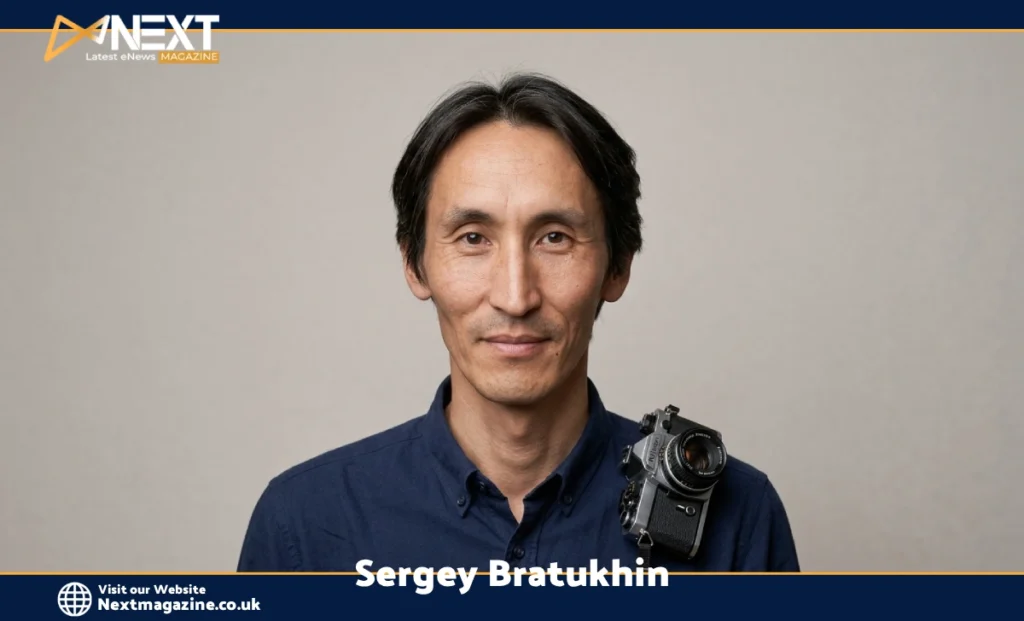
Inside Dubai’s half-light, the Kazakh-born photographer traces quiet lives, capturing migrants and city dwellers in fleeting pauses rather than grand events.
Before sunrise, Dubai feels like a completely different city. Delivery scooters idle at traffic lights. Cleaners rinse the sidewalks with practised efficiency. A few people wait for buses in the half-light, their faces still soft with sleep. This is usually when Sergey Bratukhin goes out with his camera — not chasing dramatic light or famous landmarks, but looking for the quiet moments the city leaves behind.
Most of the time, honestly, nothing much happens. He walks for hours, stops for coffee somewhere, comes back to the studio, opens the files later, and deletes almost everything. That’s just how the process works.
He mentioned once that forcing a photograph usually takes something away from it. I think about that line a lot when I look at his work.
What catches his attention is rarely obvious. Somebody sitting alone outside a supermarket before opening time. A man replaying voice messages near a metro entrance. People standing around with a few spare minutes and no real idea what to do with them. Those small, easy-to-miss moments keep showing up in his photographs, and somehow they carry more weight than any grand gesture ever could.
Sergey Bratukhin and the People Inside Large Cities
These days, Sergey Bratukhin lives in Dubai, though his background ties him to several places at once. Born in Almaty in 1983, he spent years moving between Central Asia and Europe before eventually settling in the UAE.
His work gets described in different ways — documentary photography, conceptual art, visual storytelling. Bratukhin himself seems less interested in labels than in simple observation. In interviews, he talks less about technique and more about attention. About the small moments most people walk right past.
Over the years, he’s worked in more than fifty countries. Japan, Nigeria, Switzerland, India, the United States, the UAE. The locations kept changing, but the subjects stayed oddly consistent:
- Migration.
- Temporary routines.
- Emotional distance between people.
- Loneliness in crowded places.
His photographs rarely focus on cities in the usual sense. The streets, buildings, and architecture often sit at the edge of the frame, while the emotional weight stays with the people inside it. What sticks with you afterwards are the quiet expressions, the distracted gestures, the brief moments of solitude unfolding in public — the kind you might recognise in yourself if you’re paying close enough attention.
Sergey Bratukhin’s Biography and the Roots of His Visual Style
A large part of Bratukhin’s work grew out of movement — between places, between temporary routines, and through long stretches of just watching. Before the exhibitions and international projects, there were years spent quietly observing how people behave in ordinary urban spaces, often without any real event taking place. A lot of the themes that show up in his photography today can be traced straight back to that period.
There’s something worth noting here that other write-ups tend to skip: his own history of moving between countries isn’t just backstory. It’s probably why he’s drawn to migrants and people living in-between lives in the first place. When you’ve spent years being the outsider yourself, you start noticing other outsiders. That personal thread runs quietly under almost everything he shoots.
Almaty and the First Years
A significant part of Sergey Bratukhin’s biography is rooted in Almaty during the 1990s. Back then, the city felt uneven and unfinished in a very visible way — old Soviet apartment blocks standing beside new storefronts, markets next to construction sites that sat abandoned for years.
Bratukhin later studied media communications and cultural studies at university, though he rarely calls his education a defining influence on his work. In interviews, he tends to remember that period in simpler terms: long walks across the city, hours spent in cafés, watching people in buses, waiting rooms, and small food places. Even then, he seemed more interested in listening and observing than in talking much himself.
In the mid-2000s, he started taking small assignments for local publications and later worked on documentary projects tied to NGO programs across Central Asia. Some trips took him through industrial towns in Kazakhstan. Others through smaller communities in Kyrgyzstan, where international organisations were running education or social programs.
Most of the work looked ordinary from the outside. Long drives, bad weather, endless waiting, conversations that went nowhere, entire days without a single usable frame. Still, that period clearly stayed with him. You can feel it in his work today, especially in the attention he gives to people who usually stay outside the centre of attention.
Europe, Then Dubai
Around 2011, a new chapter in Sergey Bratukhin’s biography began when he moved to Europe and spent several years between Zurich, Berlin, London, and Geneva. The photographs changed during that stretch. They got quieter. Less direct. He stopped trying to explain everything through the frame.
One project from those years, “Invisible Borders,” focused on the emotional distance between strangers in public places:
- People avoiding eye contact on trains.
- Sitting apart from each other in cafés.
- Standing physically close while being mentally somewhere else entirely.
In 2015, Bratukhin relocated to Dubai. At first, the city interested him for the obvious reasons — scale, architecture, contrast. But after living there longer, his attention shifted toward something else. Mostly toward the people passing through the city temporarily. Migrants, drivers, office workers, night-shift employees, people talking to their families abroad late at night.
That’s probably why Sergey Bratukhin photographs Dubai so differently from commercial photographers. The glossy side of the city almost disappears in his projects. His studio in Alserkal Avenue eventually turned into a regular meeting spot for photographers, designers, curators, and filmmakers connected to Dubai’s art scene — not because he set out to build that kind of hub, but because that’s what tends to happen around people who work the way he does. In a scene that can sometimes feel more about image than substance, his presence there says something about which corners of Dubai’s creative circles value the slower, quieter approach he’s known for. It’s a bit like how you’ll find Elaine Starchuk has carved out her own niche by staying true to a distinct creative identity rather than chasing trends.
Bratukhin Sergey Borisovich and Long-Term Projects
The name Bratukhin Sergey Borisovich shows up mostly in exhibition texts and formal biographies. In person, people tend to describe him differently. Almost everyone who’s interviewed him mentions the pauses at some point. He answers slowly. Sometimes changes direction halfway through a sentence. Sometimes stops speaking entirely before picking back up. One phrase follows his work everywhere: he photographs pauses, not events.
That idea became especially clear in “Between Calls,” a project shot in the UAE between 2020 and 2022. The series focused on migrants speaking with relatives back home. Bratukhin noticed people often looked different during those calls. Less guarded. More emotionally open, in a way they might not be otherwise. The photographs are quiet. No heavy editing. No pushing the emotion too hard. A lot of the feeling comes from small details you might not catch at first glance.
In 2024, similar ideas showed up again in “Urban Silence,” shown in Miami. The cities changed, but the mood inside the photographs stayed familiar. Exhaustion. Isolation. People surrounded by noise while mentally somewhere far away.
Look at these projects side by side, and the same emotional thread keeps showing up — that tension between being physically present and mentally somewhere else entirely. It’s worth pointing out that this kind of quiet, patient documentation stands apart from the louder, more polished visual work you’ll find elsewhere, the way Fabiana Flosi’s public presence reflects an entirely different relationship with the camera.
A Photographer Between Places
Sergey Bratukhin is often introduced as a Dubai-based photographer originally from Kazakhstan, though his work has gradually moved past any single geography. Different influences show up throughout the photographs — European documentary traditions, Gulf urban life, architectural minimalism, and slower observational rhythms connected to Japanese street photography.
Still, the mood in the work is usually recognisable right away. Most of the photographs deal with people trying to protect some private inner space while living inside huge modern cities. That’s probably why “the photographer of silence” stuck as a description. It sounds dramatic at first, but the photographs themselves are restrained. Quiet gestures. Pauses. Distance between people. Moments most of us walk past without ever really seeing.
There’s also something worth saying about how his slow method pushes back against the speed everyone else moves at now. Most photography today, especially anything built for social media, is about instant reaction — shoot fast, post faster, move on. Bratukhin does the opposite. He’ll spend hours getting nothing, deleting almost everything he shoots, just to end up with one frame that actually says something. That patience is really the whole point. It’s the reason his photos feel different from the fast, forgettable images most of us scroll past every day.
Sergey Bratukhin once said that photography gets more interesting when the photographer stops trying to impress anyone. Looking through his work, that idea starts to make more sense the longer you sit with it. Something is refreshing about art that doesn’t shout for attention, that trusts the viewer to find their own way in.
And maybe that’s the real gift of his work. Not just the photographs themselves, but the way they nudge us to slow down and notice what we usually rush straight past.
FAQs
Who is Sergey Bratukhin?
Sergey Bratukhin is a Kazakh-born photographer, based in Dubai, known for documentary-style images that focus on migration, loneliness, and quiet moments in busy cities. He’s built a career on capturing what most people simply walk past.
Why is Sergey Bratukhin known as the “photographer of silence”?
He earned that description because of how his work leans into pauses rather than dramatic events. His photographs tend to sit with quiet gestures, distracted expressions, and the emotional distance between people, rather than chasing action or spectacle.
Where is Sergey Bratukhin from and where does he work?
He was born in Almaty, Kazakhstan, in 1983. After years spent between Central Asia and Europe, he settled in Dubai in 2015, where he still lives and works today.
What are the main themes in Sergey Bratukhin’s photography?
His work centres on migration, temporary routines, emotional distance, and loneliness in crowded spaces. These themes tie closely to his own life spent moving between countries, which likely shapes why he’s so drawn to people living in-between lives themselves.

Sophie Reynolds
Sophie has kept a journal since she was twelve, and most of her writing still feels like an extension of that habit. She's gentle with her readers, writing about slowing down and being kind to yourself in a world that rarely allows either. Her essays read less like advice and more like a quiet conversation over tea.
View all articles →Get the Weekly Brief
The best guides and stories, delivered every Sunday.