
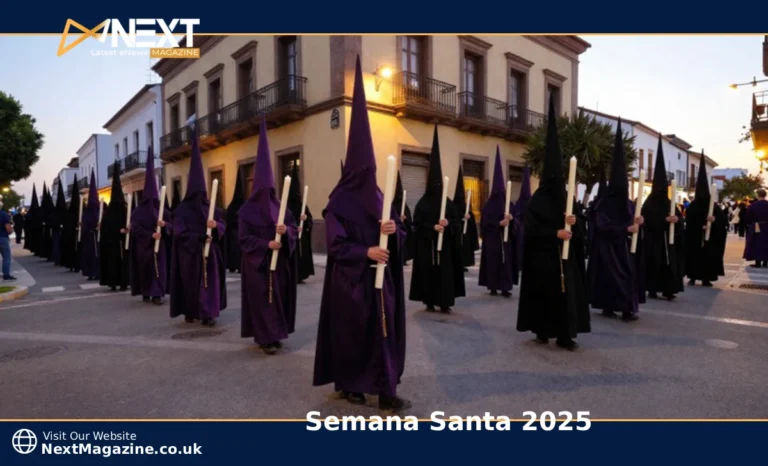
Semana Santa 2025 runs from Palm Sunday, April 13, through Easter Sunday, April 20. Holy Week 2025 is the most significant religious observance in the Catholic calendar, marking the final days of Jesus Christ — his arrest, crucifixion, and resurrection. Across Spain and Latin America, cities pause entirely for the week. Streets fill with processions, incense smoke, and the low beat of drums that you feel more than hear.
If you’ve never witnessed it, Semana Santa traditions can look intense from the outside — hooded figures, massive floats shouldered through narrow streets, crowds standing completely silent at midnight. But once you understand what’s actually happening, the week feels less like a spectacle and more like a window into something old and genuinely moving. Whether you plan to travel for it or just want to understand what you’re seeing on social media every spring, here’s what you need to know.
When Is Semana Santa 2025?
Because Holy Week 2025 follows the lunar calendar — specifically, the first Sunday after the first full moon of spring — the dates shift every year. In 2025, they fall later than usual.
- Palm Sunday (Domingo de Ramos): April 13
- Maundy Thursday (Jueves Santo): April 17
- Good Friday (Viernes Santo): April 18
- Holy Saturday (Sábado Santo): April 19
- Easter Sunday (Domingo de Resurrección): April 20
The week builds steadily in emotional weight. Palm Sunday opens with branches and processions recalling Jesus entering Jerusalem. By Good Friday, the mood is heavy. Easter Sunday breaks into something lighter. Most of the major public events happen between Thursday and Saturday, with Good Friday processions drawing the largest crowds.
What Is Semana Santa, Really?
At its core, Semana Santa is the Christian observance of the Passion of Christ — his last supper, betrayal, crucifixion, and resurrection. For Catholics, it’s not just a holiday. It’s the focal point of the entire religious year.
But if you step back and watch how it actually plays out, something else becomes clear. Semana Santa traditions are also about memory. About a community deliberately slowing down, gathering in the streets, and carrying its history forward — literally, in many cases, with men and women shouldering floats that weigh several tons.
Is it just a parade? No. Are the processions religious? Yes — though the line between faith and cultural identity blurs fast. For some participants, the week is pure devotion. For others, it’s the tradition they grew up in, whether they attend Mass or not. And for visitors, it can feel like walking into a living piece of history. All of those experiences are real at the same time.
Semana Santa Traditions You’ll Encounter
The Processions
Local brotherhoods called cofradías organize everything. Members dress in long robes with tall conical hoods called capirotes. For travelers who’ve never seen them before, the image can feel jarring. Anonymity is the point — participants are supposed to appear before God without their identity, without status. For them, it’s an act of humility, not theater.
Behind the robed members, massive carved floats called pasos move through the streets. Some depict Christ during the Passion. Others carry the Virgin Mary in mourning. Teams of carriers, hidden underneath, shoulder the weight — sometimes more than a ton per person. The floats sway and dip as the team moves in choreographed rhythm.
Live bands march alongside, playing slow funeral marches that echo off stone walls. Occasionally, from a high balcony, a singer breaks into a saeta — a raw, wailing improvisation that stops everything. The crowd goes quiet. It’s one of those sounds you don’t forget.
The Food
This part rarely makes the travel guides, but food is a genuine part of the week. In Spain, look for torrijas — bread soaked in milk and eggs, fried, then dusted with cinnamon and sugar. It’s essentially Spanish French toast, and bakeries sell them all week. Meat disappears from many menus on Good Friday, replaced by fish stews and simple dishes. In Antigua, Guatemala, local families prepare traditional foods and share them with neighbors as part of the observance. The sensory experience of Semana Santa isn’t just visual — the smell of incense, the taste of food tied to the season, all of it layers together.
The Commercial vs. Spiritual Tension
In major tourist hubs like Seville, the week can feel crowded and commercial. Hotels charge peak-season prices. Vendors line the routes. Viewing stands sell tickets. None of that erases the experience, but it does shape it. If you want something more intimate, seek out neighborhood processions rather than the main cathedral routes. A smaller cofradía winding through a residential street at 11 p.m. — with maybe a hundred people watching instead of ten thousand — often carries more weight than the flagship event.
Best Places to Experience Semana Santa
Seville, Spain
Seville is the benchmark for Good Friday processions. The city runs processions almost nonstop from Palm Sunday through Easter. The cathedral neighborhood fills with incense, trumpets, and crowds thick enough that moving becomes slow work. Book accommodations at least three to four months out. If you go expecting a quiet, meditative experience, you’ll be overwhelmed. Go expecting organized, emotional chaos, and you’ll be amazed.
Antigua, Guatemala
Antigua is famous for its alfombras — intricate street carpets made from dyed sawdust, flowers, pine needles, and fruit, assembled through the night by entire families. By morning, they stretch for blocks. By afternoon, the processions walk directly over them. Watching something that took twelve hours to build get consumed in minutes is a quiet kind of lesson. Pair that with Antigua’s colonial setting and the volcanoes on the horizon, and you have one of the most visually striking Semana Santa experiences anywhere.
Málaga, Spain
Málaga carries the same traditional procession structure as Seville, but with more room to breathe. The floats are grand, the music is serious, and locals are fiercely proud of their cofradías. The coastal location also means you can step away from the intensity when you need to.
Peru and Colombia
In Ayacucho and Cusco, Catholic traditions blend with Andean culture into something distinct from anything you’d see in Spain. In Popayán, Colombia, processions have UNESCO recognition. These are worth considering if you want the full range of what Semana Santa looks like across the Spanish-speaking world.
Practical Travel Tips for Semana Santa 2025
If you’re heading out this year, treat the week like a marathon.
- Book early. Flights and hotels in Seville, Antigua, and Málaga fill months in advance. Don’t wait.
- Pace yourself. Attend one daytime procession to see the details up close, and one late-night procession for the atmosphere. Trying to cover everything leaves you exhausted and unable to absorb any of it.
- Learn the unspoken rules. Processions have the right of way — always. Don’t stand in the middle of the street, don’t cut across a moving procession, and don’t raise your voice near participants. If it becomes too intense, you can leave. Nobody expects visitors to stay for hours.
- Check the schedule. Processions run on published timetables but often run late. Don’t build tight plans around a specific float arriving at a specific corner. Leave room for things to shift.
- Dress with sense. Dark, modest clothing helps you blend in and signals respect. Comfortable shoes matter more than almost anything else. You’ll spend long stretches standing on cobblestone.
- Watch your belongings. Large crowds attract pickpockets, especially in major cities. Keep valuables close.
- Try the local food. Find a bakery selling torrijas in Spain or ask locals in Antigua what families are cooking that week. The food connects you to the season in a way that standing on a curb alone cannot.
Final Thoughts
Semana Santa 2025 isn’t something you can fully understand from photos or a travel blog. The drums, the incense, the weight of a saeta breaking over a silent crowd — those things only make sense in person. If you go, resist the urge to document every minute. Put the camera down at least once and just stand there. That’s when it lands.
FAQs About Semana Santa 2025
What is Semana Santa, and how is it celebrated?
Semana Santa is Holy Week — the seven days between Palm Sunday and Easter Sunday. People mark it with processions, music, prayer, fasting from meat on certain days, and community gatherings. The specifics vary by country and city.
Is Semana Santa just a parade, or is it religious?
It’s religious in origin and intent, though the public processions have taken on cultural weight beyond the church. For participants, the act of carrying a float or walking in a procession is deeply personal. For spectators, the line between religious observance and cultural event is genuinely blurry.
Can I attend Semana Santa if I’m not Catholic?
Yes. Many attendees are tourists, students, or locals with no religious connection. What matters is how you behave, not what you believe. Keep your voice low, don’t interrupt or cross a procession, and ask before photographing participants up close.
Where is the best place to go for Semana Santa?
For sheer scale and tradition, Seville is the standard answer. For visual beauty and cultural depth, Antigua, Guatemala, is hard to match. For a less crowded but still serious experience, consider Málaga or a smaller Spanish city with an active cofradía culture.
