
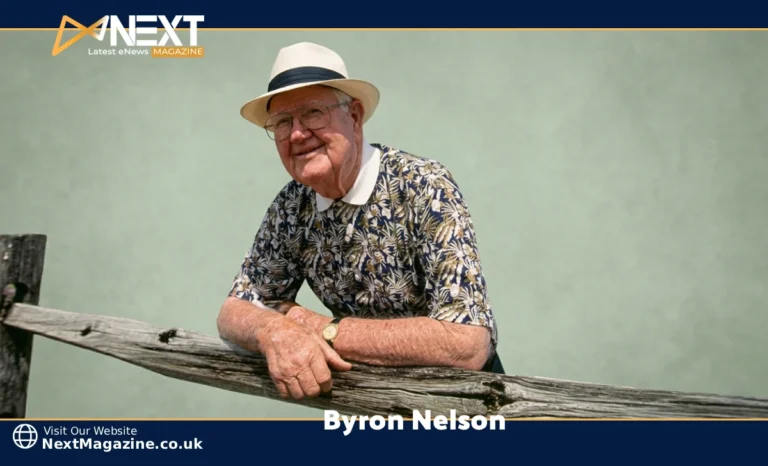
Byron Nelson is famous for winning 11 consecutive PGA Tour tournaments during the 1945 season — the most unbreakable record in professional golf. He won 18 total events that year and averaged 68.33 strokes per round. He also won five major championships and pioneered the modern golf swing that is still taught today.
Some records age. Others become more extraordinary with time.
Byron Nelson’s 1945 season — 18 PGA Tour wins, 11 consecutive victories, a stroke average of 68.33 — belongs firmly in the second category. More than 80 years later, no professional golfer has come close to replicating it.
But the full Byron Nelson story goes beyond one historic season. It’s about a self-taught caddy from Texas who rewrote how the golf swing was understood, won five majors, and walked away at 34 to live exactly the life he had always planned.
Early Life: Fort Worth, Caddying, and a Famous Rivalry
Byron Nelson was born John Byron Nelson Jr. on February 4, 1912, near Waxahachie, Texas — a small town south of Dallas. He came from modest circumstances and found golf through practicality, taking up caddying at the Glen Garden Country Club in Fort Worth as a teenager to earn spending money.
It was there that Nelson first crossed paths with another skinny kid carrying bags: Ben Hogan. In 1927, the two 15-year-olds competed in the club’s caddie championship. Nelson won — an early hint of what was ahead, and the start of a connection between two men who would define professional golf for a generation.
Nelson turned professional in 1932. Prize money was thin, and the Depression-era tour offered little comfort. He persisted, rebuilding his swing as steel shafts replaced hickory and the sport evolved around him.
Career Timeline and Major Championships
The Byron Nelson PGA Tour record speaks for itself: 52 official wins, sixth on the all-time list behind Sam Snead, Tiger Woods, Jack Nicklaus, Ben Hogan, and Arnold Palmer.
His five major championship wins came across a decade of consistent excellence:
- The Masters — 1937 and 1942
- U.S. Open — 1939
- PGA Championship — 1940 and 1945
The 1939 U.S. Open was particularly memorable — Nelson won in a playoff, and that same year he completed the Western Open at Medinah No. 3 without missing a fairway across 72 holes. That iron-play precision defined his game.
He won the Vardon Trophy in 1939 for lowest scoring average, was named Associated Press Male Athlete of the Year in both 1944 and 1945, and played on two Ryder Cup teams (1937 and 1947) before serving as non-playing captain in 1965.
The 1945 Season: Golf’s Most Unbreakable Record
If you want to understand what Byron Nelson is famous for, 1945 is the place to start.
He entered 30 events and won 18, finishing second in seven more. His 68.33 stroke average was not bettered until Tiger Woods surpassed it in 2000. Then there were the 11 consecutive wins — a streak from March through July, across different courses and formats, that no player since has approached.
Critics note that World War II thinned the tour’s fields, with many players serving in the military. Nelson was exempt due to a blood clotting disorder. The thinner fields are fair context — but he still had to beat whoever showed up, week after week, and did it with a consistency the game had never seen.
Golf historians consistently rank 1945 as the greatest single year any male golfer has produced.
The Modern Swing: Iron Byron’s Blueprint
What Nelson contributed to golf technique matters as much as any trophy.
As steel shafts replaced hickory in the 1930s, most players adapted gradually. Nelson rebuilt his swing from scratch, developing a method driven by the legs and hips with a square club face through impact — more powerful, more repeatable, and better suited to modern equipment. Golf historians widely credit him as the originator of the modern golf swing.
His mechanics were so consistent that the USGA adopted them as the model for their club-testing robot. That machine is still known as “Iron Byron” today.
The influence extended into coaching too. Tom Watson, eight-time major champion, credited Nelson’s mentorship as central to his development.
Why Did Byron Nelson Quit Golf?
Byron Nelson retired at just 34 after the 1946 season, and the answer is simpler than most people expect.
Golf was always the means, never the dream. Nelson had a clear goal from early in his career: earn enough to buy a ranch in Texas. By late 1946, he had purchased a 740-acre property near Roanoke and named it Fairway Ranch. He left the tour without hesitation.
He also disliked the grind of tour life — the constant travel, the public attention, the handshaking circuit. His haemophilia meant the physical demands were not sustainable in the long term. He had done what he came to do, and he was done.
He didn’t disappear from golf. He became a television commentator for ABC Sports, continued appearing at the Masters for years, and coached generously. But full-time competition was finished, and he never seemed to regret it.
How personal priorities shape an athlete’s arc — even at the height of their powers — comes up across sports profiles. This piece on Noelle Inguagiato explores how identity and values steer careers in ways statistics alone can’t capture.
Personal Life and Byron Nelson Kids
Nelson met Louise Shofner in 1934 and married her that June in her parents’ living room. Louise was his partner for more than five decades until her death in 1985. He married Peggy Simmons in 1986.
They had no biological children, but Byron Nelson kids in the broader sense — the golfers he mentored, coached, and invested time in — were numerous. He gave freely of his knowledge to anyone willing to learn, and that generosity became one of the defining threads of his legacy.
He died on September 26, 2006, at 94, receiving the Congressional Gold Medal in his final year — one of the highest honours the U.S. government can award a civilian.
Were Byron Nelson and Ben Hogan Friends?
Yes — though theirs was a friendship built on shared history more than daily closeness.
Nelson and Hogan grew up in the same Fort Worth neighbourhood, caddied at the same club as teenagers, and competed at the highest level for more than a decade. Along with Sam Snead, all three were born within seven months of each other in 1912 — a coincidence that produced three of the greatest players the game has ever seen.
Their bond was one of deep mutual respect. When Hogan nearly died in a car accident in 1949, Nelson was among those who visited him during recovery. The friendship was real, even when it was quiet.
Byron Nelson Net Worth and Career Earnings
Nelson played in an era when tour prize money was modest by any modern measure. His career earnings were enough to fund his ranch and build a comfortable life — most estimates place his net worth at the time of his death between $1.5 million and $5 million, drawn from tournament wins, ABC commentary, endorsements, and ranching.
The contrast with today is stark. The 2026 CJ Cup Byron Nelson alone carried a record $10.3 million purse. How earnings and legacy intersect over a career is something a profile like this on Miley Cyrus explores from a different angle.
For Nelson, the money was always a means to an end. He reached his number, bought his land, and moved on.
The Byron Nelson Tournament: Dallas Classic to CJ Cup
The event bearing his name dates to 1944 — originally called the Texas Victory Open, held at Lakewood Country Club in Dallas. In 1968 it became the Byron Nelson Golf Classic, the first PGA Tour event ever named for a professional golfer. It later carried the AT&T Byron Nelson name before becoming today’s CJ Cup Byron Nelson, played at TPC Craig Ranch in McKinney, Texas.
The Byron Nelson Dallas connection remains central to the event’s identity. It has raised more than $143 million for charity since its founding — one of the PGA Tour’s most impactful community events.
Byron Nelson Tournament 2026: Wyndham Clark shot a final-round 60 to win, overtaking Si Woo Kim by three strokes with defending champion Scottie Scheffler also in contention. The Byron Nelson leaderboard that Sunday featured some of the biggest names on tour.
How much does the Byron Nelson winner get? The 2026 purse was a record $10.3 million. Clark took home $1,854,000. Byron Nelson tickets for the annual event sell quickly given the quality of the field and the tournament’s deep charitable history in the Dallas-Fort Worth area.
Legacy: What Byron Nelson Left Behind
Byron Nelson’s legacy doesn’t rest on nostalgia — it rests on specifics.
The 11 consecutive wins and 18 victories in 1945 remain the most cited unbreakable records in professional golf. His swing mechanics gave the sport its modern technical foundation. His name graces the Byron Nelson Classic and Byron Nelson High School in Trophy Club, Texas. The tournament has given over $143 million to charity.
Nicknamed “Lord Byron” for his dignified manner, he was as respected for his character as his game. The link between genuine achievement and genuine character is what keeps a legacy alive — something this profile on Celia Kaleialoha Kenney reflects from another corner of public life.
He died in 2006. The records stand. The swing lives on. The tournament keeps giving.
FAQs
What is Byron Nelson famous for?
Nelson is famous for winning 11 consecutive PGA Tour events and 18 total tournaments in 1945 — the greatest single season any male professional golfer has produced. He also won five major championships and pioneered the modern golf swing.
Why did Byron Nelson quit golf?
Golf was always a means to an end. Nelson’s goal was to buy a ranch in Texas. Once he purchased Fairway Ranch near Roanoke after the 1946 season, he left the tour willingly at age 34. Health factors related to haemophilia also played a role.
How much does the Byron Nelson winner get?
The 2026 CJ Cup Byron Nelson purse was a record $10.3 million. Winner Wyndham Clark earned $1,854,000 at TPC Craig Ranch in McKinney, Texas.
Were Byron Nelson and Ben Hogan friends?
Yes. Both grew up in Fort Worth, caddied at the same club as teenagers, and competed at the highest level for over a decade. Their bond was one of deep mutual respect that lasted their entire lives.
