
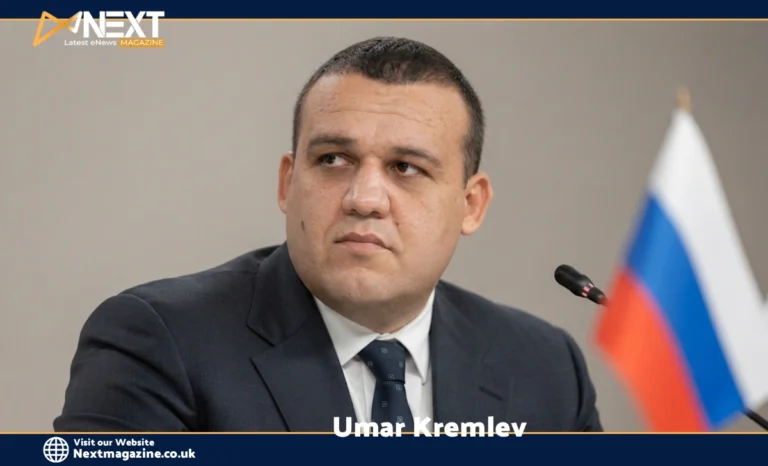
Few figures in modern sports governance have stirred as much debate as Umar Kremlev. Since becoming president of the International Boxing Association (IBA) in 2020, the Russian administrator has launched ambitious programs, clashed with the Olympic movement, and positioned himself as one of the most consequential — and controversial — leaders in boxing history.
This article examines his background, his vision for the sport, the conflicts that define his tenure, and what it all means for boxing’s future.
From Humble Beginnings to Boxing’s Top Table
Umar Kremlev was born Umar Nazarovich Lutfuloev on November 1, 1982, in the Moscow Oblast region of Russia. He later adopted the surname Kremlev under which he would become globally known.
His path into boxing administration began not as a fighter, but as an organizer and businessman within Russian sports circles. Kremlev rose through the ranks of the Russian Boxing Federation, eventually becoming its Secretary General — a role that gave him direct influence over the sport’s development at the national level.
By the mid-2010s, Kremlev had also secured a position as First Vice-President of the European Boxing Confederation (EUBC), expanding his reach beyond Russia. His profile was further elevated by national honors, including the Order of St. George, one of Russia’s distinguished awards.
These combined roles — federation official, continental leader, and nationally recognized figure — laid the groundwork for his bid for the IBA presidency.
The IBA Presidency: Elections and Early Moves
In December 2020, Kremlev was elected president of what was then still known as AIBA (Association Internationale de Boxe Amateur). The organization had been in turmoil: the IOC had suspended AIBA’s governance of Olympic boxing in 2019 due to concerns about finances, refereeing integrity, and leadership.
Kremlev’s election platform centered on three promises: clear the organization’s debts, restore credibility, and grow boxing globally.
Key early actions included:
- Rebranding the organization from AIBA to the International Boxing Association (IBA) in 2021, signaling a clean break from past governance failures.
- Eliminating AIBA’s reported $16 million debt through new sponsorship and commercial deals.
- Increasing financial support to national federations, particularly in developing nations — a strategy that built loyalty among IBA’s voting members.
In 2022, Kremlev was re-elected as IBA president, running unopposed after his main challenger, Boris van der Vorst of the Netherlands, was declared ineligible by an IBA-appointed committee — a decision that itself became a point of contention.
Kremlev’s “Golden Era” Vision for Boxing
Kremlev has repeatedly described his ambition to lead boxing into a “Golden Era.” This is not just a slogan — it refers to a suite of structural programs aimed at unifying and expanding the sport across its fragmented landscape.
IBA.Pro — Bridging Amateur and Professional Boxing
One of the most significant initiatives under Kremlev is IBA.Pro, a professional boxing series launched by the IBA. The program aims to give amateur boxers a structured pathway into professional competition without leaving the IBA ecosystem.
Historically, amateur boxers had to abandon their federation ties to turn professional. IBA.Pro attempts to remove that barrier by offering professional bouts under IBA sanctioning — essentially allowing the organization to operate across both the amateur and professional spheres.
Bare-Knuckle Boxing Regulation
Kremlev has also pushed the IBA into the emerging market of bare-knuckle boxing. Rather than leaving this growing combat sport unsanctioned and unregulated, the IBA under Kremlev has moved to establish rules, safety standards, and event frameworks for bare-knuckle competition.
This is a strategic play: by claiming jurisdiction over a new format, the IBA expands its relevance beyond traditional Olympic-style boxing.
Boxing Academies and Youth Development
Under Kremlev’s leadership, the IBA has invested in boxing academies designed to train young athletes, coaches, and officials in underserved regions. These academies serve a dual purpose: developing talent pipelines and strengthening IBA’s grassroots presence in countries where boxing infrastructure is limited.
The IBA vs. IOC Conflict
The most defining controversy of Kremlev’s presidency is the ongoing conflict with the International Olympic Committee (IOC).
The dispute dates back to 2019, when the IOC suspended AIBA’s right to govern Olympic boxing. Kremlev’s election in 2020 was supposed to mark a fresh start, but relations between the IBA and IOC deteriorated rather than improved.
Key moments in the conflict include:
- 2022: The IOC stripped the IBA of the right to organize boxing at the 2024 Paris Olympics, creating an independent body to run the Olympic boxing tournament instead.
- June 2023: The IOC formally withdrew its recognition of the IBA — an unprecedented step that effectively expelled boxing’s oldest governing body from the Olympic movement.
- 2024: Boxing was included in the 2024 Paris Olympics under IOC oversight, without IBA involvement.
Kremlev has publicly stated that the IOC “had no choice but to accept” the IBA’s position on various issues and has framed the dispute as one of political interference rather than legitimate governance concerns. The IBA has pursued legal challenges against the IOC’s decisions, though these have not resulted in reinstatement.
The practical impact is significant: Olympic boxing now operates in a governance vacuum, with no permanent federation in place for the 2028 Los Angeles Games.
The Gender Eligibility Controversy
In 2023, the IBA disqualified two athletes — Imane Khelif of Algeria and Lin Yu-ting of Taiwan — from its World Boxing Championships, citing eligibility criteria related to sex testing. Kremlev publicly stated that the athletes had been found to have XY chromosomes and that the IBA’s tests showed they did not meet the eligibility requirements for women’s competition.
The decision ignited a global debate. The IOC, which had by then taken over Olympic boxing governance, allowed both athletes to compete at the 2024 Paris Olympics. Khelif went on to win a gold medal.
The episode became one of the most visible flashpoints in the broader international conversation about gender eligibility in sport, and it deepened the rift between the IBA and the IOC. Critics argued the IBA’s testing procedures were not transparent; the IBA maintained it was protecting the integrity of women’s sport.
Political Ties and Sanctions
Kremlev’s profile extends beyond sport into geopolitics. He has been listed on sanctions databases maintained by Ukrainian government intelligence agencies, which cite his connections to Russian political figures.
These political associations have complicated the IBA’s international standing. Several Western national boxing federations have expressed concern that the organization’s leadership is too closely tied to Russian state interests — a factor that contributed to the broader push to strip IBA of Olympic recognition.
Kremlev, for his part, has not distanced himself from his political connections, instead framing his work as being in service of sport rather than politics.
Partnerships with Boxing Legends
Despite the controversies, Kremlev has been effective at building high-profile partnerships that keep the IBA in the global spotlight.
Notable collaborations include:
- Manny Pacquiao — The Filipino boxing icon has worked with the IBA on exhibition events and promotional initiatives, including discussions around a potential “Thrilla in Manila 2” event.
- Terence Crawford — The undefeated American champion has been involved with IBA.Pro events, lending professional credibility to the initiative.
- Tyson Fury — The former heavyweight champion’s association with IBA events has drawn media attention and mainstream crossover appeal.
These partnerships serve a clear strategic purpose: by aligning the IBA with recognized stars, Kremlev positions his organization as the natural home for boxing at every level — even as the IOC disputes that claim.
The IBA’s Sport + Business Forum, held in Istanbul in 2024, brought together fighters, promoters, and administrators in what Kremlev described as the largest gathering of boxing stakeholders in the sport’s history.
What Kremlev’s Leadership Means for Boxing’s Future
Umar Kremlev’s presidency has produced real, measurable change in boxing’s structure. The IBA’s debt is cleared. National federations receive more funding. A professional series exists where none did before. Youth academies are expanding into new markets.
At the same time, the sport is fractured as never before. Boxing has no permanent governing body for the Olympics. The gender eligibility debate remains unresolved. And the IBA’s political associations continue to limit its acceptance in parts of the global sports community.
What is not in doubt is Kremlev’s ambition. He has made the IBA more visible, more active, and more polarizing than at any point in its history. Whether that trajectory leads to boxing’s “Golden Era” or further fragmentation will depend on whether the bridges he is building — with fighters, with fans, and with the broader sports establishment — can withstand the weight of the controversies that follow him.
For now, Umar Kremlev remains exactly where he has positioned himself: at the center of boxing’s most consequential fight — not in the ring, but over who controls the sport itself.
