
Money can make plenty of parenting problems easier. It cannot tell you what your children should do with an empire.
That question becomes especially complicated among the richest dads in the world. Some have children already working inside the companies that created the family fortune. Others have kept the next generation almost completely away from corporate leadership. A few are giving billions away before inheritance even becomes the main conversation.
So this is not simply a list of rich men who happen to have kids. It is about what happens when enormous personal wealth meets an ordinary family question: what comes next?
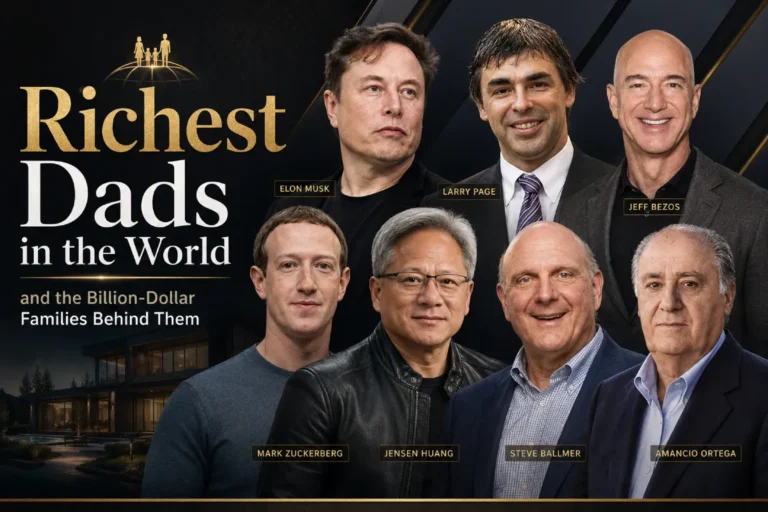
The fortunes below are estimates rather than fixed balances. Stock prices can move quickly, and the value of private companies can change just as dramatically. As of August 20, 2026, Elon Musk led this group at about $834.7 billion, followed by Larry Page, Jeff Bezos, Sergey Brin and Michael Dell. Mark Zuckerberg, Jensen Huang, Larry Ellison, Steve Ballmer and Amancio Ortega complete the list.
1. Elon Musk — About $835 Billion
Elon Musk has the largest fortune here and probably the least conventional family story. His net worth crossed the trillion-dollar mark in 2026, a scale no other fortune on this list approaches. Tesla and SpaceX account for much of his wealth, but the household around those businesses looks nothing like a traditional dynasty waiting for one obvious heir. Musk has 14 publicly known children, including one son who died in infancy, and his relationships with some of his adult children have attracted considerable public attention.
None of the next generation has emerged publicly as the designated future leader of Tesla or SpaceX. One younger son, X Æ A-Xii, has appeared alongside his father at prominent public events, while adult daughter Vivian Jenna Wilson has spoken openly about being estranged from him. The real succession question may therefore be less about who eventually receives shares and more about whether anyone can inherit the influence Musk personally holds over businesses still closely identified with their founder.
2. Larry Page — About $279 Billion
Larry Page offers almost the opposite picture: enormous wealth with remarkably little family spectacle. The Google cofounder and scientist Lucinda Southworth have two children, yet family life has remained unusually private even as his fortune climbed toward $279 billion. There are no highly publicized heirs working their way through Alphabet and no obvious family succession contest.
That privacy also mirrors Google’s corporate evolution. Sundar Pichai runs Alphabet, while Page retains major ownership and voting influence without running the company day to day. His children may eventually inherit extraordinary financial resources, but nothing currently suggests that Google itself is being prepared as a hereditary family business.
3. Jeff Bezos — About $268 Billion
Jeff Bezos spent decades making Amazon one of the most visible companies in the world. His four children have been raised much more quietly. The Amazon founder shares three sons and an adopted daughter with former wife MacKenzie Scott, and none has been publicly presented as a future Amazon executive.
Amazon already handled its leadership transition another way. Andy Jassy became CEO in 2021, allowing Bezos to focus more heavily on Blue Origin, investments and other projects. That separation matters: the Bezos children could one day inherit enormous wealth without inheriting the responsibility of running Amazon. Corporate control and family inheritance are now two different stories.
4. Sergey Brin — About $257 Billion
Sergey Brin’s legacy is easier to understand through philanthropy than through family succession. The Google cofounder remains a major Alphabet shareholder and board member, but his children have not become public figures inside the business. The company itself has long since moved to professional management rather than a second generation of Brins.
A significant portion of his financial attention has instead gone toward scientific research, particularly Parkinson’s disease and neurological conditions. That creates several different kinds of legacy at once: immense private wealth, continuing ownership in one of the world’s most valuable technology companies and billions directed toward medical research rather than a simple father-to-child corporate handoff.
5. Michael Dell — About $233 Billion
Michael Dell’s most striking family-related financial move was not naming one of his four children as the next boss of Dell Technologies. Instead, Michael and Susan Dell committed $6.25 billion toward investment accounts designed to benefit roughly 25 million American children. It is a remarkably broad interpretation of what leaving something to the next generation can mean.
The Dell children have largely followed their own paths. Alexa Dell has pursued entrepreneurial interests, while Juliette Dell has been involved in equestrian sport rather than emerging as an obvious future technology executive. Their father still serves as chairman and CEO of Dell Technologies, with much of the family’s wider investment activity managed separately through DFO Management.
6. Mark Zuckerberg — About $188 Billion
Mark Zuckerberg and Priscilla Chan have three daughters, but they made the biggest statement about their family’s wealth when their first child, Max, was born. The couple announced plans to direct 99% of their Facebook shares over their lifetimes toward philanthropic and social causes through the Chan Zuckerberg Initiative and related efforts.
That makes a current net worth approaching $188 billion a poor guide to what the children might eventually inherit. Share prices will change, charitable commitments will absorb part of the fortune, and Meta’s leadership structure could look very different decades from now. The daughters are growing up inside an extraordinarily wealthy household, but the publicly stated plan has never been simply to keep every dollar inside the family.
7. Jensen Huang — About $187 Billion
Jensen Huang is one of the few fathers near the top of the global rich list whose children are already inside the company he helped build. Madison Huang and Spencer Huang both work at Nvidia, giving the family a direct second-generation connection to the chipmaker that became one of the biggest winners of the artificial-intelligence boom.
Neither has been announced as an eventual successor, and Nvidia remains a giant public corporation rather than a conventional family company. Their presence is still notable because it contrasts sharply with the children of Page, Bezos and Brin, who remain outside the businesses that created their fathers’ fortunes. For the Huang family, the next generation is already learning the company from within.
8. Larry Ellison — About $184 Billion
Larry Ellison’s children did not follow him into Oracle. They went to Hollywood instead.
David Ellison founded Skydance Media and became a major entertainment executive, while Megan Ellison created Annapurna Pictures and built a reputation for backing ambitious films. Family capital helped provide opportunities, but neither child simply copied the Oracle founder’s career. They turned access and resources into influence in an entirely different industry.
That makes the Ellison family one of the more interesting examples of inheritance as opportunity rather than imitation. The father’s fortune came from enterprise software; the next generation used its starting position to build media businesses of its own.
9. Steve Ballmer — About $149 Billion
Steve Ballmer’s three sons have not been groomed to take over Microsoft, and one of them, Pete Ballmer, chose a career in comedy. Meanwhile, Steve and Connie Ballmer have increasingly directed their resources toward philanthropy through Ballmer Group rather than building a public family dynasty around the technology company that created most of the fortune.
Ballmer Group reported more than $1.48 billion in active giving over the past year, with a strong focus on children, families, economic mobility and behavioral health. Ballmer himself still owns the Los Angeles Clippers and remains a major Microsoft shareholder, but his family’s public legacy is becoming just as closely associated with what the wealth funds outside the household.
10. Amancio Ortega — About $148 Billion
Amancio Ortega provides the clearest example on this list of the next generation already stepping into the original empire. The Zara cofounder still owns roughly 60% of Inditex, while decades of dividends have helped build an enormous real-estate portfolio through the family’s investment company, Pontegadea.
His daughter Marta Ortega spent years working across different parts of Inditex before becoming chair in 2022. She is also involved in the family investment structure, placing her inside both the operating company and the machinery holding much of the family’s wealth. There is no need to speculate about whether the next generation will enter the business. One already has.
Ten Fortunes, Ten Very Different Ideas of Legacy
Put these families side by side and the differences become much clearer. Musk has a vast but unconventional household with no obvious corporate heir. Page keeps family life extremely private. Bezos separated Amazon management from family inheritance years ago, while Brin has pushed billions toward scientific causes rather than building a Google dynasty.
Dell’s most eye-catching recent legacy decision involves millions of other people’s children. Zuckerberg and Chan have pledged most of their Meta-derived shares toward broader causes. Huang’s children work inside Nvidia, Ellison’s children created Hollywood careers, Ballmer’s sons stayed outside Microsoft, and Marta Ortega already chairs the company her father built.
There is no single billionaire-parenting playbook hiding underneath the numbers.
Will Their Children Actually Inherit All Those Billions?
Probably not in the simple way a net-worth ranking suggests. A billionaire’s fortune is usually made up of company shares, private businesses, real estate, investment vehicles and other assets rather than cash waiting to be divided among heirs. Stock prices can change dramatically before any inheritance takes place, while taxes, trusts and estate structures can further reshape the final amount.
Philanthropy makes the picture even less predictable. Zuckerberg and Chan have pledged the vast majority of their Facebook-derived wealth toward social causes. The Dells and Ballmers are already directing billions toward charitable projects. Children may still inherit extraordinary sums, but today’s headline net worth should never be treated as a guaranteed future inheritance.
Company leadership is another matter entirely. An heir can own shares without becoming CEO, just as a professional executive can run a company without inheriting any of the founder’s personal fortune.
Which Rich Dad Has the Clearest Succession Story?
Among these ten, Amancio Ortega currently has the clearest family succession story. Marta Ortega already chairs Inditex and participates in the family’s investment structure, making her role much more concrete than the hypothetical future involvement of most billionaire children.
Jensen Huang offers a less developed but still interesting case because both of his children work at Nvidia. No formal leadership handoff has been announced, but at least the next generation is already inside the business. Larry Ellison represents a completely different model: David and Megan did not enter Oracle at all and instead built influential careers in entertainment.
Page, Bezos and Brin show another increasingly common approach in modern technology companies. A founder can create generational wealth without turning corporate leadership into a hereditary position.
Conclusion
The easiest assumption is that billionaire children simply wait for an enormous inheritance. Real life is more complicated. Some receive access and opportunity long before they inherit assets. Some enter the family company and spend years building experience. Others use family resources to create something unrelated, while a few remain almost entirely outside the public world surrounding their parents.
Philanthropy can also redirect billions that outsiders casually assume will pass straight to the children. Corporate control may move to professional executives, while ownership remains spread across trusts, investment vehicles and family members.
The money is extraordinary, but the underlying question is surprisingly ordinary. A father can create the opportunity. The next generation still has to decide what to do with it.
