
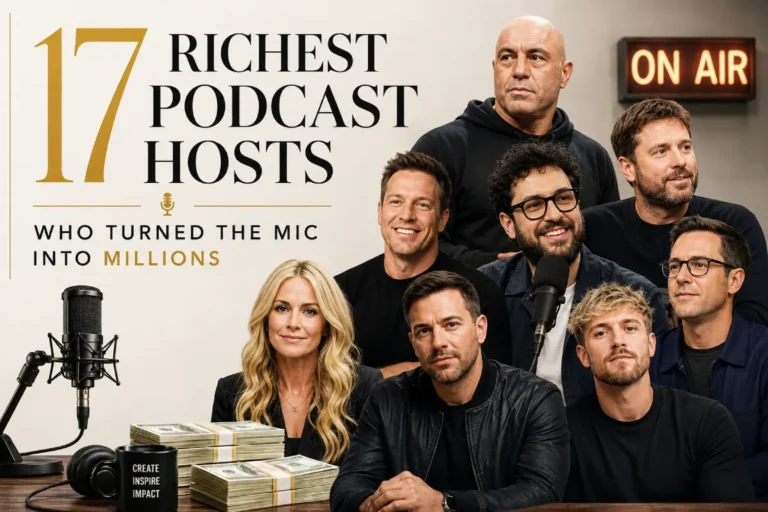
A microphone used to be one of the cheapest pieces of equipment in media. Now it can sit at the center of a $100 million deal. Podcasting has gone from two people talking in a room to a serious media business where Spotify, SiriusXM, Amazon, Wondery and Netflix are willing to spend enormous sums on hosts who can keep millions of people listening.
But there is a catch when you start ranking the richest podcast hosts: the highest-paid podcaster is not necessarily the person with the biggest overall fortune. Some hosts were already wealthy actors, athletes, entrepreneurs or television stars before they ever launched a show. Others really did build a large part of their fortune behind the microphone.
That is what makes this list interesting. We are looking beyond one year’s podcast salary and considering estimated personal wealth, major media deals, company ownership, career earnings and businesses built around the shows.
The numbers are estimates rather than audited personal financial statements, so deal values, annual earnings and company valuations should never be confused with cash sitting in a host’s bank account.
How Much Are Top Podcast Hosts Making in 2026?
Before getting into total net worth, it helps to see just how much money the biggest shows are generating right now. The figures below are estimated pretax podcast earnings from June 2025 to June 2026. They are not personal net worth figures, and shared shows such as SmartLess and New Heights represent combined earnings for their hosts.
Joe Rogan — $82 million
SmartLess — $37 million
Mel Robbins — $35 million
Jason & Travis Kelce — $35 million
Alex Cooper — $32 million
Dax Shepard — $25 million
Source note: Earnings estimates are based on Forbes’ 2026 highest-paid podcasters ranking and cover podcast-related pretax earnings between June 2025 and June 2026.
1. Oprah Winfrey — Estimated Net Worth: $3.4 Billion
Yes, Oprah belongs on the list. She hosts The Oprah Podcast, and once active podcast hosts are ranked by total personal wealth rather than by podcast income alone, everyone else suddenly has a very large gap to close. Her fortune was built over decades through television, Harpo Productions, OWN, film projects, property and investments, long before podcasting became a major part of modern media.
The interesting part is that she is still expanding into the format rather than simply lending her old name to it. In April 2026, Amazon and Harpo Entertainment announced a multi-year agreement giving Wondery exclusive distribution and advertising rights to The Oprah Podcast, with the show expanding to two episodes per week. The podcast did not make Oprah a billionaire; a billionaire media owner has simply decided that podcasting is worth being part of.
2. Joe Rogan — Estimated Net Worth: Around $250 Million
Joe Rogan was already earning serious money from stand-up comedy, Fear Factor and UFC commentary before The Joe Rogan Experience became one of the biggest shows in the world. Podcasting, however, changed the scale of the business around him — a shift also visible in how the team behind The Joe Rogan Experience has grown over the years. His audience became valuable enough for Spotify to sign a new three-year agreement in 2024 that has been reported as potentially worth up to $250 million.
And the money has not slowed down. Forbes estimates Rogan generated about $82 million in podcast-specific earnings between June 2025 and June 2026, making him its highest-paid podcaster of the year. That $82 million is not his net worth, and neither is the $250 million contract value, but the numbers make one thing pretty clear: if you ask who became dramatically richer because of podcasting itself, Rogan has one of the strongest claims on this entire list.
3. Conan O’Brien — Estimated Net Worth: Around $200 Million
Conan O’Brien is a useful reminder that “richest podcaster” and “got rich from podcasting” are two different things. Decades of late-night television had already given him a major career before Conan O’Brien Needs a Friend arrived. What podcasting did was turn the broader Team Coco operation into an asset that another media company wanted to own.
SiriusXM acquired Team Coco in 2022, including its podcast network and digital media business, while Conan signed a five-year talent agreement to remain host of his show. The acquisition has been reported at roughly $150 million. So the podcast was not the beginning of Conan’s fortune, but it helped transform an already valuable personal brand into a media company capable of producing a nine-figure exit.
4. Bill Simmons — Estimated Net Worth: Around $100 Million+
Bill Simmons followed the media-founder playbook almost perfectly: build an audience, build a company around that audience, and then sell the company. He launched The Ringer in 2016 and expanded it beyond a website into a network of sports, culture and entertainment podcasts, with The Bill Simmons Podcast sitting at the center of that ecosystem.
Spotify acquired The Ringer in 2020 for an estimated $200 million. That does not tell us exactly how much Simmons personally pocketed, because ownership stakes, investor interests and transaction terms matter, but it explains why his wealth story is very different from that of a host simply collecting advertising revenue. He turned the microphone into equity, and equity is where podcast fortunes can become much more interesting.
5. Travis Kelce — Estimated Net Worth: Around $80–90 Million
Football made Travis Kelce rich before podcasting had much to do with it. Years of NFL salaries and endorsement deals gave him substantial wealth, but New Heights, the show he hosts with his brother Jason, added an entirely new business to the Kelce brand. What began as two brothers discussing football quickly became one of the biggest sports-and-entertainment podcasts in the market.
Wondery signed a three-year distribution and advertising deal with the brothers in 2024 that was widely reported at more than $100 million. That does not mean Travis personally received a $100 million check—the deal covers both hosts and a wider commercial arrangement—but it shows how valuable the show has become. The NFL built his original fortune; podcasting helped turn his fame into a broader media business.
6. Jason Kelce — Estimated Net Worth: Around $60 Million
Jason Kelce retired from professional football and somehow became busier. His NFL career reportedly generated tens of millions of dollars in salary before endorsements, and retirement opened the door to broadcasting, advertising and a much larger media presence. New Heights now sits at the center of that second career.
The Wondery agreement is particularly important because it gives the brothers something beyond a weekly show: a major commercial relationship involving distribution, advertising and video. Jason’s football money still forms an important part of his fortune, but podcasting has become one of the clearest examples of how an athlete can keep monetizing an audience long after the final whistle.
7. Jason Bateman — Estimated Net Worth: Around $50 Million
SmartLess sounds casual by design—three famous friends talking to a surprise guest—but financially there is nothing casual about it. Jason Bateman, Will Arnett and Sean Hayes launched the podcast in 2020 and quickly turned it into one of the most commercially valuable celebrity-chat shows in audio.
SiriusXM later signed a multi-year agreement with SmartLess Media covering the flagship podcast and the wider network. Forbes estimates the three hosts collectively generated about $37 million in podcast earnings during its latest annual measurement period. Bateman also brings decades of acting, directing and producing income into the equation, which is why his overall fortune is about much more than one successful show.
8. Will Arnett — Estimated Net Worth: Around $45 Million
Will Arnett had already built a lucrative career through acting, voice work and producing before SmartLess became a hit. Shows and films such as Arrested Development and BoJack Horseman gave him a long entertainment résumé, but the podcast offered something different: a business in which the hosts could participate beyond simply being hired talent.
That ownership mindset is one of the patterns running through this list. A TV actor gets paid for a role. A podcast host who owns part of the network around the show can benefit as the whole operation grows, adds new programs or signs a major distribution agreement. That is where the microphone starts behaving less like a job and more like an asset.
9. Dax Shepard — Estimated Net Worth: Around $40 Million
Dax Shepard turned conversation into a surprisingly durable second act. Armchair Expert began as an independent podcast and grew into a major celebrity-interview and culture show, proving that audiences were willing to spend hours listening to conversations that often felt far less polished than traditional TV interviews.
Shepard already had years of acting, directing and entertainment income behind him, so the podcast is not the sole source of his wealth. It has, however, become one of the most commercially important properties attached to his name. That is the recurring lesson here: the richest hosts often arrive with one career and use podcasting to build the next one.
10. Steven Bartlett — Wealth Tied to a Much Bigger Business Empire
Steven Bartlett is where a simple “net worth” number starts becoming almost too crude to be useful. The Diary of a CEO grew from a relatively modest interview show into a global business property, but Bartlett has built an entire entrepreneurial ecosystem around the audience rather than treating the podcast as a standalone product.
Forbes says his broader business portfolio was valued at roughly $425 million following outside investment, while it estimates The Diary of a CEO generated around $45 million in podcast earnings during its latest measurement period. A $425 million company valuation is not the same as Bartlett personally owning $425 million, but it reveals why his financial story is moving so quickly. The show is not simply selling ads; it is feeding a much larger holding-company strategy.
11. Scott Galloway — Estimated Wealth: Tens of Millions
Scott Galloway’s podcasts are really one piece of a much broader business career. Before Pivot and The Prof G Pod, he had already founded companies, invested in startups, taught marketing and built a lucrative career around technology, business analysis and public speaking.
That means the microphone acts less like the source of the fortune and more like the top of a funnel. Listeners become readers, subscribers, event attendees and customers for other parts of the business. In wealth terms, that can be more powerful than trying to squeeze every possible dollar out of advertising alone.
12. Sean Hayes — Estimated Net Worth: Around $30 Million+
Sean Hayes completes the SmartLess trio, bringing with him decades of acting and producing income, most famously from Will & Grace. Like Bateman and Arnett, he did not need podcasting to establish a successful entertainment career, but the show gave the three hosts a valuable property they could help own rather than another role controlled by a studio.
SiriusXM’s multi-year SmartLess Media agreement demonstrates how much that ownership can matter. Advertisers are not just paying for three recognizable names; they are buying access to an audience and a network capable of launching additional shows. That makes SmartLess a media business, not merely a weekly celebrity conversation.
13. Alex Cooper — Estimated Fortune: Tens of Millions
Alex Cooper may have one of the fastest-moving fortunes in podcasting. Call Her Daddy began as a show and evolved into a personal brand, and then Cooper started building a media operation around that brand through Unwell. By the time SiriusXM signed its multi-year agreement with her in 2024, the deal included not only the flagship podcast but advertising and distribution rights connected to the wider Unwell Network.
Forbes estimates Cooper generated about $32 million in podcast earnings during its most recent annual period. Separate reporting has placed Unwell’s valuation around $500 million following outside investment, but that figure should not be mistaken for Cooper’s personal wealth. What matters is the direction of travel: she is moving from highly paid host to media-company owner, which is usually where the larger fortunes are built.
14. Jay Shetty — A Podcast Became the Front Door to a Bigger Empire
Jay Shetty built On Purpose around conversations about relationships, mental health, self-development and celebrity life, but the show now functions as the entry point to a much broader media business. Books, speaking, production work and brand partnerships all sit around an audience first developed through content.
In 2026, Shetty landed an agreement involving Spotify and Netflix that has been estimated at around $100 million over three years. Again, that does not equal personal net worth, but it shows what happens when a successful podcast becomes valuable across multiple formats. Audio gets the audience in the door; television, production and other businesses give that audience somewhere else to spend attention.
15. Mel Robbins — Estimated Wealth: Tens of Millions
Mel Robbins had already built a serious speaking and publishing business before The Mel Robbins Podcast exploded. That foundation matters because her show now sits inside an ecosystem that also includes bestselling books, speaking engagements, live events and brand partnerships.
Forbes estimates the podcast generated roughly $35 million in its latest annual earnings period, helped by enormous audience growth and a renegotiated SiriusXM agreement. That is podcast income rather than personal net worth, but $35 million from one year’s audio business tells you why older estimates of a host’s fortune can become outdated remarkably quickly.
16. Charlamagne Tha God — Estimated Net Worth: Around $10 Million+
Charlamagne Tha God’s audio career predates the current podcast gold rush. Radio made him famous through The Breakfast Club, but his financial story became more interesting when he moved from being only a host to participating in network ownership.
He partnered with iHeartMedia to launch the Black Effect Podcast Network, creating a platform focused on Black creators and audiences rather than simply adding another show to his résumé. Forbes estimates his recent podcast-related earnings at about $27 million, which is a good reminder that old net-worth figures can lag far behind what a host’s current business is generating.
17. Ashley Flowers — The True-Crime Founder to Watch
Ashley Flowers may be the clearest example of why a “richest hosts” article should not blindly trust old celebrity net-worth databases. She co-hosts Crime Junkie, but the bigger financial story is Audiochuck, the true-crime media company she founded around a growing slate of shows.
Forbes estimates Flowers generated about $42 million in podcast earnings in its latest annual period, placing her ahead of several household-name celebrities. Audiochuck also secured a reported $150 million distribution arrangement involving Tubi and Red Seat Ventures. Her exact personal fortune remains private, but company ownership gives her something potentially much more valuable than a large annual hosting salary.
Richest Podcast Host vs. Highest-Paid Podcaster: What’s the Difference?
This is where a lot of online rankings go wrong. If a host earns $30 million from podcasting this year, that does not mean their net worth is $30 million. Taxes, production costs, previous income, investments, debts and ownership stakes all affect how much wealth a person actually accumulates over time.
The same rule applies to giant contracts. A $100 million podcast deal might run for three years, involve several hosts, include production costs and cover distribution or advertising rights. Company valuations create another layer of confusion: saying a media company is worth $500 million does not mean its founder personally has $500 million in cash or assets.
That is why Joe Rogan can be the highest-paid podcaster of 2026 with an estimated $82 million in podcast-specific earnings while Oprah Winfrey remains vastly richer overall. One figure measures what a show generated in a particular period; the other tries to estimate a lifetime accumulation of wealth.
How Do Podcast Hosts Make Millions?
Advertising is still important, but the biggest hosts are no longer depending on a thirty-second sponsor read alone. Their businesses increasingly combine advertising, licensing agreements, video distribution, subscriptions, live shows, books, speaking, merchandise and production deals. The really valuable step, though, often comes when the host owns the company or network around the show.
Bill Simmons sold The Ringer. Conan O’Brien sold Team Coco. Alex Cooper is building Unwell. Ashley Flowers owns Audiochuck. Charlamagne helped create Black Effect. SmartLess became a wider media network rather than remaining a single podcast.
That pattern explains a surprising amount about modern podcast wealth. The show builds attention; ownership turns that attention into an asset.
So, Who Is the Richest Podcast Host?
If we take the question literally and include anyone who currently hosts a podcast, Oprah Winfrey is comfortably the richest person on this list. Her estimated multibillion-dollar fortune was built primarily through television, media ownership and investments, with podcasting becoming only the latest extension of the Oprah brand.
If the question changes to “Who built the biggest fortune primarily because of podcasting?”, Joe Rogan becomes the much more interesting answer. His show helped normalize nine-figure podcast contracts, and Forbes estimates that no individual podcaster earned more from the medium during its latest annual measurement period.
The next generation may eventually make that answer harder. Steven Bartlett is building a wider holding company, Alex Cooper is turning Unwell into a media business, Ashley Flowers owns a true-crime network, and the Kelce brothers have transformed football conversations into a major entertainment property.
The biggest lesson is simple: the richest podcast hosts are no longer satisfied with getting paid to talk into a microphone. They want to own the business that grows around the conversation.
