

Table of Contents
Quick Answer: THC vapes started as modified e-cigarette pens with cotton wicks and fixed-voltage batteries. They moved to the universal 510-thread cartridge, then to ceramic heating cores around 2016, then to sealed all-in-one devices with preheat and voltage control. The 2019 EVALI outbreak pushed the industry towards stricter testing and better materials.
Note: This article explains the history and engineering of the devices. Cannabis and THC products are illegal in the UK and many other countries, and the law varies widely elsewhere. Nothing here is a recommendation to buy or use them.
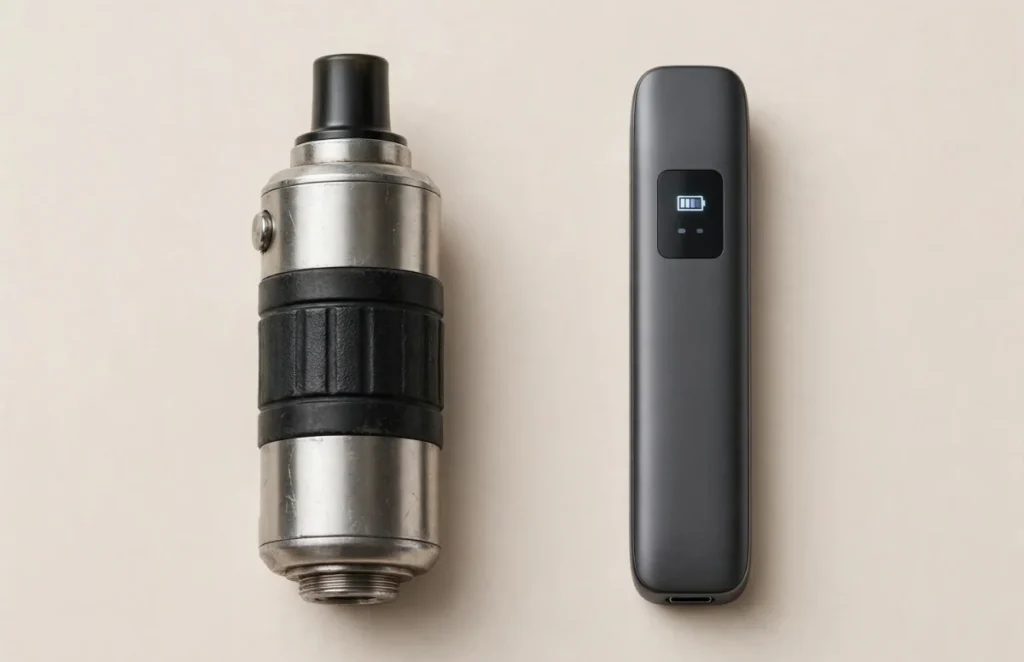
A cannabis vape cartridge looks like a simple object: a small tank of oil screwed onto a battery. Behind it sits fifteen years of trial and error with heating elements, airflow, materials and safety rules. Many of the changes came from problems users noticed, such as burnt taste, clogged tanks and leaks, while some came from a public health crisis.
Borrowed Beginnings: The E-Cigarette Era
The story starts with nicotine. In 2003, Chinese pharmacist Hon Lik developed the first commercially successful e-cigarette, built around a battery, a heating coil and a liquid reservoir. By the late 2000s, pen-style “eGo” devices were common, and they used a small threaded connector known by its size: 510.
Early cannabis users simply adapted these pens. Concentrated THC oil was much thicker than nicotine e-liquid, so the first attempts were messy. Oil soaked into cotton or silica wicks, scorched easily and often clogged.
The 510 Thread Becomes the Standard
As US states began legalising recreational cannabis, starting with Colorado and Washington in 2014, prefilled oil cartridges took off. Manufacturers settled on the 510 connection because millions of compatible batteries already existed.
That single decision shaped the whole market. Any cartridge would fit almost any battery, which kept prices low and let brands focus on the oil. The downside was inconsistency. A cartridge designed for a low voltage could be scorched by a battery set too high.
Wicks to Ceramic: Solving the Burnt Taste
The biggest leap in heating came with ceramic cores. Instead of a coil wrapped in cotton, a porous ceramic block surrounds or embeds the heating wire. Oil soaks into the ceramic and heats more evenly.
| Heating design | How it works | Main drawback |
| Cotton or silica wick | Coil wrapped around a wick that draws oil up | Burns easily, harsh taste with thick oil |
| Quartz rod | Coil around a quartz element, heats quickly | Runs hot, can taste sharp |
| Porous ceramic core | Oil absorbs into ceramic heated by an embedded element | Slower to heat; quality varies by maker |
Ceramic cartridges such as CCELL, launched in 2016, spread quickly because they produced smoother vapour and fewer dry hits. Most cartridges sold in regulated markets today use some form of ceramic heating.
Batteries Get Smarter
Early pens had one button and one voltage. Newer batteries added several features that matter to the user experience:
- Variable voltage: a dial or button cycles through settings, usually between about 2.5 and 4 volts, so users can match the heat to the cartridge.
- Preheat mode: a short, low-power warm-up loosens thick oil that has hardened in cold weather.
- Draw activation: sensors fire the coil when you inhale, removing the button entirely.
- Short-circuit and timeout protection: cut-offs prevent overheating if a draw lasts too long.
- USB-C charging: faster and more reliable than the old micro-USB connectors.
Some premium devices have gone further with app connectivity that logs sessions and caps how much a user inhales, a feature also pitched for medical cannabis patients in markets where that is legal.
All-in-One Devices Replace the Separate Battery
The next shift was the sealed disposable or all-in-one unit, where battery and tank are built together. The manufacturer tunes the voltage to the exact heating core, which removes the guesswork of mixing and matching. The trade-off is waste, since the whole device, including its lithium battery, is thrown away once the oil runs out.
2019: The EVALI Turning Point
In 2019, hospitals in the United States began reporting severe lung injuries in people who vaped. Doctors named the condition EVALI, short for e-cigarette or vaping product use-associated lung injury. By early 2020, the US Centers for Disease Control and Prevention (CDC) had counted more than 2,800 hospitalised cases and 68 deaths.
Investigators found that most patients had used illicit THC cartridges, and the CDC identified vitamin E acetate, a thickening agent used to dilute oil, as strongly linked to the outbreak. The hardware was not the main cause, but the crisis changed how devices are made and sold:
- Regulated markets tightened testing on additives, solvents and contaminants.
- Researchers began studying metals such as lead, nickel and chromium that can leach from cartridge parts at high temperatures, which pushed some makers towards lead-free alloys and medical-grade materials.
- Packaging rules added child-resistant features and clearer labelling.
The episode also made counterfeit packaging an issue that brands now actively fight with serial codes and verification checks.
Where the Technology Is Heading
Current development focuses on three goals. The first is precise temperature control, using sensors rather than fixed voltage to keep oil at a steady heat. The second is cleaner construction, with fewer metal parts in contact with the oil. The third is less waste, through rechargeable all-in-ones and refillable pods.
Looking back, THC vape technology has gone from adapted nicotine pens that burned and clogged to tuned, sealed devices with safety cut-offs. The engineering has improved far faster than the regulation in most places, which is why the source of a product remains the single biggest factor in its safety.

Tyrone Davis
Tyrone doesn't write the headlines — he makes sure everything behind them actually works. As the person holding Next Magazine's daily operations together, he thinks in checklists and deadlines rather than bylines. Readers never see his name on a story, but every smooth publish, fixed link, and on-time update carries his fingerprints. He'd rather be useful than visible.
View all articles →Get the Weekly Brief
The best guides and stories, delivered every Sunday.