

Table of Contents
- What to buy first
- Before you sign
- Kitchen
- Bedroom and bathroom
- Cleaning and tools
- The first-night box
- Before you move in
- How much to budget
- 5 mistakes that cost first-time renters money
- Frequently asked questions
- What do I need for my first apartment?
- How much money should I save before moving into my first apartment?
- What is a first-night box?
- What should I buy first for a new apartment?
- Do I really need renters insurance?
- Can I use this checklist for a college apartment or dorm?
- Final thoughts
Your first apartment is empty, and the move-in date is already set. No bed, no plates, no shower curtain. This first apartment checklist gives you 29 essentials in the order to buy them, so you sleep, shower, and cook from night one.
Every item on this list earns its place. You get a bed and bedding first, a shower curtain and toilet paper next, then basic cookware and cleaning supplies. Nothing on this list is decor, and nothing is a nice to have that can wait a month.
The list is built from what first-time renters actually buy first, not from a store catalog. It skips the long lists that mix in things you will never use. What is left is what you need to live in the place from day one.
The list is split into four groups: before you sign, kitchen, bedroom and bathroom, and cleaning and tools. Work through them in order. By the end, your apartment is ready to live in, not just to look at.
You can download this first apartment checklist as a free printable PDF. It has the same 29 items, with check boxes, in US Letter and A4. Print it, take it shopping, and check items off as you buy them. Download the printable first apartment checklist PDF
What to buy first
This first apartment checklist is built in buy order. These are the first apartment essentials. Most people buy in reverse and end up sleeping on a bare floor with a beautiful couch.
- Bed and bedding. You need a place to sleep on night one. Nothing else matters until this is done.
- Shower curtain and toilet paper. You need to wash on night one. The shower curtain is the item people forget most.
- Basic cookware and a few dishes. One pan, one pot, a knife, and four sets of plates and cups. You can cook a real meal with this.
- Cleaning supplies. All-purpose cleaner, dish soap, trash bags, and a sponge. The apartment will not stay clean on its own.
- Somewhere to sit. A chair or a couch. This can wait a few days, but not a month.
- Everything else. The rest of the list fills in over the first two weeks, after you have lived in the place and know what is missing.
Before you sign
Do these seven checks before you sign the lease. They cost nothing, and they protect your deposit.
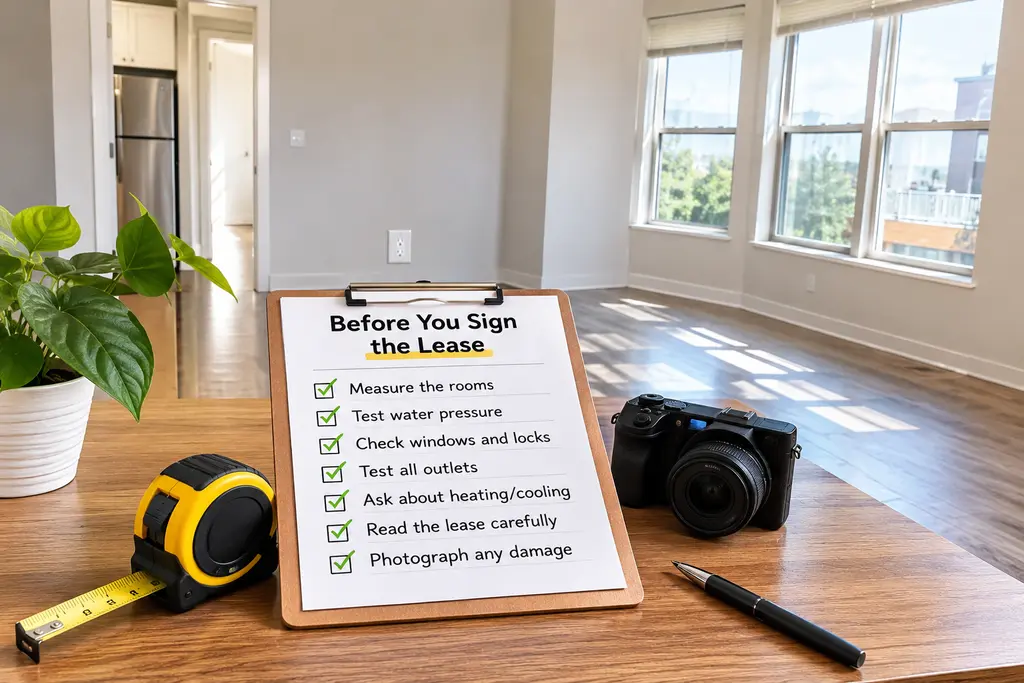
- Measure the rooms and the doorways. Measure every room wall to wall, and measure the doorways, hallway turns, and the elevator. A couch that does not fit through the front door goes back to the store.
- Test the water pressure and every tap. Run every tap and flush every toilet. Low water pressure is hard to fix after you move in.
- Open and close every window and door. Check that each one locks and seals. A window that sticks is a problem in winter, and a door that does not lock is a safety problem now.
- Check the outlets in each room. Plug a phone charger into the outlets in each room. Count how many you have, and note where they are, so you know if you need a power strip.
- Ask about the heating and cooling. Ask what type it is, what it costs to run, and who pays for it. Ask this before you sign, not after the first bill.
- Read the lease line by line. Check the rules on nails, paint, pets, guests, and breaking the lease early. If a rule is not clear, ask the landlord to explain it in writing.
- Photograph every mark and scratch. Photograph every wall, floor, and appliance mark before you move a single box in. Email the photos to yourself so you have a dated record for your deposit.
Kitchen
You do not need a 12-piece cookware set. You need one good pan, one pot, and the basics below.
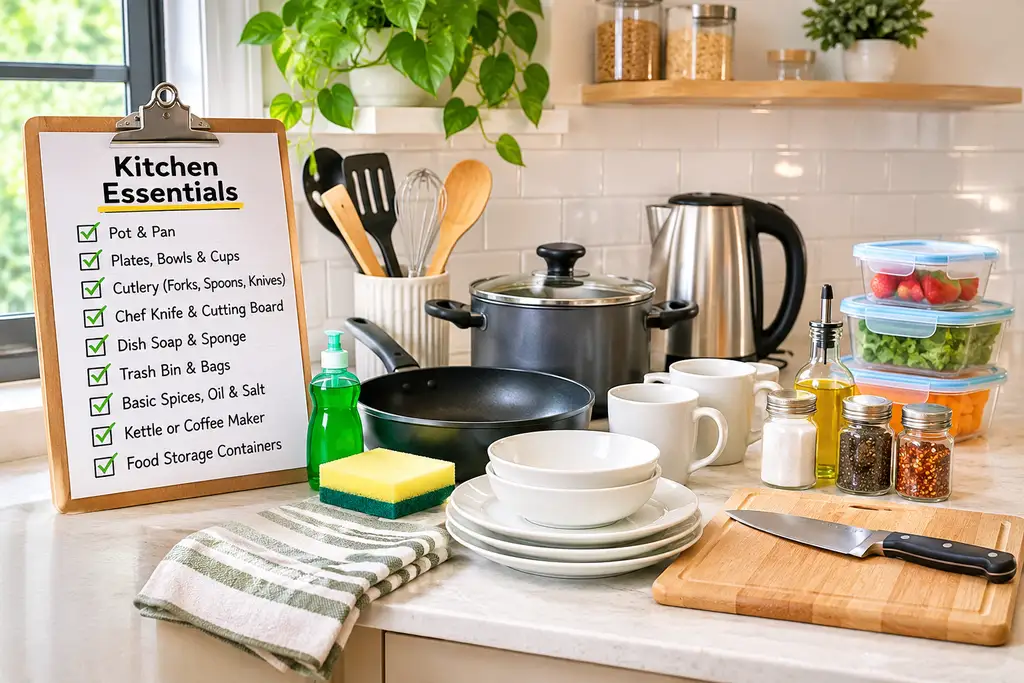
- Buy a pot, a pan and a baking sheet. One medium pot with a lid, one non-stick pan, and one sheet pan. This covers most meals.
- Get plates, bowls, cups and cutlery for 4. Four sets cover you plus one guest. Buy more only if you host often.
- Stock a knife, a cutting board and a peeler. One chef knife, one cutting board, and one peeler. This is all you need to cook.
- Buy dish soap, a sponge and a dish rack. Get these before your first meal. Without them, you will eat off paper plates for a week.
- Get a bin and bin bags. A kitchen bin with a lid keeps smells down. Buy a roll of bin bags at the same time.
- Buy basic spices, oil and salt. Salt, pepper, olive oil, and two or three spices you actually use. Do not buy a full spice rack on day one.
- Get a kettle or a coffee maker. Pick the one you use every day. The other one can wait until you know your routine.
- Buy food storage boxes. A set of three or four boxes with lids for leftovers. Glass boxes last longer than plastic.
Bedroom and bathroom
The bedroom and bathroom are where you sleep and wash. Get these right first, and the rest can wait.
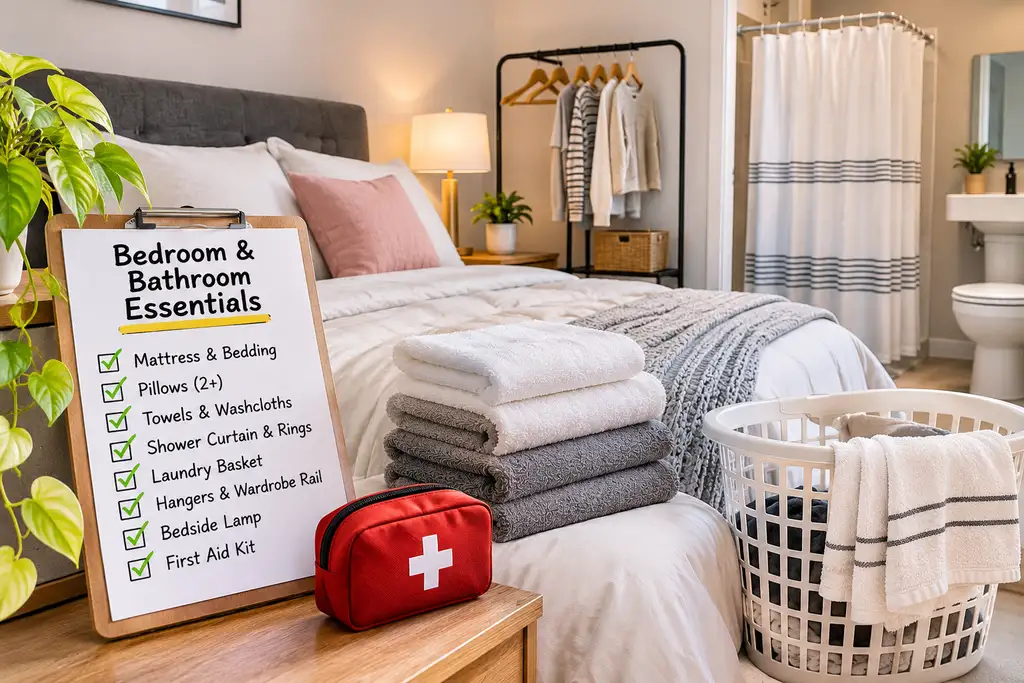
- Buy a mattress, pillows and bedding. The mattress is the one thing to spend on. You sleep on it every night for years. Get two sets of sheets so one is always clean.
- Get towels and a bath mat. Two bath towels and two hand towels per person, plus a bath mat. Wash them before first use.
- Buy a shower curtain and rings. Buy this before your first shower. It is the most forgotten item on any first apartment list.
- Get a laundry basket and detergent. A basket keeps dirty clothes off the floor. If you use a shared laundry room, add a rolling cart and laundry bags.
- Buy hangers and a wardrobe rail. If there is no closet rail, a freestanding rail works. Buy enough hangers for the clothes you own, not for a full closet.
- Get a bedside lamp. A lamp by the bed means you do not need the ceiling light at night. It also makes the room feel finished.
- Buy a first aid kit. Bandages, pain relief, antiseptic, and any medicine you take daily. Keep it in the bathroom where you can reach it fast.
Cleaning and tools
A clean apartment needs a few basics, not a separate cleaner for every surface. One all-purpose spray and one bathroom cleaner cover most jobs.
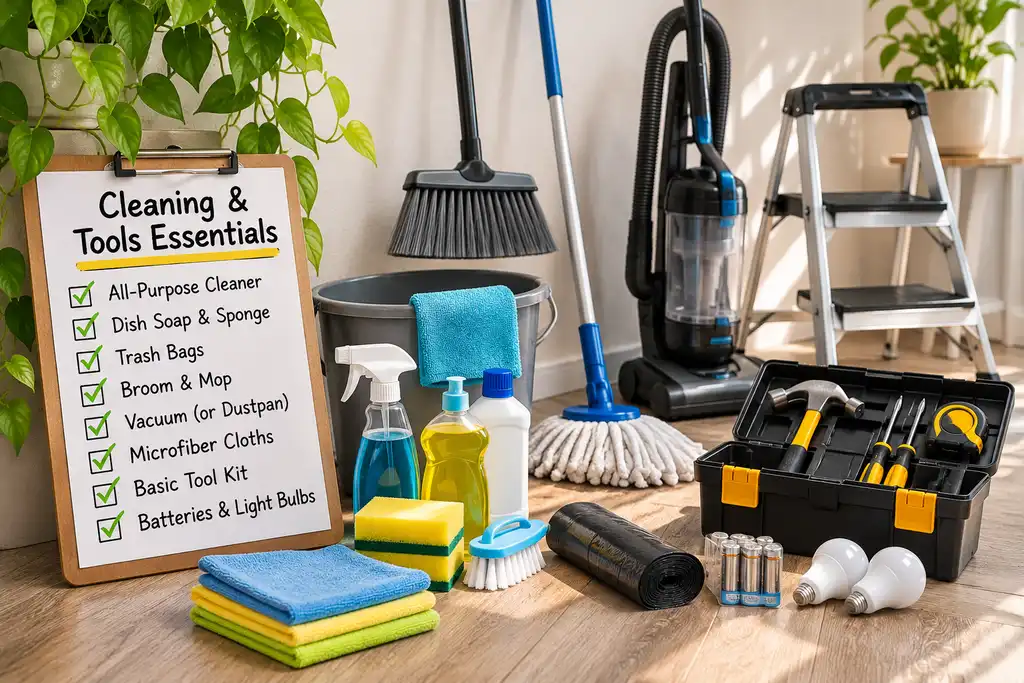
- Buy a broom, a mop and a bucket. Hard floors need a broom and a mop. If you have carpet, a vacuum matters more than a mop.
- Get a vacuum or a dustpan and brush. If you have carpet, a vacuum is not optional. If you have hard floors only, a dustpan and brush will do.
- Buy all-purpose cleaner and cloths. One all-purpose spray, one bathroom cleaner, and two microfiber cloths. You do not need a separate cleaner for every surface.
- Get a basic tool kit with a hammer and screwdriver. A hammer, a screwdriver, and a tape measure handle most small jobs, like hanging a hook or tightening a loose screw.
- Buy light bulbs and batteries. Check what size bulbs your fixtures take before you shop. Buy one spare of each size.
- Get a step stool. You will need it to reach high shelves, change bulbs, and hang curtains. A folding stool stores flat.
- Buy hooks and picture hangers. Adhesive hooks work if your lease bans nails. Check the lease first, then buy the type it allows.
The first-night box
Pack one box you carry in by hand on move-in day. Do not put it on the moving truck. If nothing else is unpacked by night, this box lets you sleep, shower, eat, and charge your phone.
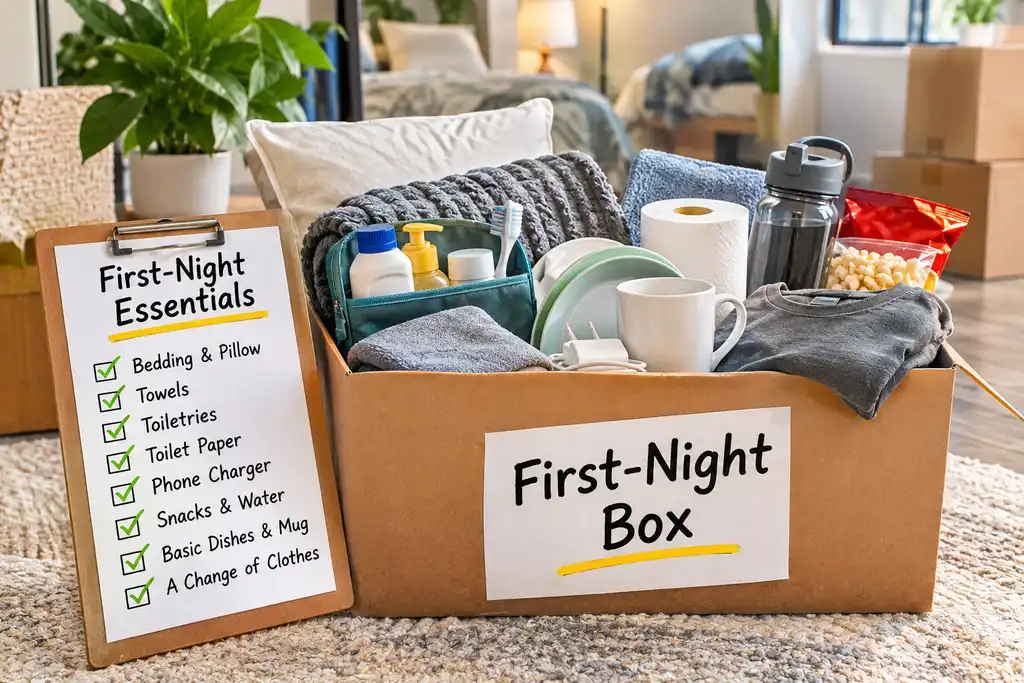
- Sheets, a pillow, and a blanket
- Toilet paper, hand soap, and a towel
- Phone charger and laptop charger
- Toothbrush, toothpaste, deodorant, and basic toiletries
- A change of clothes for the next day
- Snacks and a bottle of water
- A box cutter or scissors, so you can open the rest of your boxes
- One mug, one plate, one fork, and one spoon
Before you move in
Do these four admin jobs before move-in day. If you skip them, your first week will be harder than it needs to be.
- Set up utilities at least a week ahead. Electricity, gas, water if it is not included, and internet all need to be transferred or activated in your name. Internet especially needs 5 to 10 days of lead time, or your first weekend will have no WiFi.
- Get renters insurance. A policy runs about 12 to 25 dollars a month, according to 101Planners. It covers your belongings against theft, fire, and water damage, plus liability if someone gets hurt in your apartment. Many landlords now require it.
- Change your address. USPS mail forwarding has about a 1.10 dollar verification fee. Update your bank, employer, driver license, voter registration, credit cards, and subscriptions in one sitting.
- Do a move-in walkthrough. Photograph every existing scratch, stain, and dent with timestamped photos before a single box comes in. This protects your security deposit when you move out.
How much to budget
101Planners puts a realistic budget for a first apartment, buying mostly new but smart, at 800 to 1,500 dollars if you are solo. For a couple, the range is 1,200 to 2,000 dollars. Add another 200 to 500 dollars for moving costs like a truck rental or movers, boxes, and supplies. Buying second-hand can cut the essentials budget by 30 to 50 percent.
Spend on these:
- Mattress. You sleep on it every night for years.
- Office chair if you work from home. Your back will thank you.
- A good non-stick pan and a chef knife. Cheap versions will frustrate you daily.
Save on these:
- Furniture. Facebook Marketplace, Craigslist, Buy Nothing groups, and thrift stores are full of barely used couches from people who bought one too quickly.
- Plates, glasses, and silverware. Thrift stores have these for almost nothing.
- Decor. Wait until you have lived there a month before buying anything.
- Small appliances. Start with one, a microwave or a toaster oven, and add the rest as you actually need them.
5 mistakes that cost first-time renters money
- Buying a couch before measuring the door. Measure doorways, hallway turns, and the elevator first. Couches get returned because they do not fit through the front door.
- Furnishing the whole apartment in week one. Live in it for two weeks first. You will learn that you need a hamper in the bathroom, not the bedroom, and that the lamp goes on the other side.
- Buying two of everything with a roommate. Coordinate before you shop. Nothing wastes money like two of you buying vacuums.
- Skipping the move-in walkthrough. Photograph every mark before you move in, or you will pay for damage you did not cause when you move out.
- Buying a 12-piece cookware set. One pan, one pot, and one knife are enough to start. Add pieces only when you use them enough to earn the space.
Frequently asked questions
What do I need for my first apartment?
The non-negotiables are a place to sleep, a way to cook a basic meal, and a way to keep clean. You also need a way to clean the apartment and active utilities. That means a mattress and bedding, one pan, one pot, a knife, and a few plates. It also means a shower curtain, towels, toilet paper, and cleaning supplies.
How much money should I save before moving into my first apartment?
Beyond the first month rent and the security deposit, plan for 800 to 1,500 dollars in essentials if you are solo. For a couple, plan for 1,200 to 2,000 dollars, according to 101Planners. Add another 200 to 500 dollars for moving costs. Buying second-hand can cut the essentials budget by 30 to 50 percent.
What is a first-night box?
A first-night box is a single box you carry in by hand on move-in day, not on the truck. It holds what you need to sleep, shower, eat, and charge your phone on the first night. Inside are sheets, a pillow, toiletries, toilet paper, a charger, a change of clothes, snacks, a mug and a fork, and a box cutter.
What should I buy first for a new apartment?
Buy in this order: bed and bedding, shower curtain and toilet paper, and basic cookware and a few dishes. Then get cleaning supplies, somewhere to sit, and everything else. Most people buy in the reverse order and end up sleeping on a bare floor with a beautiful couch.
Do I really need renters insurance?
Yes. It costs about 12 to 25 dollars a month, according to 101Planners, and covers theft, fire, water damage, and liability. Replacing the contents of even a small apartment out of pocket is a five-figure expense. Many landlords now require it as a condition of the lease.
Can I use this checklist for a college apartment or dorm?
Yes. If you are moving into a college apartment or a dorm, use the same list and skip what does not apply. A studio or a one-bedroom setup fits a college budget best. Skip the office section if you do not have a workspace, and skip the full kitchen set if you share a kitchen.
Final thoughts
Your first apartment does not need to be finished on day one. It needs to be livable. Start with the bed, the shower curtain, and a pan you can cook in. Add the rest over the first two weeks, after you have lived in the place and know what is actually missing.
Keep a gaps list in your phone, and every time you reach for something that is not there, add it. After two weeks, you have a perfect shopping list with no guessing. Save this first apartment checklist to Pinterest so you can find it again on move-in day.

Isla Morgan
Isla Morgan writes travel, lifestyle, and fashion pieces with a warm and practical style. She looks past the surface of a place or topic to find the points that truly help. Isla also covers leisure, with clear notes on what to expect and what to plan. Her pieces read like friendly advice, built to make a trip or a choice feel simpler.
View all articles →Get the Weekly Brief
The best guides and stories, delivered every Sunday.