
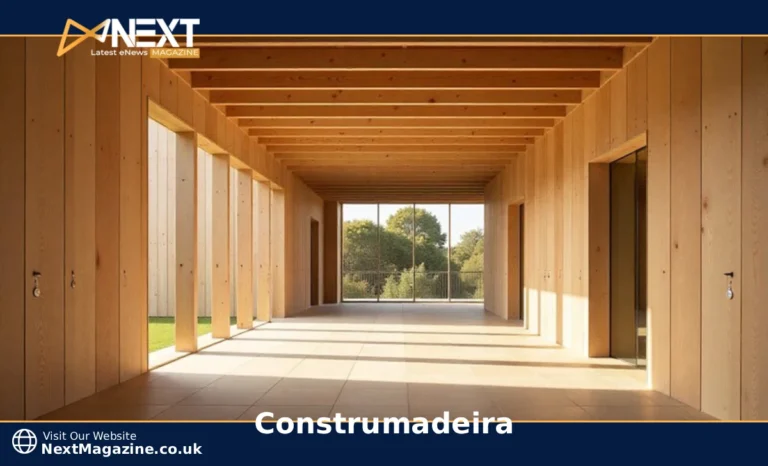
Construmadeira refers to buildings made with engineered wood systems, such as CLT and Wood Frame. It offers 30-50% faster construction, competitive costs between € 800 and € 1,200/m², excellent thermal insulation, and proven sustainability, making it increasingly popular in Portugal and globally.
What is Construmadeira and Why It’s Growing
Construmadeira designates the process of building structures using wood as the primary structural material. This isn’t about old-fashioned rustic wooden houses. Modern systems use engineered wood—industrially manufactured products with superior strength compared to solid timber.
This sector’s growth in Portugal accelerates for three concrete reasons. First, the Recovery and Resilience Plan finances new production units for wood derivatives. Second, labor shortages in traditional construction force the market toward prefabricated alternatives. Third, increasingly strict environmental regulations favor materials with lower carbon footprints.
Industry data shows approximately 90% of homes in Nordic countries use wood as their primary structure. Portugal begins following this trend, with several companies investing in automated lines for wall and floor production.
Wood Construction Systems: CLT vs Wood Frame
CLT (Cross Laminated Timber): High-Strength Panels
CLT means cross-laminated timber—solid panels formed by wood layers glued perpendicularly. Each layer has fibers oriented 90 degrees from the previous one, generating structural rigidity comparable to reinforced concrete.
A typical CLT panel has 3 to 7 layers, with thicknesses between 51 and 297 mm. It can reach up to 14.8 meters in length and 4.8 meters in width. These dimensions allow building entire walls, slabs, or roofs with a single prefabricated element.
Use CLT when you need:
- Multi-story buildings (up to 5-8 floors)
- Free spans exceeding 6 meters
- High loads (commercial, industrial buildings)
- Smooth surfaces without visible framing
CLT costs more per square meter (€150-250/m² for material alone), but reduces construction time and requires less specialized labor.
Wood Frame: Light and Fast Construction
Wood Frame consists of a structure of vertical wood profiles (studs) spaced 40-60 cm apart, covered with OSB or plywood panels. The space between studs receives thermal and acoustic insulation.
This system is divided into two main types:
- Light Wood Frame: for homes up to 2-3 floors, using smaller section timber
- Platform Frame: Each floor serves as a platform to build the next
Use a Wood Frame when you need:
- Single-family homes or small buildings
- More controlled budget (€90-150/m² structure)
- Flexibility for future modifications
- Construction in difficult-access areas (lighter panels)
Wood Frame allows greater freedom in positioning electrical and plumbing installations, as cables pass easily between studs.
Advantages and Disadvantages of Wood Construction
Proven advantages:
Construction speed reduces by 30-50% compared to traditional construction. A 150m² Wood Frame project can be enclosed in 3-4 weeks after the foundation. CLT allows erecting a 4-story building structure in 2-3 months.
Superior thermal insulation results in 40-60% energy savings. Wood has thermal conductivity 15 times lower than concrete. A Wood Frame wall with 20 cm of insulation achieves U-values of 0.15-0.20 W/m²K.
Measurable sustainability: each cubic meter of wood sequesters approximately 1 ton of CO₂. Replacing concrete with wood in a 100m² home avoids emitting 20-30 tons of CO₂.
Reduced weight facilitates construction on terrain with low load capacity. A wood structure weighs 5-7 times less than concrete, reducing foundation costs.
Real disadvantages:
Wrong perception about fire resistance persists, despite tests proving that solid wood burns slowly (0.7 mm/minute) and maintains structural capacity longer than unprotected steel.
Moisture protection requires attention during construction and maintenance. Wood exposed to humidity above 20% for prolonged periods develops fungi. A well-executed waterproof barrier solves this problem.
Initial costs can be 5-15% higher than traditional construction in Portugal, depending on the region. The difference compensates in 7-12 years through energy savings.
Availability of qualified labor remains limited. Few technicians master modern wood systems, which can delay projects.
Real Costs: How Much Does Building with Wood Cost
Costs vary according to the chosen system and finish level.
Wood Frame (turnkey):
- Basic: €800-1,000/m²
- Medium: €1,000-1,200/m²
- High: €1,200-1,500/m²
CLT (structure only):
- Material: €150-250/m²
- Assembly: €50-80/m²
- Total structural: €200-330/m²
Comparison with traditional construction: A 120m² house in Wood Frame costs €96,000-144,000. The same house in traditional construction costs €102,000-156,000. The difference reduces when considering future energy savings.
Construction timelines influence total costs. Wood Frame allows occupation 2-3 months earlier, reducing costs with temporary rental or construction credit.
Durability and Protection: Fire, Moisture, and Maintenance
Fire resistance:
Solid wood exceeding 80 mm thickness resists fire better than unprotected metal structures. Surface carbonization creates an insulating layer that protects the core. CLT panels achieve REI 60 ratings (resistance, integrity, and insulation for 60 minutes).
Fire-retardant treatments applied at the factory increase resistance. Wood treated with borate salts withstands direct flame exposure for prolonged periods.
Moisture protection:
The key lies in the continuous waterproof barrier. Use membranes with vapor permeability exceeding 1,000 g/m²/24h on the exterior and a vapor barrier on the interior. This combination allows the wall to “breathe” while blocking liquid water.
Keep wood at least 30 cm from the ground. The splash zone is critical—use water-resistant baseboards or fiber cement panels in this area.
Inspect joints and seals annually. Small infiltrations caught early prevent major damage. A well-maintained wood structure easily lasts 100+ years.
Maintenance schedule:
Years 1-5: Visual inspection every 6 months, checking for cracks or moisture stains. Years 5-10: Reapply exterior protective treatments (stains, varnishes). Years 10+: Check structural connections, replace damaged elements if necessary.
Total maintenance costs represent 0.5-1% of construction value annually, similar to or lower than traditional construction.
Wood Species Used in Portugal: Pine, Eucalyptus, and Others
Pine (Pinus pinaster and Pinus sylvestris):
Dominates the market due to its wide availability and cost. Maritime pine represents 70% of the Portuguese forest area. It offers a good strength-to-weight ratio and accepts pressure treatment well.
Structural classification: C18-C24 (strength classes according to EN 338). Average cost: €350-450/m³ for structural grade.
Eucalyptus (Eucalyptus globulus):
Gaining traction for engineered products. Higher density than pine (700 kg/m³ vs 500 kg/m³) provides superior strength. Portuguese research institutes develop specific applications for eucalyptus in CLT production.
Challenges include higher shrinkage rates and processing difficulty. Price premium of 20-30% over pine limits widespread adoption.
Imported species:
Spruce (Norway spruce): preferred for high-grade CLT panels, imported from Central Europe. Douglas fir: excellent natural durability, used for exterior applications. Larch: high natural resin content provides rot resistance without treatment.
Certification matters:
Choose FSC (Forest Stewardship Council) or PEFC (Programme for the Endorsement of Forest Certification) certified wood. These certifications guarantee sustainable forest management and legal harvesting.
Portuguese pine with FSC certification costs €30-50/m³ more but provides traceability and environmental credentials.
Standards and Certifications: What You Need to Know
Building codes:
Portuguese construction follows Eurocodes, specifically:
- EN 1995 (Eurocode 5): Design of timber structures
- EN 14081: Structural timber strength classification
- EN 16351: CLT performance requirements
Your project requires structural calculations by a certified engineer. Plans must demonstrate compliance with load requirements, fire safety, and seismic resistance.
Fire classification:
Buildings must achieve minimum fire ratings based on height and occupancy:
- Single-family homes: REI 30 (30-minute resistance)
- Multi-family buildings: REI 60
- Commercial buildings: REI 90
CLT and glulam easily meet these requirements without additional protection. Wood Frame typically needs gypsum board layers for fire rating.
Energy performance:
All new buildings must achieve minimum energy efficiency. Wood construction naturally excels here, often reaching A or A+ ratings without extraordinary measures.
Required U-values for Portugal (climate zones):
- Exterior walls: 0.35-0.50 W/m²K
- Roofs: 0.30-0.40 W/m²K
- Floors: 0.40-0.50 W/m²K
Wood Frame with standard insulation surpasses these requirements by 40-60%.
Quality control:
Factory-produced elements undergo rigorous testing:
- Moisture content: maintained at 12-16%
- Dimensional tolerances: ±2-3 mm
- Visual grading: knots, splits, and defects classified
Demand quality certificates from your supplier. Reputable manufacturers provide test reports and material traceability.
Is Building with Wood Worth It? When to Choose This System
Wood construction makes sense in specific scenarios. Evaluate your priorities against these criteria.
Choose wood when:
You prioritize construction speed. Projects with tight timelines benefit from prefabrication and rapid assembly. A wood structure can be weather-tight in weeks rather than months.
Energy efficiency matters long-term. If you plan to own the property for 10+ years, superior insulation pays dividends through reduced heating and cooling costs.
The site presents access challenges. Lighter materials reduce foundation requirements and simplify logistics in remote or steep locations.
You value environmental impact. Wood is the only major construction material that stores carbon rather than emitting it during production.
Stick with traditional when:
Local regulations create barriers. Some municipalities maintain outdated codes that complicate wood construction permitting.
You lack access to qualified builders. A poorly executed wood project performs worse than mediocre traditional construction.
Your budget is extremely tight short term. The 5-15% cost premium may exceed available financing, despite long-term savings.
Making the decision:
Request quotes for both systems. Compare not just initial costs but total ownership costs over 20 years, including energy, maintenance, and potential resale value.
Visit completed projects. Seeing and feeling a finished wood structure helps overcome misconceptions about quality and durability.
Consult multiple builders. Wood construction expertise varies widely. Interview at least three contractors with proven portfolios in your chosen system.
Calculate your break-even point. If energy savings are €150/month and the wood premium is €18,000, you break even in 10 years—acceptable for most homeowners.
Wood construction in Portugal moves from niche to mainstream. Early adopters gain advantages in cost, quality, and sustainability. The technology proves itself globally, with thousands of successful projects demonstrating performance and longevity.
Your decision should weigh concrete factors: budget, timeline, energy goals, and available expertise. Wood offers compelling benefits for those whose priorities align with its strengths.
