
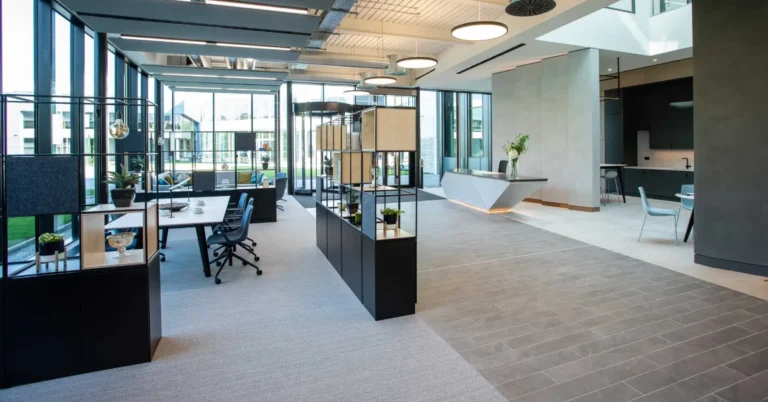
Most office redesigns start with the same questions: how many desks, where the meeting rooms go, how much natural light the space gets. Very few start with a question that matters just as much: who can see what’s on those screens, and what happens to the data that flows through the room every day?
For small businesses, that question is no longer optional. The UK government’s Cyber Security Breaches Survey 2025/2026 found that 43% of businesses identified a breach or attack in the previous twelve months, around 612,000 organisations. Hybrid working has spread the risk further, from the office floor to kitchen tables and train carriages.
This guide covers the layout, network and access decisions that protect information, without making the workplace any less pleasant to work in.
Why the office itself is part of the security risk
A functional, well-designed workspace is usually judged on comfort and collaboration. But every physical choice also shapes how information moves: an open-plan layout puts screens in view of visitors, a shared printer collects forgotten documents, and a smart TV in the meeting room is another device connected to your network.
Smaller firms are not exempt. The same survey found that 42% of micro businesses and 46% of small businesses reported a breach, and the UK’s National Cyber Security Centre publishes a dedicated guide because most attacks on small organisations rely on basic weaknesses rather than sophisticated techniques.
Secure office design starts with the floor plan
Many data leaks are low-tech. Someone reads a screen over a shoulder, picks up a printout or walks into an area they shouldn’t. Layout decisions can close most of these gaps:
- Screen placement: position monitors so they face away from windows, walkways and reception. Where that’s not possible, privacy filters limit what can be read from an angle.
- Reception and visitor flow: visitors should pass through a staffed or controlled entry point and not walk unaccompanied past desks handling client or payroll data.
- Meeting rooms: glass walls look good but expose whiteboards and presentations. Frosted film at eye level keeps the light while protecting the content.
- Printers: place shared printers away from public areas and use secure-release printing, so documents only print when the employee is standing at the machine.
- Storage: provide lockable drawers or lockers and a confidential waste bin or shredder, which makes a clean desk policy easy to follow rather than a rule people ignore.
Separating networks and managing connected devices
Guests, contractors and smart devices should never share the network that holds your files. A separate guest Wi-Fi network is inexpensive to set up and keeps visitors’ laptops and phones away from company systems. Connected equipment such as meeting-room screens, smart speakers, door entry systems and printers should sit on their own segment too, because these devices are rarely updated and often ship with default passwords.
Laptops, tablets and phones used for work need the same attention. Each one should be kept up to date with security patches, have its storage encrypted, and be enrolled in a device management system that lets you lock or wipe it remotely if it is lost or stolen.
Controlling who can access what
Weak and reused passwords remain one of the easiest ways into a business. A business password manager such as Proton Pass for Business generates a unique, complex password for every account and lets teams share access to tools without passing credentials around in emails or chat messages. When someone leaves, their access can be removed in one place instead of chasing every individual login.
Pair the password manager with two-factor authentication on email, cloud storage and finance systems. Adaptive access policies add a further layer by challenging or blocking logins that come from an unfamiliar location or an out-of-date device.
Extending protection to home offices
For hybrid teams, the office boundary now includes every employee’s home. Staff should work on company-managed devices rather than shared family computers, change the default password on their home router, and lock their screen whenever they step away, especially when working in cafés or on public transport. Short written guidance at onboarding is usually more effective than a long policy document nobody reads.
Building habits and planning for incidents
Phishing emails are the most common starting point for an attack, so automated email filtering should screen messages and attachments before they reach inboxes. Regular short training, such as recognising a fake invoice or a spoofed login page, covers what filters miss.
Planning for the worst matters too. Among businesses that suffered a breach in the latest government survey, only a quarter had a formal incident response plan. A simple plan should set out who to contact, how to isolate affected devices and when to involve your IT provider. If personal data is affected, UK GDPR may require you to report the breach to the Information Commissioner’s Office within 72 hours of becoming aware of it.
For a structured starting point, Cyber Essentials, the government-backed certification scheme run by the NCSC, covers the core technical controls every small business should have in place. Some public sector contracts also require it.
Conclusion
Think of the last time you walked through your office. You probably noticed the furniture, the lighting and the noise level, but not which screens faced the corridor or which devices sat on the main network. Secure office design means noticing those details before an attacker does. Plan the layout so information stays out of sight, keep guests and smart devices on their own network, control access centrally and give your team a clear plan for when something goes wrong. The result is a workspace people enjoy using, built on foundations that don’t need rethinking after the first incident.
