


Table of Contents
- Who Are the Orsinis?
- Does the Orsini Family Still Exist Today?
- What Is the Orsini Family’s Net Worth, Really?
- Where the Wealth Historically Came From
- What Sustains the Family Today
- What is Domenico Orsini’s Net Worth?
- How Powerful Is the Orsini Family?
- – The Church
- – Rome’s civic government
- – Military command
- – Territory
- Where is The Orsini Family Today?
- FAQs
- What is the Orsini family’s current net worth?
- How did the Orsini family build their wealth?
- How many popes came from the Orsini family?
- Who is the current head (leader) of the Orsini family?
- Does the Orsini family still exist today?
- Is the “pest control” or “Orkin” connection to the Orsini family real?
- Can the public visit Orsini family properties?
The Orsini name still carries real weight in Italian noble history — a family whose lineage stretches back over a thousand years, whose members shaped the Papal States, and whose castles still stand across Lazio and Tuscany today. But when people search for the “Orsini family net worth,” they’re usually looking for a single number.
The honest answer is: no one outside the family actually knows it, and any figure you see online — including in this article — is an estimate, not a disclosed fact.
Who Are the Orsinis?
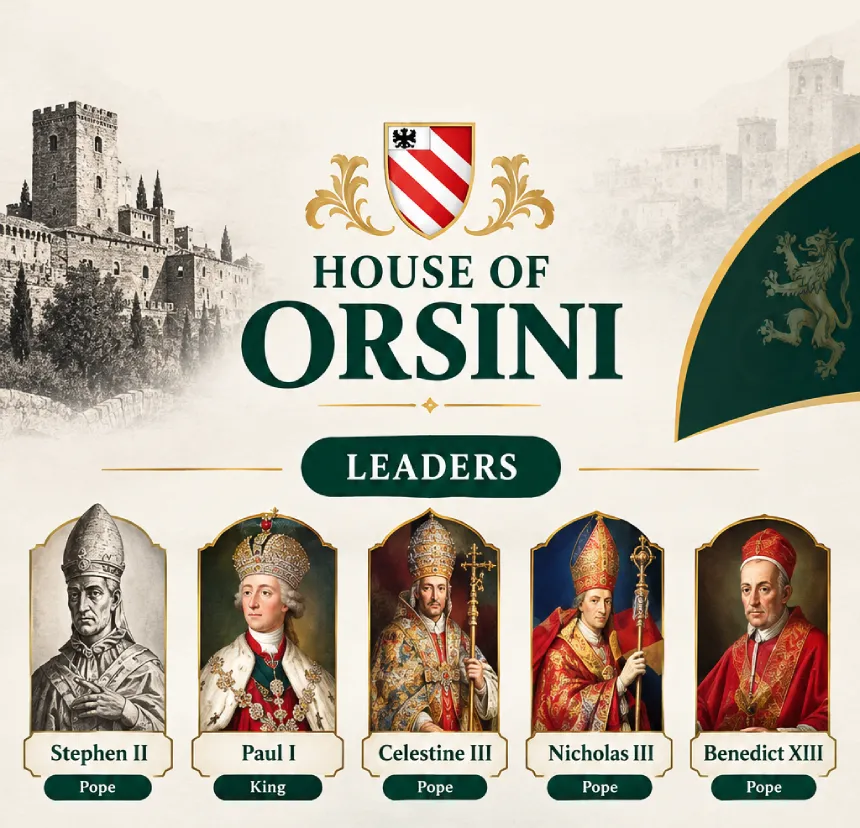
The Orsini family is a prominent Italian noble family descending from Cajo Orso Orsini, who lived around 600 AD. Over the centuries they became one of the most influential princely families in medieval Italy and Renaissance Rome, producing five popes — Stephen II (752–757), Paul I (757–767), Celestine III (1191–1198), Nicholas III (1277–1280), and Benedict XIII (1724–1730) — along with 34 cardinals, numerous condottieri (military commanders), and 62 senators of Rome.
The family belonged to what’s historically known as the “Black Nobility” — Roman aristocratic families who supported the papacy in governing the Papal States.
They held territories and titles across central and southern Italy for centuries, including the duchies of Bracciano and Gravina, and were embroiled in a famous, generations-long rivalry with the Colonna family that Rome’s papal authorities only formally ended by decree in 1511.
Does the Orsini Family Still Exist Today?
Yes. The House of Orsini still exists as a family today, though its territorial power ended centuries ago. Most of the historic Orsini titles and fiefs — Bracciano, Monterotondo, Pitigliano — were sold off, confiscated, or absorbed into other families’ holdings between the 16th and 19th centuries. The one surviving princely line is the Gravina line, currently headed by Prince Domenico Napoleone Orsini, Duke of Gravina. The family no longer holds political or territorial power, but it continues as a recognized noble lineage, with living descendants, a defined line of succession, and historic properties and archives still associated with its name.
| Detail | Information |
|---|---|
| Net Worth | Not publicly disclosed; third-party estimates vary widely (see below) |
| Founded | c. 600 AD |
| Origin | Rome, Italy |
| Notable Members | 5 popes, 34 cardinals, 62 Roman senators |
| Current Head | Prince Domenico Napoleone Orsini, Duke of Gravina (b. 1948) |
| Family Motto | Senza rimproveri (“Without reproach”) |
| Home Region | Primarily Lazio and Tuscany, Italy |
What Is the Orsini Family’s Net Worth, Really?
This is the part where most articles about the Orsini family — this one included, in an earlier draft — get ahead of the facts. There is no verified, publicly disclosed net worth figure for the Orsini family. It’s a private family, not a public company, and it doesn’t file the kind of financial disclosures that would let anyone calculate an accurate number.
That hasn’t stopped estimates from circulating, and they vary enormously depending on the source:
- Some sources put a combined family fortune in the $1.2–3.5 billion range
- Others estimate more conservatively, around €300–500 million
- Some older pop-culture pieces have cited figures as high as $14+ billion
The fact that credible-sounding sources disagree by a factor of ten or more is itself the story: these are guesses built on property valuations and historical reputation, not real accounting. Any specific number should be treated with real skepticism. (One thing worth flagging directly: some viral content online claims the Orsini fortune comes from “the pest control industry via Orkin.” This has no factual basis — Orkin is an unrelated American company founded by Otto Orkin in the 20th century — and shouldn’t be repeated as fact.)
Where the Wealth Historically Came From
The Orsini family’s wealth was built the way most old European noble fortunes were: through feudal landholding, strategic marriage alliances, and political and religious office.
- Feudal territories: Over centuries, the family acquired major fiefs including Bracciano, Gravina, Pitigliano, and Monterotondo, each generating income through rents and agricultural output.
- Strategic marriages: Alliances with other powerful families — including the Medici, Farnese, and Sforza — reinforced both wealth and political standing. Clarice Orsini’s 1469 marriage to Lorenzo de’ Medici is among the best known.
- Church and political office: With five popes and dozens of cardinals in the family’s history, the Orsinis benefited directly from ecclesiastical patronage, papal appointments, and the granting of fiefs and titles.
- Property management tools: The family used legal-administrative instruments like emphyteusis (long-term leasehold) to manage their lands and secure income across generations.
They also built and held significant properties, including Orsini castles at Bracciano, Nerola, Pitigliano, Avezzano, and Sorano, plus palazzi in Rome and Naples. The family’s historical archives — genealogical records, legal documents, correspondence — are now held at UCLA.
What Sustains the Family Today
While there’s no reliable breakdown of current Orsini finances, the general pattern that has kept many old Italian noble families financially active into the 21st century — including, plausibly, the Orsinis — tends to involve:
- Heritage tourism and event rentals at historic properties (many Italian noble castles now host tours, weddings, and film shoots)
- Agricultural land use, including vineyards and olive groves
- Preservation-linked tax incentives that Italy offers for maintaining historically significant buildings
This is a reasonable general picture of how families like this typically generate income, not a confirmed account of Orsini finances specifically — no verified source ties these activities to Orsini revenue figures.
What is Domenico Orsini’s Net Worth?
People searching specifically for “Domenico Orsini net worth” are usually asking about Prince Domenico Napoleone Orsini, the current Duke of Gravina and head of the family, born in 1948. As with the wider family fortune, his individual net worth has never been publicly disclosed, and no credible financial filing or verified source puts a figure on it.
| Detail | Information |
|---|---|
| Full name | Don Domenico Napoleone Orsini |
| Titles | 22nd Duke of Gravina, 13th Prince of Solofra, 12th Prince of Vallata, 9th Prince of Roccagorga; Head of the House of Orsini |
| Born | 1948 |
| Parents | Don Filippo Orsini (1920–1984), 21st Duke of Gravina; Francesca Romana Bonacossi (1926–2014) |
| Wife | Martine Bernheim — married 1977 in Rome; daughter of banker Antoine Bernheim |
| Net worth | Not publicly disclosed |
| Heir | Don Benedetto Orsini (brother, b. 1956) |
| Family lineage | House of Orsini, founded c. 600 AD |
Domenico is the son of Don Filippo Orsini, who himself served as Prince Assistant to the Papal Throne from 1950 to 1958 — a reminder that the family’s remaining currency is ceremonial and historical rather than financial. In 1977 he married Martine Bernheim, daughter of banker Antoine Bernheim, in Rome. He has no sons, so the dukedom passes next to his brother Benedetto, and then to their cousin’s line.
The most concrete verifiable asset fact about him: in 2012 he bought back part of the Palazzo Orsini-Savelli in Rome — the historic palace built over the ancient Theatre of Marcellus, on Monte Savello (Italian Wikipedia). No purchase price was publicly recorded, but it confirms he personally had the means for a significant Rome property transaction that year — and that the family is, in small ways, reacquiring pieces of its historic footprint rather than merely inheriting them.
Beyond his title and lineage, there’s no public record — no company filings, no disclosed estate valuation, no interview confirming a figure — that would support any specific net worth number attributed to him personally. Any number you see online for “Domenico Orsini net worth” specifically is an unverified estimate, not a sourced fact.
How Powerful Is the Orsini Family?
At their historical peak — from the 13th through the 16th century — the Orsinis were among the most powerful families in Italy, rivaling ruling dynasties like the Medici and Colonna. Their power came from several overlapping sources:
– The Church
Five family members became pope, and 34 became cardinals — giving the family direct influence over papal appointments, Church land grants, and the governance of the Papal States for generations.
– Rome’s civic government
Orsini family members served as Senator of Rome — the city’s highest civic office — at least three times across different generations, and 62 senators of Rome came from the family overall.
– Military command
Several Orsinis served as condottieri — mercenary military commanders — commanding armies for the Papal States, Naples, Florence, and Venice at various points.
– Territory
At their height, they controlled a network of duchies, counties, and fortified towns stretching from Lazio into southern Italy, including Bracciano, Gravina, Pitigliano, and Tagliacozzo.
That said, “powerful” today looks very different from “powerful” in the 1400s. The family’s political and military influence effectively ended by the 19th century, as fiefs were sold, confiscated, or lost to debt. What remains today is historical and cultural influence — the Orsini name still carries weight in Italian noble circles and in discussions of Vatican and Roman history — rather than any active political or economic power.
Where is The Orsini Family Today?
The current head of the family is Prince Domenico Napoleone Orsini, Duke of Gravina, born in 1948. He has no sons or male-line descendants; the heir to the dukedom is his brother, Don Benedetto Orsini (b. 1956), followed by their cousin, Prince Lelio Orsini d’Aragona (b. 1981).
Like many centuries-old noble families, the Orsinis faced real setbacks. The 19th century brought financial strain and legal disputes with creditors that affected the family’s position. Earlier, in the 15th and 16th centuries, individual branches lost fiefs through confiscation, political fallout, and unpaid debts — the Bracciano line, for instance, was eventually forced to sell its dukedom to the Odescalchi family in 1696 due to accumulated debt.
FAQs
What is the Orsini family’s current net worth?
Not publicly known. Estimates in circulation range from a few hundred million to several billion dollars, but none are backed by disclosed financial records.
How did the Orsini family build their wealth?
Primarily through feudal landholding, strategic marriages into other powerful families, and the family’s extensive presence in the Catholic Church hierarchy, including five popes and 34 cardinals.
How many popes came from the Orsini family?
Five: Stephen II, Paul I, Celestine III, Nicholas III, and Benedict XIII.
Who is the current head (leader) of the Orsini family?
Prince Domenico Napoleone Orsini, Duke of Gravina, born in 1948, is the current head — sometimes referred to as the “leader” — of the House of Orsini.
Does the Orsini family still exist today?
Yes. The main surviving line, headed by Prince Domenico Napoleone Orsini, continues as a recognized noble family, though without the political or territorial power it once held.
Is the “pest control” or “Orkin” connection to the Orsini family real?
No. This claim has circulated online but has no credible source behind it and appears to be a mix-up or fabrication.
Can the public visit Orsini family properties?
Some historic Orsini castles and palazzi are open for tours or events, though ownership and public access vary by property.

Daniel Ryan
Daniel covers celebrity and entertainment for readers who want more than a headline — the career path, the context, the parts that don't fit in a caption. He digs past the obvious angle on a person's story and pieces together something with real shape. His writing favors depth over speed, even on fast-moving topics.
View all articles →Get the Weekly Brief
The best guides and stories, delivered every Sunday.