

Table of Contents
- What Was Paul Hornung’s Net Worth at Death?
- The Golden Boy Years
- Five Championships and a 176-Point Season
- The 1963 Suspension
- Money in the 1960s
- Personal Life
- FAQs
- What was Paul Hornung’s net worth at the time of his death?
- How many championships did Paul Hornung win?
- Why was Paul Hornung suspended in 1963?
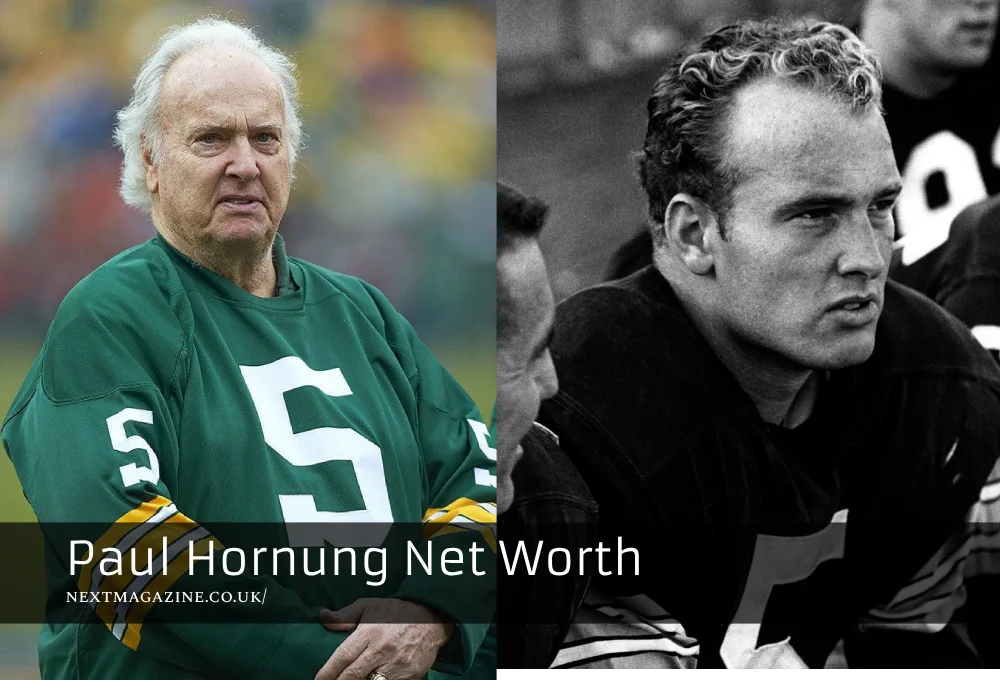
In 1960, Paul Hornung scored 176 points in a 12-game NFL season — 13 rushing touchdowns, two more receiving, two thrown as a passer, 15 field goals and 41 extra points kicked. The record stood for decades. He was the Golden Boy of the Green Bay Packers, the most versatile player of Vince Lombardi’s dynasty, and an athlete whose fame, in its day, was enormous.
His money was not. Paul Hornung’s net worth at his death in 2020 was an estimated $1–3 million. That figure needs stating plainly, because an earlier version of this article claimed $103 million — a number that appears to be a mangled rendering of “$1–3 million” and is wrong by a factor of fifty. Let that sink in: the old figure wasn’t a rounding disagreement. It was a typo that became a fact.
What Was Paul Hornung’s Net Worth at Death?
The tracker consensus is consistent and narrow:
- $1.5–3 million — floodyjournal.com
- $2 million — aboutnetworth.org
- $1–2 million — collegenetworth.com
- $1.4 million — widely repeated tracker figure
The honest estimate: roughly $1–3 million, held at the time of his death on November 13, 2020. An earlier version of this page also claimed his wealth was “$103 million at death, approximately $8 million adjusted for inflation in 2024” — the inflation arithmetic was reversed (inflation increases nominal figures, it doesn’t shrink them), and the base number was the error above. Both claims have been removed. There is no inflation adjustment to make: at-death is at-death.
The modest figure isn’t a contradiction of his fame. It’s a consequence of when he played.
The Golden Boy Years
Born Paul Vernon Hornung on December 23, 1935, in Louisville, Kentucky, he starred at Flaget High School and played for Notre Dame from 1953 to 1956 as a halfback, quarterback, and kicker. In 1956 he won the Heisman Trophy. The Green Bay Packers took him first overall in the 1957 NFL draft.
Under Vince Lombardi, Hornung became the engine of the Packers’ dominance: a runner who could also pass and kick, which made him the most dangerous multi-threat player of his era. In 1961 he was named the Associated Press NFL Most Valuable Player. In 1986 he entered the Pro Football Hall of Fame.
Five Championships and a 176-Point Season
Between 1959 and 1966, Hornung’s Packers won four NFL championship games (1961, 1962, 1965, 1966) plus Super Bowl I in January 1967 — five titles in all. He led the league in scoring for three straight seasons from 1959 to 1961.
The peak was 1960: 176 points in 12 games, a single-season record that stood for decades. No modern player needed to be told how remarkable that was — but the money attached to it would be unrecognizable today. Hornung’s playing salary never topped $50,000 in a season. The $50-million-a-year quarterbacks of the modern era play a different sport financially. That $50,000 ceiling is the single most important fact for understanding his net worth: the wealth was built after football, not during it.
The 1963 Suspension
In 1963, Hornung was suspended for the entire season for betting on football games. It was the most serious controversy of his career — a genuine threat to his legacy. He served the suspension, returned, and played through 1966. The episode is part of the record, not a footnote, and his wealth story includes it: a lost season of prime earnings in an era when there was no guaranteed money to fall back on.
Money in the 1960s
Hornung’s primary income during his playing days was his NFL salary, supplemented by endorsements that his Golden Boy image attracted. After retirement, he worked as a sports broadcaster for TBS, CBS, and ABC, and on the Minnesota Vikings radio network — steady professional income for a former star.
He is also reported to have invested in a vegetable and soy oil company, restaurants, and real estate. These ventures are claimed by multiple biographical sources but lack primary documentation, so treat them as reported rather than proven. What is clear is that his post-football decades — broadcasting fees, endorsements, and investments — did the slow work of building a $1–3 million estate from a playing career that paid $50,000 a year.
Personal Life
Hornung married Patricia Roeder in January 1967; the marriage ended in divorce in 1979. Later that year he married Angela Cervilli, and they remained together until his death. He had no children.
In his later years he suffered from dementia, which he attributed to the repetitive head trauma of his football career. He died on November 13, 2020, in his hometown of Louisville, Kentucky, at 84, of complications from dementia.
FAQs
What was Paul Hornung’s net worth at the time of his death?
An estimated $1–3 million, per the consensus of wealth trackers. An older $103 million figure published on this page was an error and has been corrected.
How many championships did Paul Hornung win?
Five: four NFL championship games (1961, 1962, 1965, 1966) and Super Bowl I. He also won the 1956 Heisman Trophy and the 1961 NFL MVP award.
Why was Paul Hornung suspended in 1963?
He was suspended for the entire 1963 season for betting on NFL games — the defining controversy of his career.
Net-worth figures are modeled estimates based on public information, not audited financial statements. For a subject who died in 2020, the figure represents an at-death estimate and should be treated as approximate.

Samuel Clarke
Samuel covers finance, business, and property, centering his writing on the details that actually explain a topic. He gives readers context, plain definitions, and practical information in a format that's easy to follow from start to finish. Substance over style, every time.
View all articles →Get the Weekly Brief
The best guides and stories, delivered every Sunday.