

Table of Contents
- What Does Pentachronism Mean?
- The Five Time Dimensions of Pentachronism
- Dimension 1 — Past: Reflection and Learning
- Dimension 2 — Present: Immediate Action
- Dimension 3 — Future: Planning and Goals
- Dimension 4 — Cyclical: Patterns and Rhythms
- Dimension 5 — Holistic: Integration and Balance
- How Pentachronism Compares to Established Methods
- A Practical Example: Before and After Pentachronism
- The Honest Case For and Against Pentachronism
- Where It Has Real Value
- Where It Falls Short
- How to Test Pentachronism Without Disrupting Your Current System
- When Pentachronism Is Worth Trying
- When to Skip It
- What Pentachronism Gets Right — Even If the Label Doesn’t Stick
- Conclusion
- FAQs
- What does pentachronism mean in simple terms?
- Is pentachronism backed by research?
- How is pentachronism different from the Eisenhower Matrix?
- Can I use pentachronism alongside GTD or Covey’s system?
- How much time should I spend in each dimension?
- Who benefits most from pentachronism?
- Is pentachronism suitable for teams?
Most time management systems share the same blind spot: they treat time as a straight line. You have tasks. You have deadlines. You move from one to the next.
That model works — until it doesn’t. You keep repeating the same mistakes. Your recurring tasks eat hours you never get back. And somewhere along the way, the work stops feeling connected to anything meaningful.
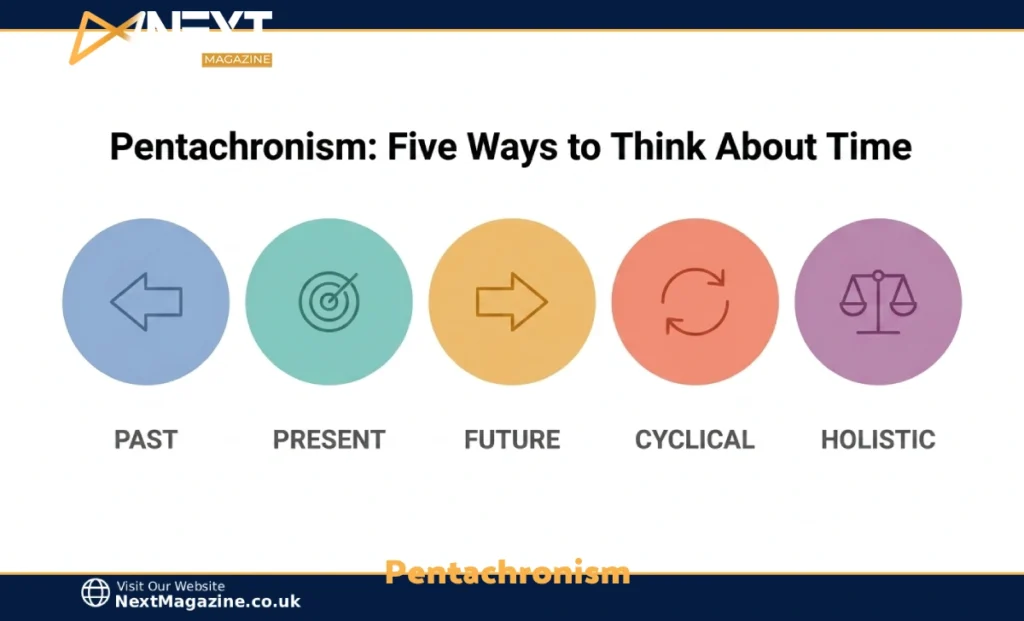
Pentachronism offers a different lens. Rather than plotting tasks on a single timeline, it asks you to view your work through five distinct time dimensions at once. The result is a more complete picture of where your energy is going — and where it should be going.
This guide explains what pentachronism actually means, breaks down each of its five dimensions, compares it to established methods, and gives you a practical way to test it without overhauling your entire workflow.
What Does Pentachronism Mean?
Pentachronism comes from two Greek words: penta (five) and chronos (time). The term describes a productivity framework that expands traditional time thinking — past, present, and future — by adding two more dimensions: cyclical patterns and holistic integration.
The central argument is straightforward. When you only linearly think about time, you miss important context. You react to what’s urgent. You plan for what’s coming. But you rarely stop to learn from what’s already happened, improve the things you repeat every week, or check whether your daily output actually connects to your long-term goals.
Pentachronism adds those missing layers.
It’s worth being honest about where the concept stands: it emerged in online productivity discussions rather than academic research. You won’t find it in peer-reviewed journals or university curricula. That doesn’t mean the ideas are wrong — but it does mean you’re experimenting with a framework that lacks the validation of something like Covey’s Four Quadrants or Getting Things Done.
What it does have is structural logic. Each of its five dimensions maps to something real that most people genuinely neglect.
The Five Time Dimensions of Pentachronism
Dimension 1 — Past: Reflection and Learning
The past dimension is about reviewing completed work with purpose. Not ruminating, but extracting. What patterns show up in your mistakes? Which approaches consistently produce good results? What did last month’s project reveal about how you work?
This is the dimension most people skip entirely. There’s always something more pressing. But without deliberate reflection, you repeat errors you’ve already paid for.
A project manager who spends 30 minutes each Friday reviewing what caused delays in the past three months will eventually stop being surprised by the same bottlenecks.
Dimension 2 — Present: Immediate Action
This is the most familiar dimension. It covers everything demanding your attention right now — emails, meetings, deadlines, urgent fixes.
Most productivity systems are almost entirely built around this dimension. That’s not a criticism; present-tense work is real and non-negotiable. But pentachronism treats it as one layer among five, which prevents it from crowding out the others.
Dimension 3 — Future: Planning and Goals
The future dimension covers work that isn’t urgent today but shapes what tomorrow looks like. Strategic planning, skill development, long-range goal-setting, and preparing for projects that are months away.
Stephen Covey called tasks like these “Quadrant 2” work — important but not urgent. Research on this category consistently shows that people who invest time here experience less stress and better outcomes over time. Pentachronism formalises this as its own dedicated dimension.
Dimension 4 — Cyclical: Patterns and Rhythms
Every recurring task — weekly reports, monthly reviews, seasonal campaigns, onboarding new team members — belongs to this dimension.
The insight here is that repetitive tasks shouldn’t be approached fresh each time. They should be refined, templated, and batched. If you spend two hours every Monday morning assembling the same report from scratch, that’s not a Monday morning problem — it’s a Dimension 4 problem.
This connects to broader thinking about process improvement and knowledge systems. Publications like the Kellogg Innovation Network have long examined how organisations identify and address inefficiency in repeated workflows — the same principle applies at the individual level.
Dimension 5 — Holistic: Integration and Balance
The holistic dimension asks the biggest question: does the work you’re doing connect to the life you want to build?
This isn’t abstract. A marketing director who fills every day with reactive tasks might be highly productive in Dimension 2 while producing almost no Dimension 5 value — because none of those tasks actually move the company toward its stated mission.
The holistic dimension functions as a periodic sanity check. It doesn’t need daily attention, but without it, you can spend years optimising a path that leads somewhere you didn’t intend to go.
How Pentachronism Compares to Established Methods
| Framework | Primary Focus | Core Dimensions | Best For | Limitations |
|---|---|---|---|---|
| Eisenhower Matrix | Urgency + Importance | 2 | Quick daily prioritisation | Ignores learning, patterns, and life context |
| Covey’s Four Quadrants | Urgency + Effectiveness | 2 (with deeper philosophy) | Long-term planning | Limited attention to recurring tasks or past reflection |
| Getting Things Done (GTD) | Capture + Process + Action | Linear flow | Managing high-volume task lists | Doesn’t address holistic purpose or pattern optimisation |
| Pentachronism | Multiple time perspectives | 5 | Complex projects, work-life integration | No peer-reviewed backing; higher cognitive load |
The Eisenhower Matrix is fast. You can categorise any task in under ten seconds. That speed is genuinely valuable when you’re juggling competing demands.
GTD excels at giving you a trusted system to capture and process everything. It’s built for people managing large volumes of inputs across multiple contexts.
Pentachronism sits differently. It doesn’t replace urgency-based thinking — it adds context around it. The three dimensions it brings that others largely ignore (Past, Cyclical, Holistic) address real gaps that many experienced practitioners eventually notice.
The trade-off is mental overhead. Applying five lenses takes longer than applying two. That cost is worth paying only if you’ve already mastered simpler systems and feel they’re leaving something important on the table.
A Practical Example: Before and After Pentachronism
The situation: A software developer tracks her time and finds she spends 90% of her week writing code (Dimension 2) and roughly 10% planning upcoming features (Dimension 3). The other three dimensions receive zero attention.
What she notices:
- She regularly makes similar bugs because she never reviews what caused the last batch (no Dimension 1)
- Her weekly testing process takes two hours every Thursday, always from scratch, using no template (no Dimension 4)
- She can’t clearly say whether her current projects are building toward the senior engineering role she wants (no Dimension 5)
What she changes:
- Adds a 30-minute Friday reflection block to review recent mistakes and patterns
- Spends one hour in the first week of the month scripting and templating her testing process
- Builds a 15-minute Monday check-in to ask whether her current week moves her toward her career goal
The result: Her coding time drops from 90% to around 75%. But her output quality improves because she’s applying lessons from the past, no longer rebuilding her testing workflow from scratch each week, and filtering tasks against a clear career direction.
The total added time investment: roughly 2.5 hours per month. The return is compounding.
The Honest Case For and Against Pentachronism
Where It Has Real Value
The five dimensions don’t come from nowhere. Each one maps to something well-established:
Past reflection is the foundation of after-action reviews, used in military and corporate settings to extract learning from completed work. Cyclical optimisation is core to process improvement disciplines. Holistic integration aligns with decades of work-life balance research.
Pentachronism’s contribution is packaging these into a single coherent framework and making them part of regular time management thinking, rather than separate disciplines rarely applied to daily work.
The framework also meshes well with how AI tools are reshaping productivity. As explored in discussions around ChatPic and AI-assisted workflows, the repetitive, templatable tasks that belong to Dimension 4 are increasingly the ones best suited for automation — and recognising them as a distinct category is the first step to addressing them effectively.
Where It Falls Short
Cognitive load is the real concern. Research on decision-making and mental resources consistently shows that more variables don’t automatically produce better decisions. Asking yourself to check five dimensions against every task risks creating analysis paralysis rather than clarity.
The framework also provides no benchmarks. Should you aim for equal time across all five? 60% present, 10% in each other? Pentachronism doesn’t say. Without guidance on what “balanced” looks like, you’re making judgment calls with no reference point.
Finally, the lack of research backing means you’re building on a concept with no validated track record. That’s not fatal — plenty of useful practices predate their own academic study — but it’s worth knowing before you invest in restructuring your workflow around it.
How to Test Pentachronism Without Disrupting Your Current System
You don’t need to abandon your existing approach. Try this four-step experiment over 30 days.
Step 1 — Label Your Current Task List
Take your to-do list for one week. Assign each item to its primary dimension: Past, Present, Future, Cyclical, or Holistic. A task can touch multiple dimensions; pick the dominant one.
Step 2 — Count the Distribution
Most people will find heavy concentration in Present, some in Future, and nothing in Past, Cyclical, or Holistic. That distribution tells you where your blind spots are.
Step 3 — Schedule Time for the Missing Dimensions
You don’t need equal time. You need some time. A 20-minute Friday reflection covers Dimension 1. A monthly process review hour covers Dimension 4. A 15-minute weekly alignment check covers Dimension 5.
Step 4 — Review After 30 Days
Are you making fewer repeated mistakes? Have you reduced time spent on recurring tasks? Does your week feel more purposeful? If yes on at least two of those: the framework is delivering value. If no: simplify back to what worked before.
When Pentachronism Is Worth Trying
Consider it if you:
- Already use a time management system but feel it misses important context
- Repeatedly make the same mistakes across projects
- Spend significant time on recurring tasks that never seem to improve
- Feel a disconnect between your daily work and your longer-term goals
- Manage complex, multi-timeline projects
When to Skip It
Stick with simpler methods if you:
- Are still building basic prioritisation habits
- Work in a fast-paced environment where speed of decision matters more than depth
- Find that adding complexity to your system tends to make you less productive
- Want a method with published research behind it
What Pentachronism Gets Right — Even If the Label Doesn’t Stick
The specific name may or may not become mainstream. That’s less important than what the concept points toward.
Traditional productivity thinking is overwhelmingly present-focused. It’s built for execution. What it undervalues — and what pentachronism formalises — is the infrastructure around execution: learning from experience, improving repetitive work, and periodically checking whether all of it serves a larger purpose.
Those ideas aren’t new. But packaging them as distinct time dimensions alongside the present-focused work most people already do gives them a structure that’s easier to actually apply.
The concept also intersects with broader trends in how people think about digital work and attention. Much like the conversation around whether certain digital platforms are losing relevance in favour of more intentional, structured approaches, pentachronism reflects a shift toward viewing time as something to design rather than simply react to.
Conclusion
Pentachronism won’t replace the fundamentals. If you struggle with basic prioritisation, urgency vs. importance is where to start — not a five-dimension framework that requires regular reflection and process thinking to apply.
But if you’ve hit the ceiling on simpler systems — if you manage your present well but keep making the same mistakes, keep rebuilding the same recurring tasks from scratch, and feel your work has drifted from your goals — pentachronism offers something concrete to work with.
The five dimensions give you five questions worth asking:
- What have I learned from the past that I’m not applying?
- What needs attention right now?
- What am I building toward?
- What recurring work could I stop reinventing?
- Does this week actually reflect what I want my work life to look like?
Those aren’t complicated questions. But most people never ask them in a structured way. Pentachronism is, at its core, a commitment to asking all five — regularly enough that the answers start shaping how you spend your time.
FAQs
What does pentachronism mean in simple terms?
Pentachronism is a time management framework that views time through five dimensions — past reflection, present action, future planning, cyclical patterns, and holistic life alignment — rather than treating it as a simple forward-moving line.
Is pentachronism backed by research?
Not directly. The concept appears in productivity and blog discussions rather than academic literature. Its individual components (reflection, pattern recognition, work-life integration) have research support, but pentachronism as a unified framework has not been formally studied.
How is pentachronism different from the Eisenhower Matrix?
The Eisenhower Matrix sorts tasks by urgency and importance, operating entirely in the present. Pentachronism adds three additional perspectives: learning from the past, optimising recurring tasks, and checking alignment with long-term goals. It’s more comprehensive but requires more mental effort to apply.
Can I use pentachronism alongside GTD or Covey’s system?
Yes. It’s designed to layer onto existing methods rather than replace them. Many people find it useful as a weekly or monthly audit tool rather than a moment-by-moment prioritisation system.
How much time should I spend in each dimension?
The framework doesn’t prescribe a specific ratio. Present-focused work will naturally dominate for most people — 60–70% is reasonable. The goal is to ensure the other four dimensions receive some deliberate attention each week, not equal time.
Who benefits most from pentachronism?
Experienced time managers who already handle basic prioritisation well, people managing complex or long-horizon projects, and anyone who feels their current system doesn’t address recurring inefficiencies or work-life alignment.
Is pentachronism suitable for teams?
It can be adapted for teams, particularly the Cyclical and Holistic dimensions — which translate naturally into process reviews and team purpose alignment. However, most documentation of pentachronism focuses on individual application.

Oscar Bennett
Oscar writes technology, consumer, and business stories with an emphasis on practical takeaways over hype. He explains products, services, and trends clearly, helping readers understand what actually matters without wading through unnecessary complexity. His pieces are built for people who want the point, not the pitch.
View all articles →Get the Weekly Brief
The best guides and stories, delivered every Sunday.