

Table of Contents
The biggest Polymarket dispute in months isn’t about geopolitics. It’s about whether decentralized resolution can withstand pressure when one side has $77M in volume and the other has a literal reading of the rules contradicting obvious facts.
TL;DR
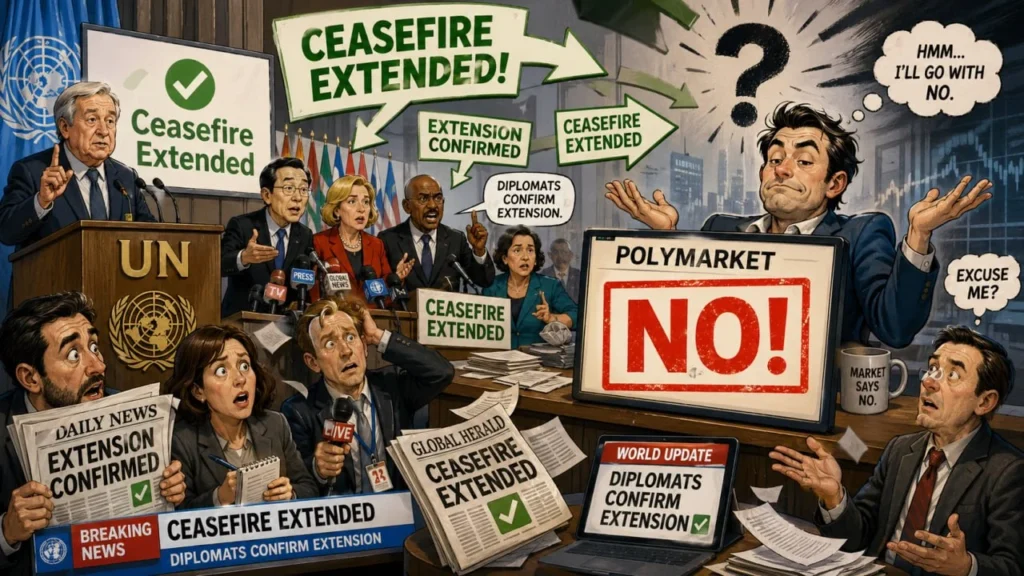
The «US x Iran ceasefire extended by April 22, 2026» market on Polymarket is moving toward a No resolution despite: — Trump’s Truth Social statement on the extension (April 21); — Pak- istani PM’s confirmation as official mediator; — UN Secretary-General’s Note to Correspondents; — Consensus from Reuters, AP, Axios, Al Jazeera, BBC, WSJ, CNBC. Large Yes holders (positions bought at 0.1–0.3¢) demand correct resolution. Potential payout to one of them exceeds $20M. Resolution falls to UMA voting.
Quick refresher on the mechanics
Polymarket is a Polygon-based prediction market where users buy Yes/No shares on binary ques- tions. Resolution flows through the UMA Optimistic Oracle: at market close, a resolver proposes an outcome, after which a dispute window opens (~2 hours). Anyone can challenge by posting an economic bond. On dispute, resolution moves to DVM (Data Verification Mechanism)— UMA token holders stake and vote on the correct outcome. Voters against consensus lose part of their stake. Elegant in theory. In this market, everyone already knows there will be a dispute — because the answer the facts produce diverges from where the market sits.
What the facts say?
Market rules prescribe two alternative paths to a Yes resolution:
Path 1. Clear public confirmation of the extension by both governments — US and Iran.
Path 2. Alternatively — «overwhelming consensus of credible media reporting».
Yes holders argue both are satisfied.
Path 1. Trump’s Truth Social post — a source Polymarket has previously accepted. Pakistani PM’s statement — Pakistan officially recognized as «principal mediator» by Iran — under Article 8 of the 1907 Hague Convention legally conveys Iran’s position. Plus the UN Secretary-General’s Note to Correspondents — a formal document that wouldn’t exist without official notes from both sides.
Path 2. Eight major global outlets reported the extension. None reported the contrary.
Why this matters for crypto?
UMA positions itself as a schelling-point oracle for Web3 — a universal mechanism for estab- lishing truth for smart contracts. If in a case with this much factual clarity — public statement from the US president, formal UN document, Reuters-and-AP consensus — DVM rules against the literal reading of the rules, a serious question emerges.
The question: if UMA can’t trust AP and Reuters, what data can UMA trust? This isn’t rhetorical. This logic will underpin every lawsuit filed in the case of a No resolution. Lawsuits against Polymarket are a separate story, given prior US regulatory scrutiny.
Position economics
$77.2M total volume. Yes at 0.1–0.3¢ — sellers absent at the lower levels. Open buy orders unfilled for over 24 hours. Standard binary asymmetry at 0.3¢ — roughly 1:333. Most «easy» Polymarket markets resolve in the dispute window without contestation. This one will go to DVM almost certainly.

Isaac Bell
Isaac approaches habits and willpower the way a scientist approaches a stubborn hypothesis — with genuine curiosity and no fixed conclusions. His writing often reads like thinking out loud, full of questions he hasn't fully answered yet. That openness is intentional; he trusts readers to sit with uncertainty too.
View all articles →Get the Weekly Brief
The best guides and stories, delivered every Sunday.