
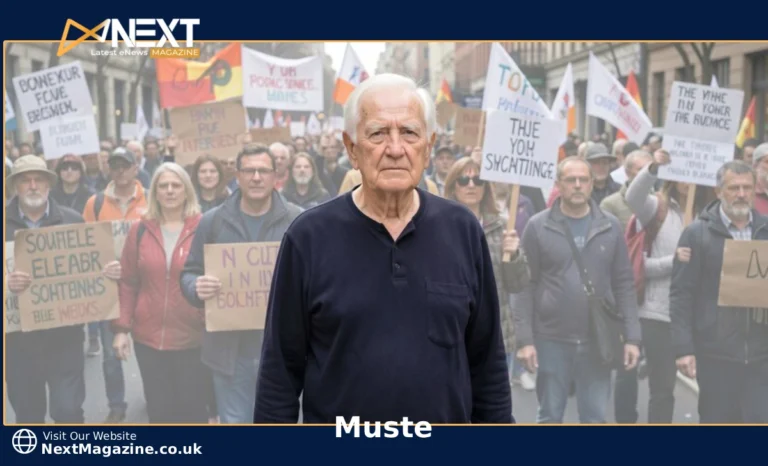
A.J. Muste (1885-1967) was a Dutch-born minister who became America’s most influential pacifist. He led labor strikes, mentored Martin Luther King Jr. and Bayard Rustin in nonviolent resistance, and opposed every American war from WWI to Vietnam while building the modern peace movement.
When Abraham Johannes Muste died in February 1967, condolences arrived from two unlikely sources: Robert Kennedy and Ho Chi Minh. This strange pairing captured the essence of a man who spent his life bridging seemingly unbridgeable divides. Time magazine called him “the Number One U.S. Pacifist” in 1939. His students called him the American Gandhi. History mostly forgot him.
That forgetting is a mistake. Muste didn’t just oppose wars—he built the movements and trained the leaders who changed America. Understanding his life means understanding how nonviolent resistance became the dominant strategy of American social movements.
The Minister Who Left the Pulpit for the Picket Line
Muste arrived in America at age six, part of the wave of Dutch immigrants who settled in Grand Rapids, Michigan. His family was working-class and deeply religious. The young Muste excelled at Hope College and entered seminary, ordained as a Dutch Reformed minister in 1909.
His first pastorate at Fort Washington Collegiate Church in New York City exposed him to urban poverty. Liberal theology at Union Theological Seminary gave him new frameworks. Socialist Eugene Debs gave him a political vocabulary. By 1916, he had joined the pacifist Fellowship of Reconciliation and become a Quaker.
World War I forced the choice. His conservative congregation demanded patriotic sermons. Muste preached pacifism instead. They forced him out. He moved to Massachusetts, where another congregation fired him for the same reasons.
Out of work and out of options, Muste joined the 1919 Lawrence textile strike almost by accident. Thirty thousand workers walked off the job. The strike needed leadership. The pacifist minister found himself organizing picket lines, negotiating with factory owners, and coordinating relief efforts. The workers won.
This success redirected his life. He became general secretary of the Amalgamated Textile Workers of America, then director of Brookwood Labor College in Katonah, New York. For twelve years, he trained union organizers and labor activists. The school produced many of the leaders who would build industrial unions in the 1930s.
Muste discovered he had a gift for organizing. He could bring hostile factions together. He could articulate complex ideas in language that workers understood. Most valuably, he could envision a long-term strategy while managing immediate crises.
When a Pacifist Becomes a Marxist
The Great Depression radicalized Muste. Labor organizing wasn’t enough—the entire system needed replacement. The American Federation of Labor seemed too conservative, too willing to compromise. He wanted revolution.
In 1929, he founded the Conference for Progressive Labor Action to push for more militant tactics. By 1933, this became the American Workers Party, with Muste as chairman. The group led several important strikes, including the successful 1934 Toledo Auto-Lite sit-down strike.
Muste briefly aligned with Trotskyists, traveling to Europe in 1936 to meet Leon Trotsky himself. He advocated for class struggle. He abandoned his earlier pacifism as naive middle-class sentimentalism. Violence, he argued, was already embedded in the capitalist system. Refusing to fight back was a collaboration with oppression.
Then came the conversion.
Standing in a Paris church in 1936, Muste experienced what he later described as a religious revelation. The details remained private, but the impact was total. He returned to America and resigned from the Workers Party. He rejoined the Fellowship of Reconciliation. He became a Christian pacifist again, but with a decade of organizing experience and no illusions about power.
His famous quote came from this period: “In a world built on violence, one must be a revolutionary before one can be a pacifist.” He had been the revolutionary. Now he would be both.
Building the Infrastructure of Nonviolence
Muste became executive secretary of the Fellowship of Reconciliation in 1940, just as World War II made pacifism deeply unpopular. He defended conscientious objectors, opposed Japanese internment, and worked with Civilian Public Service camps. He refused to make his pacifism conditional on who was fighting whom.
More importantly, he began systematically training activists in nonviolent direct action. He studied Gandhi’s methods and adapted them for American conditions. The Fellowship became a laboratory for developing protest techniques that would define the next three decades.
In 1942, Fellowship staff members founded the Congress of Racial Equality. James Farmer and George Houser created CORE as a testing ground for Gandhian tactics against segregation. Muste supported the experiment and helped fund it.
His most significant student was Bayard Rustin. The young African American activist joined the Fellowship in 1941. Muste became his mentor, teaching him strategy, coalition-building, and the philosophy of nonviolence. When Rustin faced jail for refusing the draft, Muste supported him. When Rustin was marginalized for being gay, Muste stood by him.
Rustin, in turn, became the key connection between Muste’s peace movement and the emerging civil rights movement. In 1947, Rustin organized the Journey of Reconciliation, the first Freedom Ride. In 1955, he went to Montgomery to advise Rosa Parks and the young minister leading the bus boycott: Martin Luther King Jr.
King had heard Muste lecture at the seminary in 1949. The ideas stuck. When the Montgomery boycott began, King needed practical guidance on maintaining nonviolent discipline. Rustin provided it, drawing directly from Muste’s training. Glenn Smiley, another Fellowship staffer, also worked with King in Montgomery.
Muste operated mostly behind the scenes, but his fingerprints were everywhere. When King needed advice on strategy, he could call Rustin, who had learned from Muste. When CORE needed funding, Muste helped raise it. When activists needed training, Fellowship workshops taught them.
He built the infrastructure that made the civil rights movement’s nonviolent strategy possible.
From Red Square to Hanoi: A Pacifist Without Borders
Nuclear weapons horrified Muste. He saw them as the logical endpoint of militarism—the technology that could end human civilization. Starting in the late 1940s, he organized protests that seemed crazy at the time and prophetic in retrospect.
In 1957, he helped found the Committee for Nonviolent Action. The group specialized in dramatic civil disobedience: trespassing at nuclear test sites, sailing boats into restricted waters, and refusing to take shelter during civil defense drills. Muste, now in his seventies, was frequently arrested.
He didn’t limit his activism to America. In 1961, he traveled to Moscow and demonstrated in Red Square against Soviet nuclear weapons. The police detained him briefly before deporting him. He considered the trip a success—he had delivered his message directly to the Kremlin.
He also pioneered tax resistance, refusing to pay the portion of federal taxes that funded the military. The IRS seized his assets. He continued refusing.
Vietnam became his final cause. As the war escalated in the mid-1960s, Muste brought together the fractured peace movement. He helped found the Spring Mobilization Committee to End the War in Vietnam, serving as chairman. On April 15, 1967, massive anti-war demonstrations occurred in New York and San Francisco—the largest protests to that date.
Muste didn’t just protest from America. In 1966, he traveled to Vietnam. He went to Saigon, where South Vietnamese police arrested him for organizing an anti-war meeting. He went to Hanoi and met with Ho Chi Minh, attempting to open dialogue that might end the war.
He returned to New York exhausted but energized. The movement was growing. Real change seemed possible.
He died three weeks later, on February 11, 1967, from an aneurysm. He was 82. The antiwar movement he had built would continue growing, eventually helping end the war he opposed.
The Paradox Muste Never Be Resolved
Muste spent his life navigating an impossible tension. He believed in peace, nonviolence, and reverence for life. He also believed in justice, equality, and revolutionary change. The two commitments often conflicted.
How do you challenge violent systems without using violence? How do you create urgency without creating danger? How do you build power for the powerless while maintaining moral purity?
Muste never solved these contradictions. He lived them. His decade as a Marxist revolutionary represented one answer—justice first, even at the cost of peace. His return to pacifism represented another—peace as the only foundation for real justice.
The synthesis came in his mature philosophy. He rejected passive pacifism, the kind that tolerates injustice to avoid conflict. He insisted that pacifism must be revolutionary, actively working to dismantle oppressive systems. Nonviolence was a tactic, yes, but also an ethical commitment that couldn’t be compromised.
This is why both Robert Kennedy and Ho Chi Minh mourned him. Kennedy represented liberal reform within the American system. Ho represented armed revolution against it. Muste had worked with both, challenging both, finding common ground with both in their shared opposition to a war he thought immoral.
His legacy lives in every protest movement that chooses nonviolent tactics, every activist who studies how to build coalitions across differences, every organizer who believes systems can change without becoming as violent as the systems they oppose.
The A.J. Muste Memorial Institute, founded after his death, continues supporting peace and justice work globally. The methods he taught—sit-ins, boycotts, tax resistance, civil disobedience—remain standard tools of activists worldwide.
Contemporary movements from Black Lives Matter to climate activism use tactics Muste either pioneered or refined. His insight that labor rights, civil rights, and peace are interconnected struggles has become conventional wisdom among organizers.
His life offers lessons for anyone working for change: build coalitions, train others, think strategically, act boldly, maintain your values without becoming rigid, and understand that the work continues whether you succeed or fail. He knew most of his projects would collapse. He kept building them anyway.
The minister who left his pulpit to join a picket line understood something essential: you can’t wait for perfect conditions to act on your convictions. You start where you are, with what you have, and trust that committed people working together can shift history.
