
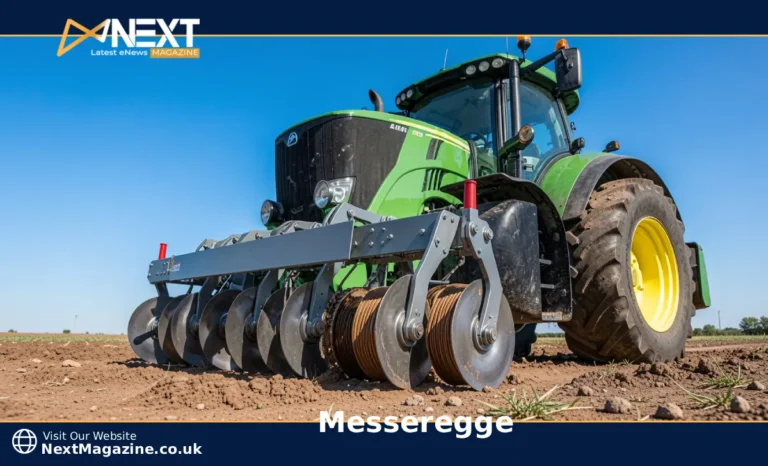
A Messeregge is a blade-based soil tillage implement used in arable farming to prepare an even, fine-textured seedbed with minimal soil disturbance. Unlike tine-based harrows that pull and churn the topsoil, it uses fixed steel blades to cut cleanly through the surface layer, preserving soil structure while creating consistent conditions for germination.
What Is a Messeregge?
The word “Messeregge” comes directly from German agricultural terminology. Messer means knife or blade. Egge means harrow. Together, the term describes a harrow that uses cutting blades instead of the rigid or spring-loaded tines found on a standard Zinkenegge.
In practice, it is a precision soil cultivation tool. It works at shallow depth — typically the top 3 to 8 cm of the topsoil — and cuts rather than tears. This distinction is more important than it might first appear.
How It Differs from Other Harrow Types
A standard harrow (Egge) is a tillage implement with tines or discs that loosen the upper soil layer, break down clods, and prepare a fine seedbed for sowing. Most traditional versions rely on spring tines, rigid tines, or rotating discs. The Messeregge takes a different mechanical approach: fixed steel blades slice the soil surface horizontally rather than dragging through it.
This matters because time-based implements can pull buried weed seeds to the surface. The Messeregge’s cutting action stays shallower and more controlled, reducing this effect. It also maintains a more even surface finish across varying soil conditions.
How a Messeregge Works
Blade Design and Cutting Action
A Messeregge uses fixed steel blades to cut, level, and break down surface material rather than pulling soil apart. This cutting-based approach delivers precise control over soil structure and moisture retention.
The blades are typically arranged in two rows — a configuration known as zweireihig — which ensures full coverage of the working width without leaving uncut strips. Many current models include zentral einstellbare Messer (centrally adjustable blades), meaning the farmer can change the blade angle from a single point rather than adjusting each blade individually. This saves significant setup time.
Working Depth and Soil Impact
The Messeregge is a shallow-working tool by design. It does not replace primary tillage like ploughing or deep loosening. Instead, it refines the top layer after primary work has already taken place.
Because it operates at shallow depth, the Messeregge helps preserve moisture and protects beneficial soil life. Farmers gain control rather than disruption — the soil responds better, and crops benefit from a stable start.
This shallow profile also makes it well-suited to reduced tillage and conservation farming approaches, where protecting soil biology is a priority.
Main Uses of the Messeregge in Modern Farming
Seedbed Preparation
This is the primary purpose. After ploughing, stubble tillage, or another form of primary cultivation, the field surface needs to be levelled, broken down into a fine tilth, and made ready for sowing.
The blade system of the Messeregge smooths the surface, improves seed placement accuracy, and supports more consistent germination. Uniform emergence leads to stronger crops and easier field management later in the season.
The result is a seedbed that is fine enough for good seed-to-soil contact but not so worked over that it risks capping or compaction.
Stubble and Residue Management
After harvest, crop residues — stalks, straw fragments, and surface debris — interfere with the next sowing operation. The blade system slices through stalks and organic matter, allowing faster decomposition and easier follow-up operations. This is especially useful in cereal farming systems where straw is chopped and spread by the combine harvester.
Combined Operations as a Vorwerkzeug
One of the most important applications of the Messeregge in current practice is its role as a Vorwerkzeug — a front-mounted pre-implement. Rather than making a separate pass over the field, the farmer mounts the Messeregge at the front of the tractor while a roller, packer, or seeder works at the rear.
Messeregge units are often mounted on the front of the tractor, allowing them to work simultaneously with rear-mounted seeders or other implements. This combined approach allows multiple soil tasks to be completed in a single tractor pass, saving fuel and time.
Messeregge vs. Federzinkenegge vs. Crossboard
These three tools frequently appear together in modern implement catalogues as alternative Vorwerkzeug choices. Each suits different soil and field conditions.
| Feature | Messeregge | Federzinkenegge | Crossboard |
|---|---|---|---|
| Working principle | Blade/knife cutting | Spring tine action | Angled disc/board |
| Best for | Firm, cloddy soils; residue cutting | Loose, already-worked soils | Levelling, spreading |
| Soil disturbance | Low — controlled cut | Medium — tine drag | Low — surface levelling |
| Weed seed transfer | Minimal | Moderate | Minimal |
| Depth range | Shallow (3–8 cm) | Shallow to medium | Very shallow |
| Adjustability | Central blade angle | Individual tine angle | Board angle |
The Kerner Toron front packer system combines the roller with a choice of Vorwerkzeug — Messeregge, Federzinkenegge, or Crossboard — making it adaptable for different soils and requirements. This flexibility reflects how modern implementation design has moved toward modular systems rather than single-purpose tools.
Real-World Application — The Kerner Toron System
The clearest current example of the Messeregge in a commercially available system is the Kerner Toron, presented at Agritechnica 2025 by Kerner Maschinenbau GmbH from Aislingen, Germany.
The Toron combines a roller system with the choice of Vorwerkzeug. The roller uses the ICW system (650 mm roller diameter, 550 mm in the tractor track, 125 mm segment spacing) with a new tine design suited to reliable re-compaction on variable soils.
An additional feature is the patented cleaning and cutting tool integrated between the roller rings, which crumbles clods for noticeably better soil breakdown. This detail gives the Toron a real functional benefit, according to Kerner.
The Messeregge variant for the Toron is zweireihig (two-row) and includes centrally adjustable blades and hydraulic depth adjustment. A front packer listing from 2024 confirms this specification: “Messeregge (zweireihig), Beleuchtung mit Vorwerkzeug, zentral einstellbare Messer, Dreipunktbock Kat.2.”
This system shows how the Messeregge is not a standalone machine in most modern contexts — it is one component in a combined, modular front-rear tillage approach.
Maintenance and Blade Care
Like all cutting tools, blades wear over time. Replacement blades — known as Ersatzmesser — are a normal part of upkeep and add to the tool’s long-term reliability.
The central adjustment system on modern models reduces maintenance time significantly. Blade sharpness directly affects the quality of cut, so checking blade condition before each major season is good practice. Worn blades increase soil drag, which undermines the key advantage of the implement — its clean, low-disturbance cutting action.
Blade replacement on current models is typically a straightforward bolt-removal process, and Ersatzmesser are stocked by major agricultural suppliers across the DACH region.
Is a Messeregge Right for Your Farm?
The Messeregge suits specific situations well. Consider it when:
- Your primary goal is seedbed refinement after ploughing or stubble work, not deep loosening
- You have firm or cloddy soil that benefits from a cutting action over tine dragging
- You want to combine soil preparation with another rear implement in a single pass
- You farm under a conservation or reduced tillage approach and want to limit soil disturbance
It is less suited to very loose soils that are already well-structured, or to fields with heavy, matted surface residues that need more aggressive incorporation.
Messeregge tools fit naturally into precision farming. Their predictable action works well with GPS-guided tractors and combined operations. When soil conditions remain consistent, sowing accuracy improves across large fields and varying conditions.
Frequently Asked Questions
What does “Messeregge” mean in English?
The closest English translation is blade harrow or knife harrow. It describes a soil tillage implement that uses fixed steel cutting blades rather than flexible tines or rotating discs to prepare the soil surface.
How deep does a Messeregge work?
Typically between 3 and 8 cm — making it a shallow-tillage tool. It is used for surface refinement and seedbed preparation, not deep soil loosening. Working depth is adjustable on most modern models, including hydraulically on some front packer systems.
Can a Messeregge replace a Kreiselegge?
Not in every situation. A Kreiselegge works by rotating powered tine-pairs driven by the tractor’s PTO, making it more aggressive and better at intensive seedbed work on difficult soils. The Messeregge is lower-disturbance and often works faster in combined operations. Many farms use both, choosing based on the soil condition and the crop being established.
