
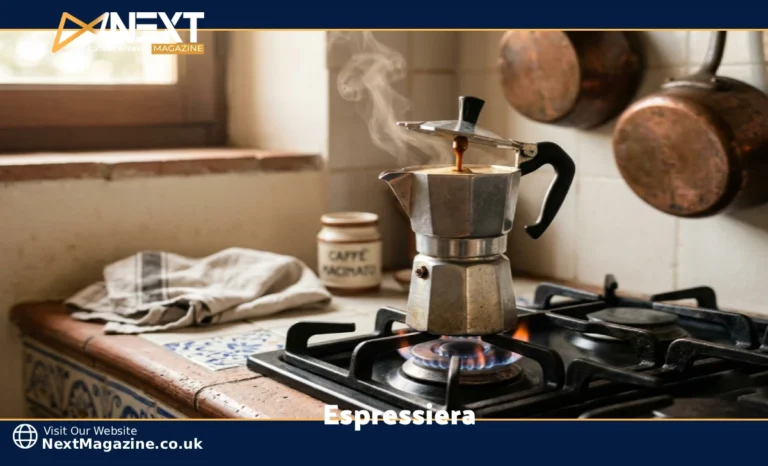
An Espressiera — also called a moka or caffettiera — is a stovetop coffee maker that brews concentrated coffee through Vapor pressure. Invented by Alfonso Bialetti in Italy in 1933, it uses a three-chamber design to force hot water through ground coffee. It is not a true espresso machine, but it produces a strong, rich cup that has been a daily ritual in Italian homes for over 90 years.
Walk into any Italian kitchen, and you will almost certainly find one on the stovetop. About 90% of Italian families own an espresso machine, and nearly 300 million are in use worldwide. It sits in the permanent collections of the Museum of Modern Art in New York and the Design Museum in London — not as a curiosity, but as a benchmark of functional design.
Yet many people who own one have never been told exactly how it works, why the coffee sometimes turns bitter, or whether the Aluminum is safe to use every day. This guide covers all of it.
A 90-Year Design That Never Needed Updating
The Espressiera was designed in 1933 by Italian engineer Alfonso Bialetti, who named it the Moka Express — a reference to the Yemeni port city of Al Moka, historically known for exporting high-quality Arabica coffee beans.
Bialetti ran a small Aluminum workshop in Crusinallo, northern Italy. The idea came from observing a lisciveuse — an early washing machine that used a central tube to circulate boiling water through laundry. He adapted the same pressure-driven principle for coffee. The result was an octagonal aluminium pot with an Art Deco profile that has not changed in structure since its debut.
For the first decade, sales were modest and mostly local. The real turning point came after World War II. Renato Bialetti, Alfonso’s son, took over in the 1940s and transformed the moka into a mass-market product through industrial production and an aggressive advertising campaign, including the now-famous animated mascot — the “Omino con i baffi” (the little man with the moustache) — created by illustrator Paul Campani.
The first advertising slogan was direct and compelling: “In casa un espresso come al bar” — Espresso at home, just like the bar. That positioning worked because, at the time, espresso was exclusively a café product. The espresso brought the bar counter into the home kitchen, permanently changing Italian coffee culture.
Today, Bialetti holds a Guinness World Record for the most popular coffee maker on the planet.
How an Espressiera Works
The Espressiera runs on a simple physical principle: heat turns water into Pressurized steam, and that pressure forces water upward through ground coffee.
When placed on the stove, the water temperature reaches around 100°C, which causes steam to build up. The steam exerts pressure on the water, forcing it out of the boiler, through the coffee grounds, and into the upper chamber.
This process generates between 1 and 2 bars of pressure — enough to extract strong, concentrated coffee, but well below the 9 bars required for true espresso. That distinction matters for taste and texture, which is covered in the next section.
The Three Chambers and What Each One Does
- The boiler (lower chamber): Holds the water. It has a safety release valve — the water level must never exceed this valve, or the brew will be diluted and the seal may fail.
- The filter funnel (middle): A metal basket that holds the ground coffee. It sits between the two chambers, sealing against a rubber gasket. Water is forced up through it.
- The collector (upper chamber): Where the finished coffee arrives. It has a central spout and, in most models, a hinged lid.
All three are held together by threading the upper chamber onto the lower. A tight seal is essential — any gap means pressure loss and uneven extraction.
Moka Coffee vs. Espresso — Is There a Real Difference?
Yes. Despite being called a “stovetop espresso maker,” an Espressiera does not produce true espresso. The pressure difference is the main reason.
| Factor | Espressiera (Moka) | Espresso Machine |
|---|---|---|
| Brew pressure | 1–2 bar | 8–10 bar |
| Brew temperature | ~100°C or above | 90–96°C (regulated) |
| Brew time | 4–6 minutes | 25–30 seconds |
| Coffee-to-water ratio | ~1:10 | ~1:2.5 |
| Crema | Minimal or none | Thick, persistent |
| Flavor profile | Strong, bold, slightly bitter | Intense, complex, layered |
Because there is no mechanism to cool the pressurised water in a standard stovetop brewer, the actual brew temperature can exceed 100°C. These conditions mean that Moka coffee can sometimes taste over-extracted and bitter. That is not a flaw in the device — it is a sign that the technique needs adjustment.
Moka coffee is roughly two to three times stronger than drip coffee in terms of dissolved solids. It is satisfying, rich, and direct. It is just not espresso.
How to Brew a Proper Cup — Step by Step
- Fill the boiler with cold, filtered water up to just below the safety valve. Never cover it.
- Grind your coffee to a medium-fine consistency — roughly the texture of granulated sugar or table salt. Finer than pour-over, coarser than espresso grind. For a 6-cup moka pot, use approximately 20–22 g of coffee.
- Fill the filter funnel loosely. Level the surface with a finger or flat edge. Do not tamp or compress the grounds — packing the coffee increases resistance, raises internal pressure, and leads to bitter extraction.
- Wipe the rim of the funnel clean before assembling. Coffee grounds caught in the seal prevent a proper pressure lock.
- Screw the upper chamber on firmly. Any gap will cause leaks and a failed brew.
- Place on low to medium heat. On a gas stove, keep the flame smaller than the base of the pot so the handle stays cool.
- Leave the lid open and watch. Coffee should rise slowly and evenly — a steady, amber-colored stream into the collector.
- Stop at the gurgle. When the lower chamber is almost empty, bubbles of steam mix with the rising water, producing a characteristic gurgling noise. This is the signal that brewing should stop. Scientists who have studied the moka pot call this the “strombolian phase” — after the eruption pattern of the Stromboli volcano. At this point, highly heated steam begins pushing through the grounds, rapidly over-extracting and introducing harsh, bitter flavours. Remove the pot from the heat immediately.
- Pour and serve. Use a cloth or handle grip — the body stays hot for several minutes.
The Most Common Mistakes (and the Fixes)
- Bitter, harsh coffee: You let it reach the strombolian phase, or your grind is too fine. Remove from heat the moment gurgling begins. Try a slightly coarser grind.
- Weak, watery coffee: Grind is too coarse, heat was too high (water rushed through), or the funnel was underfilled. Slow down the heat and grind finer.
- Coffee leaking from the seal: The rim of the funnel had loose grounds on it, or the gasket is worn. Clean the rim before assembly. Replace the gasket every 6–12 months.
- No coffee coming out: The safety valve may be blocked, or the lid was left closed, building pressure with nowhere to go. Check and clear the valve before every use.
Aluminium or Stainless Steel — Which Should You Choose?
Most espresso machines are made from one of two materials.
Aluminium is the original. It heats quickly, distributes heat evenly, and produces the classic moka flavour. Scientific investigation found that aluminium migration into coffee falls below 1% of the recommended total weekly intake with regular use, and even after a dishwasher cleaning, it rose to a maximum of just under 4% — the reason dishwasher use is strongly discouraged, not because of daily brewing. Aluminium models do not work on induction hobs without an adapter plate.
Stainless steel heats slightly slower but is more durable, easier to clean, and induction-compatible. Stainless steel pots, but not aluminium, can be used with induction cooking. The taste difference is minimal if the brewing technique is consistent.
If you cook on a gas or electric range, aluminium is the traditional and reliable choice. If you have an induction hob, go stainless steel or purchase a Bialetti induction adapter plate for an aluminium model.
Cleaning and Maintenance — What You Must Never Do
The espresso’s longevity depends entirely on how you treat it after use.
- Never put it in the dishwasher. Harsh detergents strip the aluminium oxide layer that develops with use and directly affects flavour. Wash by hand with warm water only.
- Do not use soap or chemical detergents on aluminium models. Residue absorbs into the porous surface and will transfer to your next cup.
- Disassemble fully after every use. Remove the filter plate and rubber gasket, rinse each part individually, and allow everything to air dry.
- Replace the rubber gasket when it becomes stiff, cracked, or starts to leak — typically every 6 to 12 months, depending on use.
- Decalcify the boiler when white mineral deposits appear around the safety valve. Fill the boiler with one part white vinegar to eight parts water, leave overnight, then rinse several times to eliminate any taste carry-over.
The espresso has outlasted capsule machines, pod systems, and every wave of kitchen gadget trends because it asks something of the person using it. You have to pay attention to the water level, the grind, the heat, and the gurgle. That involvement is not a drawback. It is the point. For over 90 years, the moka has remained a symbol of tradition capable of holding its own against new coffee cultures, precisely because it produces something no capsule can replicate: coffee made by hand, on a flame, with nothing between you and the cup.
