
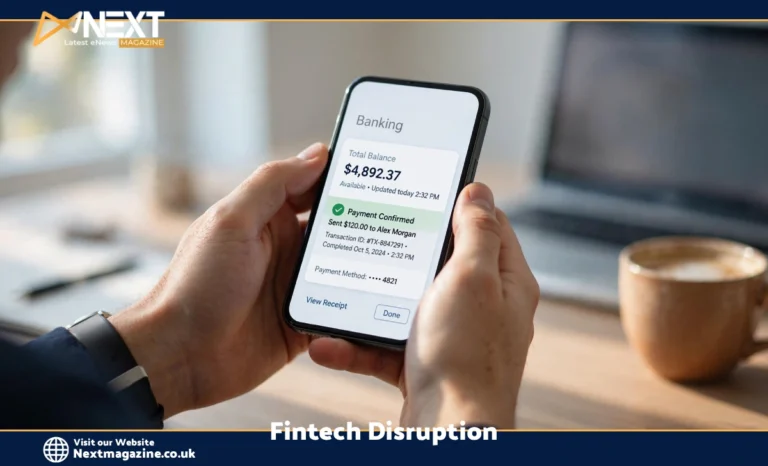
Fintech disruption is the shift happening as financial technology companies introduce faster, cheaper, and more accessible alternatives to traditional banking, lending, and investment services. It’s driven by AI, blockchain, cloud computing, and open banking, and it’s reshaping how consumers and businesses manage money.
Ten years ago, opening a bank account meant a trip to a branch, a stack of paperwork, and a wait of several days. Today, it can happen in under five minutes from a phone, without ever speaking to a person. That shift didn’t happen by accident. It’s the result of financial technology companies rebuilding the systems banks have relied on for decades.
Fintech disruption describes this shift: new technology-driven companies and tools challenging how traditional banks, lenders, and insurers operate. It’s not one single change. It’s a collection of them, spanning payments, lending, wealth management, and insurance, all moving toward something faster, cheaper, and more accessible than what came before.
This guide covers what’s driving that change, where it’s showing up most, the real benefits and risks involved, and what it means for businesses and workers trying to keep pace.
What Is Fintech Disruption?

Definition of Fintech Disruption
Fintech disruption happens when financial technology companies introduce products or services that shift how people and businesses manage money, forcing established institutions to adapt or lose ground. It covers everything from mobile payment apps to AI-based lending platforms and blockchain-powered settlement systems.
The core idea is simple: technology removes friction that used to be unavoidable. Slow transfers, high fees, and rigid banking hours are no longer treated as normal costs of doing business.
The Evolution of Financial Technology
Financial technology isn’t new. ATMs, electronic trading, and online banking all counted as fintech in their day. What’s different now is the pace and scope of change. Cloud computing, mobile devices, and better data infrastructure have made it possible for smaller companies to build financial products that once required a bank’s licensing, capital, and physical branch network.
That shift opened the door for startups to compete directly with institutions that had operated with little competition for generations.
Why Fintech Matters More Than Ever
Consumer expectations have changed. People compare their banking app to their favourite shopping or ride-share app, and they expect the same speed and simplicity. Businesses expect the same from payment processing and lending.
Fintech matters because it’s setting a new baseline for what “good service” looks like in finance, and traditional institutions are being measured against it whether they like it or not.
How Fintech Is Changing the Financial Industry
From Traditional Banking to Digital Finance
Traditional banking relied on physical infrastructure: branches, tellers, and paper-based processes. Digital finance strips that down to an app or a website. Account opening, loan applications, and even mortgage approvals can now happen without a single in-person interaction.
This doesn’t mean branches are gone. It means they’re no longer the default way most people handle everyday banking.
The Rise of Fintech Startups
Fintech startups built their businesses around solving one specific problem well, rather than trying to be a full-service bank from day one. A company might focus only on international transfers, or only on small business lending. That narrow focus lets them build faster and cheaper than banks juggling dozens of product lines.
Many of these companies have since expanded, but the original approach, solving a narrow problem with precision, is still what separates the successful ones from the rest.
Fintech vs Traditional Financial Institutions
Traditional banks still hold major advantages: regulatory relationships, large deposit bases, and public trust built over decades. Fintech companies counter with speed, lower overhead, and product design built around the customer rather than internal banking processes.
The two aren’t purely competitors anymore. Many banks now partner with fintech firms, using their technology behind the scenes while keeping the banking license and customer relationship in-house.
Why Consumers Prefer Fintech Solutions
Lower fees, faster approvals, and clearer interfaces are the main draw. A person applying for a personal loan through a fintech lender might get a decision in minutes instead of days. Someone sending money abroad might pay a fraction of what a traditional wire transfer costs.
Convenience, not brand loyalty, is what’s pulling customers toward these tools.
Technologies Powering Fintech Disruption
Artificial Intelligence (AI) and Machine Learning
AI is used across fintech for credit scoring, fraud detection, and customer support chatbots. Machine learning models can evaluate loan applications using far more data points than a traditional credit score alone, which helps lenders make faster and, in some cases, fairer decisions.
Blockchain Technology
Blockchain provides a shared, tamper-resistant record of transactions without needing a central authority to verify every one. It’s the foundation for cryptocurrency, but it’s also being used for cross-border settlement, trade finance, and identity verification.
Cloud Computing
Cloud infrastructure lets fintech companies launch products without building their own data centres. This lowers the cost of entry significantly and lets smaller companies scale their systems up or down based on demand.
Big Data Analytics
Financial companies now have access to far more data than a customer’s credit history: spending patterns, transaction timing, even device usage. Analysing that data helps companies detect fraud earlier and personalise products more accurately.
Open Banking and APIs
Open banking lets customers securely share their financial data with third-party apps through application programming interfaces (APIs), a set of rules that let two systems communicate. This is what allows a budgeting app to pull transaction data directly from a bank account with the customer’s permission.
Mobile Banking Technologies
Mobile-first design is now the standard, not an add-on. Biometric login, instant push notifications for transactions, and in-app customer support have become baseline expectations rather than premium features.
Embedded Finance
Embedded finance places financial services directly inside non-financial platforms. A ride-share app offering its drivers a debit card, or an online store offering “buy now, pay later” at checkout, are both examples. The financial product becomes part of another company’s experience instead of a separate destination.
Automation and Smart Financial Services
Automation handles repetitive tasks such as document verification, compliance checks, and account reconciliation. This cuts processing time and reduces the manual errors that come with high-volume paperwork.
Key Areas Where Fintech Is Creating Disruption
Digital Payments and Money Transfers

Payment apps and digital wallets have replaced cash and checks for a large share of everyday transactions. Cross-border transfers that once took days and carried high fees can now settle in minutes at a fraction of the cost.
Digital Banking and Neobanks
Neobanks, banks that operate entirely online without physical branches, offer checking accounts, savings tools, and budgeting features built into a single app. Because they carry no branch overhead, many can offer lower fees and higher savings rates than traditional banks.
Peer-to-Peer Lending
Peer-to-peer lending platforms connect borrowers directly with individual or institutional investors, cutting the bank out of the middle. This can mean better rates for borrowers and better returns for lenders, though it also shifts risk assessment away from traditional underwriting standards.
Wealth Management and Robo-Advisors
Robo-advisors use algorithms to build and manage investment portfolios based on a person’s goals and risk tolerance. They’ve made professional-style portfolio management available to people who could never have justified paying a human advisor’s fees on a smaller account.
Personal Finance Applications
Budgeting apps, savings tools, and spending trackers give people a real-time view of their finances that used to require manual spreadsheet work. Many now offer automated savings features that move small amounts of money based on spending patterns.
Insurance Technology (InsurTech)
InsurTech companies use data and automation to simplify how policies are quoted, purchased, and claimed. Some use usage-based models, like pricing car insurance based on actual driving behaviour rather than broad demographic categories.
Blockchain and Cryptocurrency Services
Beyond trading, blockchain-based services now include stablecoins for payments, decentralised lending, and tokenised assets. Adoption varies widely by region and regulation, but the underlying infrastructure continues to mature.
Real Estate Technology (PropTech)
PropTech tools have changed how people get mortgages, verify income, and even buy property. Digital mortgage platforms can pre-approve buyers in a fraction of the time it took a decade ago, using automated income and asset verification.
Benefits of Fintech Disruption
Faster Financial Transactions
Same-day or instant settlement is increasingly the norm, not the exception, for payments, transfers, and even some loan disbursements.
Lower Costs for Businesses and Consumers
Reduced overhead lets fintech companies charge lower fees for services that used to carry significant markups, from currency exchange to account maintenance.
Better Customer Experience
Cleaner interfaces, faster support response times, and self-service tools have raised the bar for what customers expect from any financial provider, fintech or traditional.
Increased Financial Inclusion
Mobile-first fintech products have given banking access to people who were previously excluded due to minimum balance requirements, lack of nearby branches, or thin credit files.
Improved Accessibility
Round-the-clock account access, instant notifications, and mobile support mean customers aren’t limited by branch hours or geography anymore.
Greater Transparency
Fee structures are typically clearer in fintech products, often displayed upfront in the app rather than buried in lengthy account disclosures.
Enhanced Security Through Innovation
Biometric authentication, real-time fraud alerts, and behavioural monitoring have made it harder for unauthorised transactions to go unnoticed, in many cases catching fraud faster than traditional bank monitoring.
Challenges and Risks of Fintech Disruption
Regulatory Compliance
Financial regulation exists to protect consumers and the stability of the system, but it wasn’t written with today’s technology in mind. Fintech companies often operate in a regulatory grey area, navigating rules built for a different era of banking.
Cybersecurity Threats
Digital-first companies are attractive targets for attackers. A single breach can expose sensitive financial data for millions of users, making cybersecurity investment non-negotiable for any fintech firm.
Data Privacy Concerns
Fintech products rely on large amounts of personal financial data. How that data is stored, shared, and monetised raises legitimate privacy concerns, especially when third-party apps are involved through open banking connections.
Fraud Prevention
Faster transactions also mean faster fraud. Instant payments leave little room to reverse a mistaken or fraudulent transfer once it’s sent, which puts pressure on prevention rather than after-the-fact correction.
Legacy Banking Systems
Many traditional banks still run on decades-old core banking systems. Integrating new fintech partnerships with that infrastructure is slow, expensive, and technically complex.
Talent Shortage in Fintech
Demand for people who understand both finance and software development has outpaced supply, making hiring one of the biggest bottlenecks for growing fintech companies.
Balancing Innovation with Security
Moving fast is part of the fintech identity, but speed and security don’t always align. Companies that cut corners on security to launch faster often pay for it later, sometimes at the cost of customer trust that’s difficult to rebuild.
The Impact of Fintech on Businesses
Changing Business Models
Subscription pricing, usage-based fees, and embedded financial products have replaced the flat fee structures that used to define financial services. Businesses now build revenue models around ongoing customer relationships rather than one-time transactions.
Digital Transformation Strategies
Companies outside finance are treating financial services as part of their core product rather than a separate function. A retailer offering its own credit product, or a software company adding payment processing, are both signs of this shift.
Fintech Integration with Existing Systems
Connecting new fintech tools to older internal systems is one of the most common technical challenges businesses face. APIs have made this easier than it used to be, but integration still requires real planning and testing.
Buy vs Build: Choosing the Right Strategy
Businesses generally choose between building financial features in-house or partnering with an existing fintech provider. Building offers more control but takes longer and costs more upfront. Partnering gets a product to market faster but means relying on someone else’s infrastructure and roadmap.
Creating a Culture of Innovation
Companies that adapt well to fintech tend to share one trait: they treat new technology as a tool to test and iterate on, not a one-time project to finish and forget.
Fintech’s Impact on Jobs and the Workforce
New Skill Requirements
Roles in fintech increasingly require a mix of financial literacy and technical skill. Understanding regulation, risk, and compliance matters just as much as understanding code.
Finance and Technology Skill Integration
The line between “finance job” and “tech job” has blurred. Analysts now need to understand data pipelines, and developers need to understand financial regulation well enough to build compliant products.
Workforce Upskilling
Traditional financial institutions are investing heavily in training existing staff on new systems rather than replacing them outright, recognising that institutional knowledge still matters even as tools change.
Job Displacement vs Job Creation
Some roles, particularly manual data entry and basic transaction processing, have shrunk as automation takes over. At the same time, fintech has created entirely new roles in areas like compliance technology, fraud analytics, and product design that didn’t exist a decade ago.
The Growing Demand for Fintech Professionals
Demand remains high for people who can bridge finance and technology, particularly in compliance, cybersecurity, and product roles within fintech companies.
The Role of Regulation in Fintech
Why Financial Regulations Matter
Regulation exists to protect consumers, prevent fraud, and keep the financial system stable. Even as technology changes how services are delivered, the underlying goals of regulation haven’t changed.
Challenges for Regulators
Regulators often move slower than the industry they oversee. Keeping pace with new products, cross-border services, and decentralised technology like blockchain requires constant adaptation of existing rules.
Compliance Best Practices
Fintech companies that treat compliance as a core part of product design, rather than an afterthought, tend to avoid the costly penalties and reputational damage that come from regulatory violations.
The Future of Fintech Regulation
Expect more countries to introduce fintech-specific regulatory categories, rather than forcing new financial products into rules written for traditional banks. Sandbox programs, where regulators allow controlled testing of new products, are becoming more common as a way to balance innovation with oversight.
Real-World Examples of Fintech Disruption
Digital Payment Platforms
Apps that let people send money instantly using just a phone number or email address have replaced checks and cash for many everyday transactions between individuals and small businesses.
Mobile Banking Apps
Full-service banking apps now handle everything from account opening to loan applications, letting customers manage their entire financial relationship without visiting a branch.
Blockchain-Based Financial Services
Cross-border payment networks built on blockchain infrastructure allow settlement in minutes instead of days, cutting out several intermediary banks that traditionally slowed the process down.
AI-Powered Lending Platforms
Lenders using machine learning models can approve small business loans in hours rather than weeks, evaluating factors like cash flow patterns instead of relying solely on credit scores.
Robo-Advisory Investment Services
Automated investment platforms rebalance portfolios and manage tax strategies without requiring a human advisor for every decision, making professional-grade investment management available at a much lower cost.
Future Trends Shaping Fintech
Artificial Intelligence in Finance
AI’s role will keep expanding beyond fraud detection and credit scoring into areas like personalised financial advice and predictive cash flow management for small businesses.
Embedded Finance
More non-financial companies will build financial products directly into their platforms, making the line between “fintech company” and “regular business offering financial services” increasingly blurry.
Open Banking Expansion
More regions are adopting open banking standards, which will likely lead to more competition and more third-party apps that draw on shared financial data with customer consent.
Web3 and Decentralised Finance (DeFi)
Decentralised finance, financial services built on blockchain without a central intermediary, is still maturing. Regulatory clarity will play a large role in determining how much mainstream adoption it sees over the next several years.
Real-Time Payments
Instant payment infrastructure is expanding across more countries, moving the industry toward a standard where “same-day” transfers feel outdated rather than fast.
Sustainable Fintech
Green banking products, carbon tracking tools tied to spending, and sustainability-linked lending are growing as both consumer demand and regulatory pressure push finance toward environmental accountability.
The Next Decade of Financial Innovation
Expect fewer standalone “fintech apps” and more financial services woven directly into the platforms people already use daily, from shopping apps to workplace tools.
How Businesses Can Prepare for Fintech Disruption

Invest in Emerging Technologies
Businesses don’t need to adopt every new technology immediately, but they should evaluate which ones directly solve a real problem for their customers or operations.
Prioritize Cybersecurity
Any business handling financial data needs security built into its systems from the start, not added after a breach forces the issue.
Stay Updated on Regulations
Regulatory requirements shift often in this space. Businesses need a clear process for tracking changes that affect their products or customer data handling.
Encourage Continuous Learning
Teams that stay current on fintech trends and tools are better positioned to spot opportunities and risks before competitors do.
Partner with Fintech Companies
Partnering with an established fintech provider is often faster and less risky than trying to build every capability from scratch.
Build Customer-Centric Financial Solutions
The businesses succeeding in this space are the ones designing products around what makes a customer’s financial life easier, not just what technology makes possible.
Frequently Asked Questions (FAQs)
What is fintech disruption?
Fintech disruption is the shift happening as financial technology companies introduce faster, cheaper, and more accessible alternatives to traditional banking, lending, and investment services.
How is fintech disrupting traditional banking?
Fintech companies offer digital-first alternatives to branch banking, often with lower fees, faster approvals, and better mobile experiences, pushing traditional banks to modernise their own systems.
What technologies are driving fintech disruption?
Artificial intelligence, blockchain, cloud computing, big data analytics, and open banking APIs are the main technologies behind most fintech innovation today.
Is fintech replacing banks?
Not entirely. Many fintech companies partner with banks rather than replace them, using bank infrastructure behind the scenes while offering a better front-end experience.
What are the biggest advantages of fintech?
Speed, lower costs, better accessibility, and improved transparency are the most consistent advantages fintech offers over traditional financial services.
What are the main risks of fintech?
Cybersecurity threats, data privacy concerns, and regulatory uncertainty are the biggest risks facing fintech companies and the customers who use their products.
How does fintech improve financial inclusion?
Mobile-first products remove barriers like branch access and minimum balance requirements, giving underserved populations a path to basic banking and credit services.
What is the future of fintech disruption?
Expect more embedded finance, wider open banking adoption, and continued growth in AI-driven financial products, along with tighter regulation as the industry matures.
Conclusion
Fintech disruption isn’t a single event. It’s an ongoing shift built on AI, blockchain, cloud infrastructure, and open banking, each pushing the financial industry toward something faster and more accessible than what came before. Consumers get more choice and lower costs. Businesses get new tools to build with. Traditional institutions get pressure to modernise or fall behind.
The risks, security threats, regulatory gaps, and data privacy concerns are real and shouldn’t be brushed aside. But the direction is clear. Financial services are moving toward systems built around the customer, not the institution. Businesses and individuals who understand that shift now will be better positioned for what comes next.
Want to stay ahead of where finance is headed? Explore how fintech tools can fit into your own financial strategy today.
