

Table of Contents
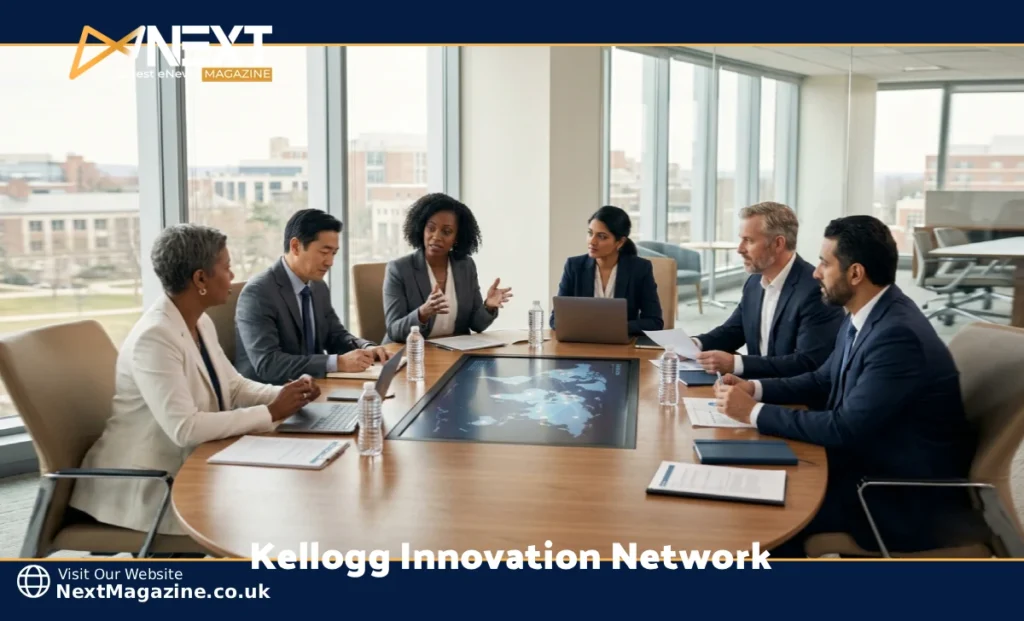
The Kellogg Innovation Network (KIN) is a selective global community founded in 2003 by Northwestern University’s Kellogg School of Management. It connects senior executives, policymakers, and researchers to address complex global challenges through cross-sector collaboration and research-backed dialogue. Members gain access to annual summits, peer roundtables, and long-term strategic peer networks.
What the Kellogg Innovation Network Actually Is
Most senior executive communities are built around one of two things: access or visibility. KIN was built around a third thing — thinking.
It isn’t a conference brand or an alumni association. It’s a working community of senior leaders who gather to work through problems too complex for any single industry or organisation to solve alone. It sits inside Northwestern University’s Kellogg School of Management structurally, but operates well beyond the boundaries of a business school program.
The founding idea was specific: innovation rarely originates at the top of a single organisation. It tends to emerge at the collision points between industries, disciplines, and geographies. KIN was designed to manufacture those collisions deliberately, in a structured setting, over time.
That’s a different proposition from most leadership forums, where the real value is exchanging business cards at a cocktail reception.
How KIN Was Built and How It Evolved
Robert Wolcott, then a faculty member at Kellogg and a researcher focused on corporate innovation, co-founded the network in 2003 alongside colleagues at Northwestern. The premise was that senior leaders — particularly in large, established organisations — needed a space where they could explore innovation as a strategic and organisational challenge, not just a product development question.
The network grew in scope and geographic reach through the mid-2000s. By the late 2000s, it had expanded enough to justify an independent organisational home. That’s when The World Innovation Network (TWIN) was established as a separate entity.
The KIN/TWIN relationship is one of the most misunderstood aspects of this community. Here’s the clearest way to frame it:
- KIN functions as the intellectual core — research-led, faculty-informed, and anchored to Kellogg’s academic standards.
- TWIN is the operational layer that runs global events and sustains cross-border member relationships at scale.
They share a mission and a community but operate with different mandates. TWIN gave KIN’s global ambitions an independent structure that wasn’t constrained by a single university’s calendar or geography. KIN gave TWIN the academic credibility that purely commercial networks rarely carry.
Together, they represent one of the more durable industry-academia partnerships in the senior executive education space — now spanning more than two decades.
Who Gets Into KIN and How Membership Works
KIN is not open access, and that’s deliberate. The community’s value depends on the calibre and diversity of its members. Membership is curated and largely invitation-based.
Typical members include:
- C-suite executives — CEOs, CIOs, Chief Innovation Officers
- Senior government and policy leaders
- Researchers and academics from leading universities
- Founders and senior leaders of large-scale global organisations
- Innovation strategists embedded in complex institutional settings
The mix is the point. A pharmaceutical executive, a public policy director, and a materials scientist working through a healthcare delivery problem in the same room is not accidental — it’s the model.
There’s no public application form or published fee schedule, which reflects KIN’s invitation-led structure. Executives typically enter through existing member referrals, Kellogg faculty relationships, or corporate partnerships that the network maintains with global firms. Companies like Anglo American have engaged with KIN at the institutional level, not just through individual employee participation.
If you’re wondering whether KIN is right for your role, the honest answer is: if you need to ask whether you qualify, the path in is through someone who already knows the network and can make an introduction.
What Happens Inside KIN
The KIN Global Summit
The flagship event is the KIN Global Summit, held annually. This is structured differently from most senior leadership conferences.
There are no keynote presentations from celebrity speakers and no sponsor-branded breakout rooms. It’s a closed, invitation-only gathering organised around working sessions, small dialogue groups, and structured co-creation exercises. Participants aren’t an audience — they’re contributors. Attendees are expected to bring real problems, challenge each other’s assumptions, and build on each other’s thinking across sessions.
Themes shift year to year but consistently address long-horizon challenges: climate transition, AI governance, demographic change, geopolitical risk, and the future of supply chains. Past summits have drawn participants from North America, Europe, Latin America, and Asia-Pacific, spanning sectors from mining and healthcare to finance and public administration.
The invitation-only format keeps the dynamic candid. In most industry conferences, what people say on stage and what they say over dinner are different things. KIN is designed to collapse that gap.
Industry Catalyst Projects
Beyond the summit, KIN runs industry catalyst projects — a less publicised but arguably more impactful part of the network’s work.
These projects bring together senior leaders from a specific sector to rethink how that sector could operate differently. One well-documented example involved Anglo American and several other global mining firms working through how the industry could balance profitability with community well-being and environmental accountability — in practice, not in principle.
Participants apply real constraints from their own organisations, work through scenario planning with Kellogg faculty, and stress-test assumptions against peer experience across sectors. The outputs aren’t whitepapers filed and forgotten. They’re typically a set of strategic directions or principles that participants take back to their boards and leadership teams.
KIN vs. Other Executive Innovation Networks
KIN occupies a specific position in the landscape of senior executive communities. The table below shows where it sits relative to comparable networks:
| Network | Affiliation | Primary Focus | Access Model |
|---|---|---|---|
| Kellogg Innovation Network (KIN) | Northwestern / Kellogg | Cross-sector innovation, global challenges | Invitation-based |
| MIT Industrial Liaison Program | MIT | Technology transfer, R&D partnerships | Corporate membership fee |
| Stanford Social Innovation Review Network | Stanford | Social impact, nonprofit sector | Open / publication-led |
| World Economic Forum (WEF) | Independent | Global governance, policy | Highly selective, fee-based |
KIN sits closer to WEF in selectivity but closer to MIT’s ILP in its focus on practical organisational application. What distinguishes it from all three is the sustained peer-learning format. Members interact repeatedly across years — not just across a single event. That continuity changes the quality of relationships and, by extension, the quality of conversations.
What Members Actually Take Away
Senior executives are selective about where they invest time. The sustained engagement levels across KIN’s membership suggest the return is real. Here’s what the network consistently delivers:
- Peer relationships across industries. In most C-suite roles, candid conversations with peers outside your sector are rare. KIN creates that space by design — and protects it with a closed, trust-based environment.
- Early access to research. Members don’t receive polished executive summaries of completed studies. They engage with Kellogg faculty thinking at earlier stages — ideas still being shaped, models still being tested — which means they can stress-test research against real organisational constraints before it becomes conventional wisdom.
- Long-horizon thinking is structured in. The network deliberately pulls leaders away from quarterly reporting cycles. Thinking in 5–10-year arcs is genuinely difficult without an environment that makes it the default mode of a gathering. KIN builds that environment deliberately.
- Institutional credibility. For senior leaders building global profiles and board-level relationships, KIN membership carries weight. The Kellogg affiliation and peer calibre of the community signal a level of professional standing that has value beyond the events themselves.
The Kellogg Innovation Network isn’t trying to be the largest senior executive community in the world. It’s trying to be the most useful one for a specific problem: navigating long-term, cross-sector challenges that don’t respond to industry-specific thinking.
For leaders who already have access to industry conferences, alumni networks, and management consultants, KIN offers something different. A room full of people carrying the same level of responsibility, from entirely different industries, with a shared commitment to thinking past the next quarter.
That’s harder to build than a conference or a membership club. For the right executive, it’s also considerably more valuable.

Sebastian Ford
Sebastian writes technology, finance, and business content focused on explaining systems and services clearly. He gives readers enough context to understand both the immediate basics and the wider picture behind a trend. His pieces work well as a first, dependable read on an unfamiliar subject.
View all articles →Get the Weekly Brief
The best guides and stories, delivered every Sunday.