
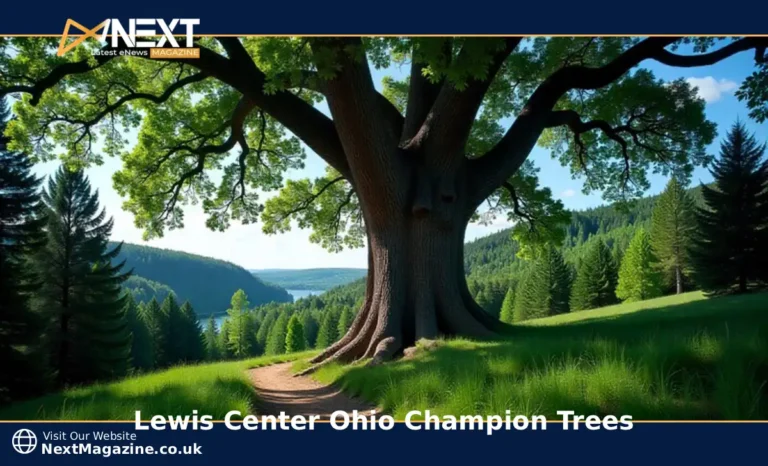
Lewis Center sits in Delaware County, home to two of Ohio’s largest champion trees, including a national record holder. The Ohio champion tree program tracks the state’s biggest trees by species, and you can visit several remarkable specimens within minutes of Lewis Center.
What Makes a Tree a Champion in Ohio
Champion trees aren’t just old or historically significant. They’re the biggest living examples of their species, measured by a specific point system.
The Ohio Division of Forestry has tracked these giants since the 1950s. Each tree gets scored using a formula that combines three measurements: trunk circumference in inches (one point per inch), height in feet (one point per foot), and average crown spread in feet (one quarter point per foot). Add these together, and you get the tree’s total score.
The tree with the highest score for each species becomes Ohio’s state champion. Some Ohio trees also rank as national champions, meaning they’re the largest of their kind in the entire United States. American Forests manages the national registry and uses the same measurement system.
You can nominate any tree you find. Champions appear in backyards, cemeteries, parks, and occasionally in forests. Dense woodlands rarely produce champions because trees compete too heavily for light and nutrients.
Delaware County’s Record-Breaking Trees
Delaware County punches above its weight in the champion tree world. The county hosts at least two of Ohio’s largest trees, including one that holds a national title.
The eastern cottonwood at Alum Creek State Park stands as the national champion of its species. Located near the intersection of Africa Road and Cheshire Road, just east of Alum Creek Lake and minutes from Lewis Center, this tree measures 370 inches in circumference (about 31 feet around), reaches 136 feet tall, and spreads 135 feet across. That gives it 540 points on the national scale.
This cottonwood keeps growing. It gains a couple inches in circumference each year and will likely become Ohio’s largest tree of any species within a few years.
Delaware County also holds Ohio’s largest black walnut tree. Black walnut ranks as the most valuable timber species east of the Mississippi River, which makes this champion particularly notable.
The county’s soil composition and climate create ideal conditions for these giants. Glacial till deposits left nutrient-rich soil, and the region’s rainfall patterns support steady growth without the drought stress that stunts trees in other parts of Ohio.
How to Visit Champion Trees Near Lewis Center
You can see the national champion cottonwood at Alum Creek State Park without much trouble. The tree stands in woodland near Dr. Don R. Mann’s veterinary offices, just a few yards into the woods. Its enormous size makes it unmistakable once you’re in the area.
Park near the Africa Road and Cheshire Road intersection. The tree sits on public land, but respect any posted signs and stay on designated paths. Early morning or late afternoon provides the best light for photography, and spring through fall offers the most dramatic canopy views.
Alum Creek State Park also features The Storybook Trail in Lewis Center, where you can see other notable trees during your visit. Delaware State Park, another short drive from Lewis Center, offers additional opportunities to see mature native trees in a natural setting.
When visiting any champion tree, remember these guidelines. Don’t climb on or carve into the bark. Stay back from the root zone, which extends as far as the branches spread. Take only photos and leave the area as you found it. These trees have survived decades or centuries, and they need protection to keep growing.
The Champion Tree Measurement System
The champion tree formula balances three dimensions to capture a tree’s overall size. Here’s how it works in practice.
Trunk circumference gets measured at 4.5 feet above the ground, a standard height called “diameter at breast height” or DBH. You measure around the trunk at this point and record the result in inches. A tree that’s 100 inches around the trunk at this height gets 100 points.
Height measurement runs from the ground to the highest living part of the tree. This requires either climbing equipment, a laser rangefinder, or trigonometry with a clinometer. A tree that stands 80 feet tall receives 80 points.
Crown spread measures the average width of the tree’s canopy. You measure the widest point, then measure perpendicular to that line, then average the two numbers. A tree with a 60-foot average spread gets 15 points (60 divided by 4).
Add those three numbers together for the total score. In this example: 100 + 80 + 15 = 195 points.
Trees must get remeasured every 10 years to stay on the registry. Storms damage trees, disease weakens them, and new discoveries happen regularly. The list stays current through this decade-by-decade verification process.
Nominating a Tree for Champion Status
Anyone can nominate a tree for champion status. You don’t need special training or expensive equipment.
Start by identifying the tree species correctly. Ohio tracks 239 different species, both native and naturalized. If you’re not sure what kind of tree you’ve found, take photos of the leaves, bark, and overall shape. Local arborists or the Ohio Division of Forestry can help with identification.
Measure the tree using the three-part system described above. You need accurate numbers for circumference, height, and crown spread. Basic tools work fine. A measuring tape handles circumference, a clinometer or laser rangefinder measures height, and a long tape or pacing measures crown spread.
Document your measurements with photos. Show the full tree, the measurement points, and the surrounding area. Note the exact location with GPS coordinates or a detailed address.
Contact the Ohio Division of Forestry through their website or by phone. They’ll provide the official nomination form and any additional requirements. A forester may visit to verify your measurements before adding the tree to the state registry.
The entire process takes a few weeks to a few months, depending on the forester’s schedule and verification needs. If your tree sets a new state record, you’ll receive recognition, and the tree gets listed in the official registry.
Why Champion Trees Matter to Your Community
Champion trees provide measurable benefits beyond their impressive size. A single large tree can store several tons of carbon in its wood, pulling CO2 from the atmosphere and locking it away for decades or centuries.
These trees filter thousands of gallons of water each year through their root systems. This reduces runoff, prevents erosion, and helps maintain water quality in local streams and lakes. The eastern cottonwood at Alum Creek State Park processes massive amounts of water given its size and location near the lake.
Wildlife depends on large trees for food and shelter. Old trees develop cavities that house birds, mammals, and insects. Their extensive canopies create habitat niches that younger trees can’t match.
Properties with large, healthy trees command higher values than similar properties without them. Real estate studies consistently show that mature trees add thousands of dollars to home values, and champion-caliber specimens create even more impact.
From an educational standpoint, champion trees offer hands-on learning opportunities. Students can study ecology, forestry, and conservation through these living examples. Local schools in the Lewis Center area use nearby champion trees as outdoor classrooms.
Getting Involved with Big Trees Ohio
Marc DeWerth founded Big Trees Ohio in recent years to help find and document Ohio’s largest trees. His volunteer organization has catalogued over 1,000 trees that were previously unknown to the Ohio Division of Forestry.
DeWerth and his network of “big tree hunters” search the state for champion candidates. They measure, photograph, and document trees they find, then submit nominations to the state program. This citizen science approach has dramatically expanded Ohio’s champion tree registry.
You can join this effort through Big Trees Ohio’s Facebook page, which has more than 15,000 followers. Members share tips on potential champions, discuss measurement techniques, and coordinate search efforts across the state.
Preservation Parks of Delaware County also offers programs related to tree conservation and education. They maintain several parks near Lewis Center where you can observe mature trees and learn about forest ecology.
The work matters because many champion trees remain undiscovered. They grow on private property, in remote areas, or in plain sight where no one has thought to measure them. Every new discovery helps complete the picture of Ohio’s natural heritage and provides another specimen to protect for future generations.
If you spot a remarkably large tree anywhere in Delaware County or the Lewis Center area, take the time to measure it. You might find the next state or national champion, and you’ll contribute to the ongoing effort to identify and preserve Ohio’s biggest trees.
