

Table of Contents
Lipofullerene is gaining attention in the world of health and wellness, usually marketed as a powerful antioxidant. But the name is used loosely online. It’s attached to skincare ingredients, to oil-based “C60” supplements and to anti-ageing claims that the science doesn’t always support. This guide explains what lipofullerene actually is, what the research shows so far, and what to check before you buy a product that contains it.
What Is Lipofullerene?
Lipofullerene starts with fullerene C60, a molecule made of 60 carbon atoms arranged in a hollow sphere, often compared to a football. C60 was discovered in 1985 by Harold Kroto, Robert Curl and Richard Smalley, work that earned them the 1996 Nobel Prize in Chemistry. For a technical overview of fullerene materials, ScienceDirect has a detailed summary.
Pure C60 doesn’t dissolve in water, which makes it hard to use in products. Japan’s Vitamin C60 BioResearch Corporation solved this in two ways. It wrapped C60 in water-soluble polymers for water-based formulas (sold as Radical Sponge), and it dispersed C60 in squalane, a skin-friendly oil, for oil-based formulas. That oil-dispersed version is LipoFullerene, a trademarked ingredient. Its INCI name on cosmetic labels is “Fullerenes, Squalane”, and the current grade uses plant-derived squalane from olives.
In other words, lipofullerene isn’t a lipid-modified molecule. It’s ordinary C60 carried in an oil, designed mainly for creams, serums and other skincare.
Lipofullerene vs. C60 Oil Supplements: What’s the Difference?
This is where most confusion comes from. Two different product types are often described with the same words:
- LipoFullerene (cosmetic ingredient): C60 in squalane, applied to the skin as part of a skincare formula. It’s sold to manufacturers, not usually as a stand-alone product.
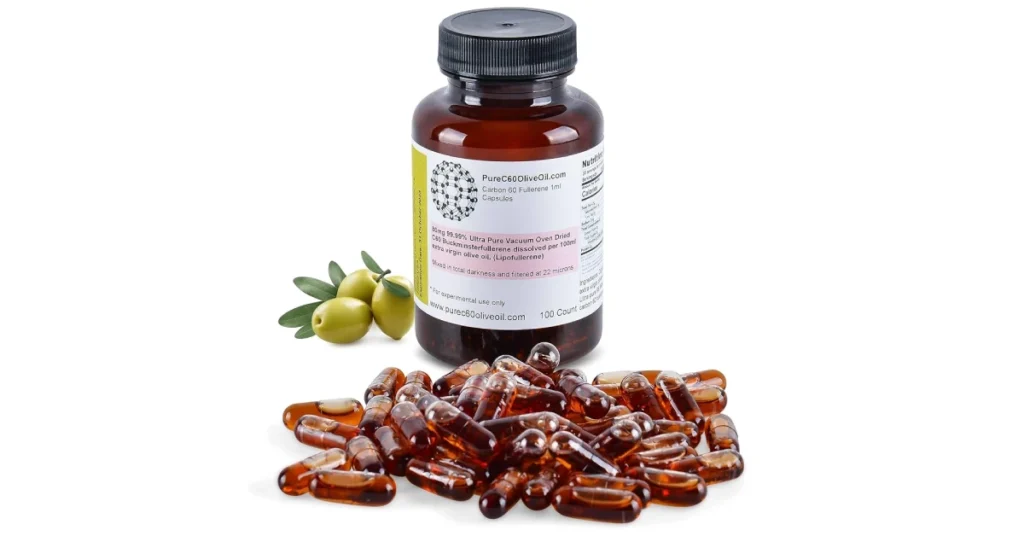
- C60 oil supplements: C60 dissolved in olive, avocado, MCT or other oils and taken by mouth. These are sold directly to consumers, often with claims about energy, ageing or longevity.
The two share a molecule but not an evidence base. Research on topical use doesn’t tell you anything about swallowing C60, and vice versa. If a product is labelled a “lipofullerene supplement”, check whether it’s meant for the skin or for oral use, and what oil it uses.
What the Research Actually Shows
Fullerene’s appeal comes from its ability to neutralise free radicals in laboratory tests. Free radicals drive oxidative stress, which is linked to skin ageing and many chronic diseases. A review of fullerenes as anti-ageing antioxidants explains the theory behind this. Turning lab activity into proven health benefits is a different matter, and the evidence so far looks like this:
- Skin cells (lab studies): a 2010 study in the Journal of Biomedical Nanotechnology found that C60 dissolved in squalane protected human skin cells and a 3D skin model from oxidative damage better than squalane alone. That supports its use in skincare, but it was a lab study, not a trial on people.
- Lifespan in animals: a widely shared 2012 study (Baati et al., Biomaterials) reported that rats given C60 in olive oil lived almost twice as long. Later attempts to repeat it didn’t hold up. A 2020 mouse study in GeroScience found no lifespan extension, and it found that C60 oil exposed to light could become toxic. A 2021 mouse study also found no meaningful benefit.
- Heart health, inflammation and energy in humans: no published human clinical trials support these claims for oral C60 or lipofullerene products.
The honest summary: lipofullerene has a reasonable lab basis as a skincare antioxidant, while claims for oral supplements remain unproven. Manufacturer comparisons such as “hundreds of times stronger than vitamin C” come from marketing material, not independent human studies.
Safety and Regulation
LipoFullerene is used in cosmetics, where ingredient databases list fullerenes as a skin-conditioning ingredient. Oral C60 products are less well studied, so a few points are worth knowing:
- No pre-approval: in the UK and US, food supplements aren’t tested or approved for effectiveness before they’re sold. The seller is responsible for safety and for not making unauthorised health claims.
- Light and storage: the 2020 study linked toxicity to C60 oil that had been exposed to light. If you use an oil-based product, choose a dark or opaque bottle and store it away from sunlight.
- Medications and health conditions: there’s little interaction data, so check with a doctor or pharmacist first, particularly if you’re pregnant, breastfeeding or on regular medication.
A healthcare professional can help you ensure the supplement is suitable for your specific health needs.
How to Choose a Lipofullerene Product
Selecting the right lipofullerene supplement requires careful consideration of several important factors:
- Product type: decide whether you want a skincare product containing LipoFullerene or an oral C60 oil, as they’re used and evaluated differently.
- Ingredient transparency: look for the C60 concentration and the carrier oil. On skincare, “Fullerenes” or “Fullerenes, Squalane” should appear in the INCI list.
- Third-party testing: choose products tested by independent labs for C60 purity and for residual solvents left over from manufacturing, and ask to see the certificate of analysis.
- Packaging: for oils, prefer light-protective bottles with a clear batch number and expiry date.
- Realistic claims: treat promises about longevity, disease prevention or “doubling lifespan” as a red flag.
For more on judging supplement quality in general, see this guide on choosing supplements.
Real-World Applications of Lipofullerene
Lipofullerene’s main established use is in skincare, where it appears in anti-ageing serums, creams and oils intended to protect skin from free-radical damage caused by UV light and pollution. Suppliers also position it for products targeting wrinkles, pores, acne-prone skin and hair care.
Beyond cosmetics, fullerenes more broadly are being studied for drug delivery and other medical uses. That work is still at an early research stage and isn’t a reason to take C60 products today.
Wrapping Up
Lipofullerene is best understood as C60 fullerene carried in squalane, developed mainly as a skincare antioxidant. Laboratory studies support that role, but claims about heart health, inflammation or longer life from oral lipofullerene supplements aren’t backed by human evidence, and the famous rat lifespan result failed when others tried to repeat it.
If you decide to try a product, choose one with clear labelling, independent testing and light-protective packaging. Talk to a healthcare professional before adding any oral C60 product to your routine.

Mia Saunders
Mia writes health, lifestyle, and wellbeing content with a careful, reader-first approach that never blurs fact and general guidance. She favors understandable language and sensible context over sweeping claims, treating her readers as capable of handling the distinction. Her pieces are calm, clear, and genuinely useful.
View all articles →Get the Weekly Brief
The best guides and stories, delivered every Sunday.