
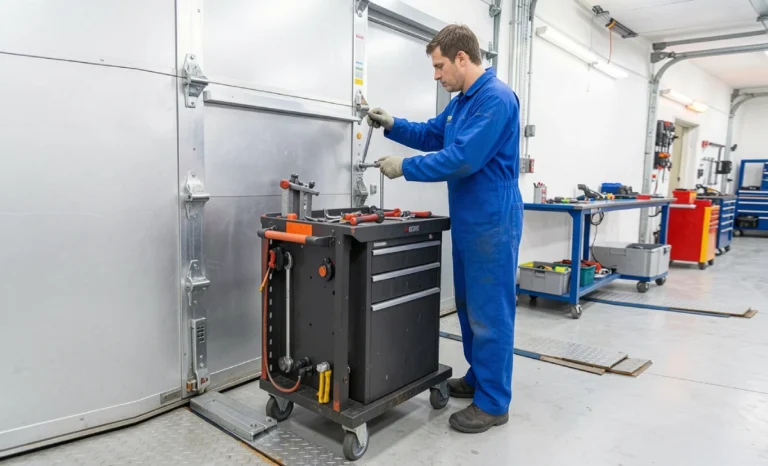
An Ausbeulstation is a mobile, professional dent repair workstation used in auto body repair. It combines a stud welder (spotter), pull bridges, slide hammers, and dent lifters on a wheeled workshop trolley. Technicians use it to remove dents through glue-pull or lever techniques without damaging the original paintwork.
A dent appears on a car door. The repair needs to be clean, fast, and paint-free. The technician wheels a compact station to the vehicle, connects the spotter, positions the pull bridge, and gets to work. No sanding. No filler. No repainting. This is what an Ausbeulstation makes possible.
The term is German, but the equipment is used in professional body shops across Europe and beyond. If you work in automotive repair or are evaluating equipment for your workshop, understanding what an Ausbeulstation actually does and what separates a good one from a weak one matters more than the price tag.
What an Ausbeulstation Actually Is
An Ausbeulstation is a wheeled workshop trolley built specifically for car body repair. It holds all the tools needed for paintless dent repair (PDR) in one organized, mobile unit. The core component is an Ausbeulspotter (stud welder), paired with pulling tools, bridges, hammers, and glue-pull accessories.
The difference between working with an Ausbeulstation and using individual tools scattered around a workshop is time and focus. With everything mounted on a single rolling station, you move the workstation to the vehicle, not the other way around. That cuts setup time and keeps your attention on the repair itself.
Systems vary in size and complexity. Entry-level sets include a trolley, a basic spotter, and one or two pull bridges. Professional complete systems, such as the KRAUSS TOOLS Car Body Repair System 4200 or the GYS Speedliner Combi, include multiple bridge sizes, several hammer types, full glue-pull kits, and dedicated storage for every accessory.
Common use cases include hail damage (Hagelschaden), parking dents (Parkdellen), side panel creases, and fender damage, in which repainting would unnecessarily reduce the vehicle’s value and increase repair costs.
The Key Tools Inside an Ausbeulstation
The Ausbeulspotter (Stud Welder)
The spotter is the electrical centerpiece of the station. It uses resistance welding to temporarily attach pulling elements directly onto the dent: pull stars, corrugated wires, eyelets, or copper-coated bolts. The technician then pulls through these elements to reshape the panel.
Modern inverter spotters, such as the Telwin Car Spotter 5500 or the GYS GYSPOT series, regulate current and weld time through a microprocessor. This matters because today’s car body panels are thinner than they were ten years ago. Too much heat burns through the panel or damages the anti-corrosion coating on the reverse side. Inverter spotters control this precisely. Older transformer-based spotters are cheaper but offer less control and are poorly suited to modern thin-gauge panels.
Professional stations run on 400V three-phase power, which delivers more consistent output during heavy use. Entry-level models run on 230V single-phase, which works well for smaller operations with lighter workloads.
Pull Bridges, Slide Hammers, and Dent Lifters
Every Ausbeulstation includes at least one scissor pull bridge (Scherenzugbrücke) and a slide hammer (Gleithammer). The pull bridge spans across the damaged area and distributes pulling force evenly over a larger surface. It is the right tool for long creases and widespread hail damage where a point-pull would create new high spots.
The slide hammer pulls with force and works best on deeper, more structural dents where the metal needs aggressive correction before fine-tuning. The dent lifter (Dellenlifter or Pull System) is a precision tool. It lifts small dents with millimeter-level control and minimal stress on surrounding areas.
Professional complete sets include multiple bridge sizes, typically 750 mm, 850 mm, and 1,250 mm. Having the right bridge size for each type of damage is not a luxury. It is what makes the difference between a clean repair and an overcorrected panel.
The PDR Light
A PDR light is not optional. It is a requirement for any paintless dent repair work. The LED strips cast a defined pattern of reflective lines across the body panel. The technician reads these reflections to identify where tension remains in the metal, where the high points are, and when the surface is fully restored.
Without proper lighting, you cannot see the result of your work accurately. Reflections reveal what the naked eye misses. Systems like the KRAUSS TOOLS PDR Fixierlampe with a flexible arm and suction mount attach directly to the station and position where needed without taking up floor space.
Glue-Pull or Lever Technique?
Both methods are standard in professional PDR work. Which one you use depends on the damage type and how accessible the panel is from the inside.
The lever technique (Hebeltechnik) works from the inside of the panel. The technician removes interior trim, feeds a PDR rod behind the sheet metal, and pushes the dent outward from the inside. This method is highly precise and well-suited for single dents on accessible panels such as doors, fenders, and bonnets.
The glue-pull technique (Klebetechnik) works entirely from the outside. A pull adapter is bonded to the dent surface with hot glue or cold glue. A pull bridge or slide hammer then applies tension from above. This is the right choice when the inside of the panel is inaccessible or when removing the interior trim would take longer than the repair itself.
In practice, both methods are often used together on the same repair. Glue-pull lifts the bulk of the dent, lever technique brings the surface to its final level. Knowing when to switch between the two is what separates a trained PDR technician from someone working with a basic consumer kit.
Aluminum Panels Require a Different Approach
Aluminum behaves differently from steel under mechanical stress. It work-hardens quickly when cold-formed, which means attempting to pull a dent without heat can cause the panel to crack or deform permanently.
Professional Ausbeulstations for aluminum use capacitor discharge (CD) welding instead of standard resistance welding. This process bonds aluminum studs, typically AlMg3 or AlSi12 alloy, to the dent without damaging the surrounding metal. An induction heater or hot air blower then warms the panel to around 200 to 300 degrees Celsius before pulling begins. This heat increases the ductility of the aluminum and allows a clean, lasting repair.
Combi spotters, such as the GYS GYSPOT Combi 230 E.PRO, handle both steel and aluminum in a single unit. As of 2026, multi-material car bodies combining high-strength steel, aluminum, and ultra-high-strength steel (UHSS) are standard across most new vehicle platforms. An Ausbeulstation configured only for steel will fall short when servicing newer vehicles. If your workshop handles a mixed fleet, a combi system is the practical choice.
What to Consider Before You Buy
Before purchasing an Ausbeulstation, answer these questions honestly:
- What material do you repair most? Steel-only workshops can work with a standard spotter. Regular aluminum work requires a combination system with CD welding capability.
- How much floor space do you have? A mobile station on castors is a major advantage in compact workshops. It comes to the vehicle, not the other way around.
- What power supply is available? 230V single-phase is easier to connect and sufficient for light use. 400V three-phase is built for sustained professional output.
- Is a spotter included or sold separately? Some suppliers sell the trolley and tools without the spotter. Read the contents list before ordering.
- How many bridge sizes are included? Hail damage repairs require at least one long bridge over 1,000 mm. A single small bridge limits the types of damage you can handle efficiently.
Market pricing for complete sets ranges from around 500 euros for entry-level steel systems to over 3,000 euros for professional combi stations with aluminum spotters, multiple bridges, and full accessories. The price difference reflects the range of repairs you can take on, so match the system to your actual workload.
FAQ
Does an Ausbeulstation always preserve the original paint?
Not automatically. The station enables paintless dent repair, but the outcome depends on the damage. Dents with paint cracks, very sharp creases, or significant metal deformation at the impact point may require conventional repair, including filler and repainting. PDR works best on smooth, round dents where the paint is undamaged.
Can I use an Ausbeulstation for hail damage?
Yes. Hail damage repair is one of its primary uses. Technicians work systematically across the panel using the glue-pull technique and flat pull bridges to lift multiple small dents in sequence. Spotters with automatic parameter settings speed up this process considerably when working across a large affected area.
What is the difference between an Ausbeulspotter and a standard spot welder?
An Ausbeulspotter is designed for temporarily bonding pull elements to body panel surfaces. It delivers high current over very short intervals, calibrated to minimize heat damage to the paint and the panel’s protective coatings. A standard spot welder is built for permanent structural joins and generates far more heat than a body panel can tolerate without damage. The two are not interchangeable.
