
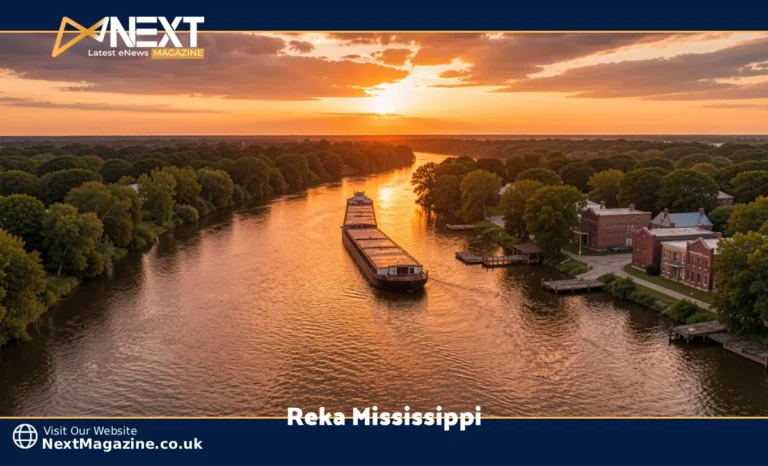
Let me clear something up right away. If the term “Reka Mississippi” stopped you for a second, that’s fair. Reka simply means “river” in several Slavic languages—Czech, Russian, Slovak, and others. So yes, we’re technically saying “River Mississippi.” And honestly? That double weight feels right. Because this isn’t just any river. It’s the river.
I’ve stood on its banks in Minneapolis, where it’s narrow enough to make you think, ” That’s it? And I’ve looked out at it near New Orleans, where it spreads so wide it stops looking like a river at all. Down there, it looks like an inland sea that’s still deciding where it wants to go.
The Reka Mississippi has shaped North America in ways most of us don’t think about during daily life. But once you start looking, you see its mark everywhere—in the food on your plate, in the price of gas, in the history books your kids bring home.
What Makes the Reka Mississippi So Powerful?
If I had to boil it down to one truth, it would be this: The Reka Mississippi isn’t just a body of water. It’s a backbone. It holds up the middle of a continent.
The river starts quietly. It trickles out of Lake Itasca in northern Minnesota as a modest stream—maybe 20 to 30 feet wide at its narrowest. You could nearly jump it. From there, it winds more than 2,340 miles south through ten states, picking up strength from major tributaries like the Missouri and Ohio Rivers, before finally emptying into the Gulf of Mexico. Along the way, it drains a basin covering roughly 41% of the contiguous United States.
For thousands of years, Native American nations travelled it by canoe. Later, it hauled steamboats loaded with cotton and corn. Today, it still moves around 500 million tons of cargo every year—grain, steel, petroleum, chemicals. Most people have no idea how much of their daily life floated past Memphis or Baton Rouge on a barge.
Here’s what surprised me most: even with all our highways and freight trains, the Mississippi River remains one of the cheapest ways to move heavy goods across the country. A single barge carries the same load as roughly 70 semi-trucks—using far less fuel to do it. That’s not nostalgia for an older era. That’s just math.
A River That Carried a Nation’s Story
Long before European explorers arrived, Indigenous peoples lived with the river—not against it. They fished its waters, farmed its rich floodplains, and read its currents the way we read road signs. The Ojibwe called it “Misi-ziibi,” meaning great river. That name, and the deep respect behind it, tells you everything about how central it was to life on this land.
When Spanish explorer Hernando de Soto encountered it in 1541, and later French missionaries Marquette and Jolliet in 1673, they recognised its potential immediately. Steamboats in the 1800s turned the Mississippi River into a commercial highway. Goods moved south faster and cheaper than they ever could over land, connecting the interior of the country to global markets through New Orleans.
There’s something almost striking about how the river both divided and connected the nation. During the Civil War, control of the Reka Mississippi was a turning point—literally cutting the Confederacy in two when Union forces took key stretches. Mark Twain understood this river the way most of us understand our hometowns. He described its ever-shifting channels, its sandbars, its moods. To him, it wasn’t scenery. It was a living thing.
That sense still holds today. Mississippi River history isn’t just a school subject. It’s the foundation of how the American interior was settled, traded, and fought over.
A Reality Check—Because Nothing’s Perfect
Now here’s something worth sitting with, even if it’s uncomfortable.
There’s an ongoing debate among hydrologists and environmental planners: Have we controlled the Reka Mississippi too much?
The levees, locks, and dams built over the last century have stopped a lot of flooding. But they also cut the river off from its natural floodplain. When a genuinely large flood comes—and they always do—the water has nowhere to spread except up and over.
And then there’s a problem most people haven’t heard enough about: invasive species. Asian carp have pushed through much of the Mississippi River watershed, competing aggressively with native fish. Zebra mussels clog water intake pipes and alter entire ecosystems. These aren’t distant environmental abstractions. They affect local fishing economies, water treatment costs, and the health of waterways that millions of people depend on.
Some experts argue we need to allow certain stretches of the river to flood on purpose again—the way nature intended—to restore those floodplain functions. Others say that’s simply not realistic with so many cities and farms in the way.
I don’t have a clean answer to offer. But I’ve learned that respecting a river means listening to both sides of the argument, not just the comfortable one.
What the Next Few Years Could Look Like
Here’s a question I think about more than I probably should: What will the Reka Mississippi look like in five years?
We’re already watching longer droughts in the upper Midwest followed by sudden, heavy rainfall events. That’s a rough combination for any river system. In late 2024 and into 2025, low water levels slowed barge traffic along the lower Mississippi for weeks at a time. Farmers couldn’t move grain to the port. Shipping costs climbed. Communities that depend on Mississippi River barge traffic felt it in their operating margins.
Over the next few years, I’d expect more of that unpredictability—not constant crisis, but more frequent disruption. Towns from Cairo, Illinois, to Baton Rouge are already starting to ask harder questions: Do we build higher flood walls, or do we learn to work around more water?
Some places are experimenting with “managed retreat”—moving streets back from the water’s edge and turning old flood zones into parks and wetlands. It’s slow, honest work. And it’s one of the more realistic Mississippi River flooding solutions anyone’s come up with.
Why the Gulf Dead Zone Matters to Your Dinner Table
Let’s talk about something that sounds distant but really isn’t.
Every year, chemical runoff—mainly fertilisers from farms across the Mississippi River watershed—flows downstream and into the Gulf of Mexico. There, it creates a massive oxygen-depleted zone that marine life can’t survive in. This dead zone regularly reaches the size of Connecticut.
Here’s why that should bother you, even if you don’t live anywhere near the Gulf: that dead zone kills off shrimp and oysters. It disrupts fish populations. And when the Gulf’s seafood output drops, prices at your grocery store and favourite restaurant go up. The river’s health and your seafood dinner are connected by a very direct line.
Less chemical fertiliser on lawns and fields upstream means more oxygen—and more life—in the water downstream. It’s one of those ripple effects that’s hard to see, but very real.
What You Can Actually Do (No Grand Gestures Required)
You don’t have to become an environmental activist to make a meaningful contribution. Here’s what I’ve seen work for regular people:
- Look up a local river cleanup event. Search “Mississippi River cleanup [your city]” and sign up for an hour on a Saturday morning. It’s low-effort, social, and surprisingly satisfying.
- Cut back on lawn fertiliser. Seriously. The runoff connection to the Gulf dead zone is real, and this is one of the most direct personal contributions you can make.
- Visit a river town—not just a river view. Places like Dubuque, Iowa or Vicksburg, Mississippi, have small museums, riverfront trails, and people who’ve lived beside this water their whole lives. Walk those trails. Talk to locals. They’ll tell you things no website can.
- Pay attention to where your food comes from. A lot of Midwestern grain and produce travels by barge. Supporting farms that use sustainable practices near the river helps keep the life along the Mississippi River healthier for everyone.
- Donate used life jackets or fishing gear to local boating safety programs. Small thing. Real impact.
None of this is dramatic. It’s just thoughtful. And that’s genuinely enough.
A Few Questions Worth Sitting With
The Reka Mississippi has been here for roughly 12,000 years—since the last ice age carved it into shape. It will be here long after we are.
But I keep coming back to a few things:
- How will the next generation remember this river—as an economic workhorse, a wild place, or both?
- What would change if more schools taught kids to read a river current before teaching them to read a balance sheet?
- And maybe most personally: when was the last time you just watched a river move without checking your phone?
If this article gets you to find the nearest stretch of the Mississippi—even a quiet public access point—and stand there for five minutes, it did exactly what it was meant to do.
The river doesn’t need you to save it. It just needs you to see it.
FAQs
What does “Reka Mississippi” mean?
“Reka” means “river” in several Slavic languages, including Czech and Russian. So “Reka Mississippi” essentially translates to “River Mississippi.” It’s often used as a respectful nod to the river’s cultural roots and linguistic history, echoing Indigenous names like the Ojibwe “Misi-ziibi,” which also means great river.
How long is the Mississippi River?
The Mississippi River stretches approximately 2,340 miles from Lake Itasca in northern Minnesota to the Gulf of Mexico, passing through ten states along the way.
Why is the Mississippi River so important economically?
It supports massive commercial shipping—around 500 million tons of cargo per year—and connects agricultural regions in the Midwest to global markets. The barge industry tied to the river contributes hundreds of billions in economic activity annually.
Does the Mississippi River still flood regularly?
Yes. Flooding remains a natural and periodic reality. Engineering has reduced some risks, but extreme weather patterns and upstream land use continue to affect water levels in unpredictable ways.
What are the biggest environmental threats facing the river today?
Chemical runoff from agricultural fertilisers (which fuels the Gulf of Mexico dead zone), invasive species like Asian carp and zebra mussels, and shifting weather patterns that cause both droughts and severe flooding are among the most pressing concerns.
Can you visit or travel on the Mississippi River?
Absolutely. There are riverboat cruises, national parks, recreation areas, fishing access points, and scenic overlooks all along its length. Towns like Dubuque, Iowa, and Vicksburg, Mississippi, are good starting points for first-time visitors.
