
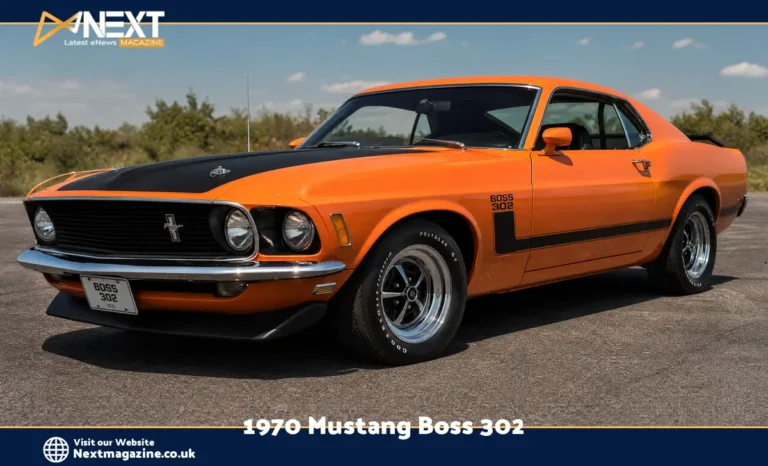
The 1970 Mustang Boss 302 packed a 290-horsepower 302 cubic-inch V8 into a homologation special built to beat the Chevrolet Camaro Z/28 in Trans Am racing. Ford built 6,318 examples for the model year. Clean, numbers-matching cars now trade between $75,000 and $150,000, with rare colours and documented race history pushing well past that.
Ford built exactly two model years of the Boss 302, and 1970 was the one that finally worked. The 1969 car had the look and the engine, but tyre trouble and slow pit stops kept it off the top step of the Trans Am podium. For 1970, Ford handed the racing program to Bud Moore, switched to Goodyear tyres, and the results showed on the street car too. If you are researching a 1970 Mustang Boss 302, here is what actually separates a genuine one from a look-alike, what it is worth today, and what to check before you buy.
What Made the Boss 302 Different From a Regular Mustang
The Boss 302 was never meant to be a trim package. Ford needed a production car to qualify the Mustang for SCCA Trans Am racing, and the rules said the street version had to share real hardware with the race car.
Larry Shinoda led the design. He had come from GM alongside new Ford president Semon “Bunkie” Knudsen, and he knew exactly what the Camaro Z28 was capable of because he had helped build it. Shinoda stripped the fake rear quarter scoops off the 1969 Mustang, added a front spoiler, and gave the car a rear deck wing. For 1970 he went further, replacing the outer headlights with vents and pulling the inner lights into the grille opening, plus adding the “hockey stick” side stripes that are now the car’s signature look.
Under the hood sat a small block V8 fitted with big port cylinder heads borrowed from the still-unreleased 351 Cleveland. That combination is what gave the Boss 302 its high-revving character. Ford rated it at 290 horsepower, a figure most historians and owners consider deliberately conservative to keep insurance costs and racing classifications favourable.
1970 Mustang Boss 302 Specs and Performance
Here is what came standard on every 1970 Boss 302:
- Engine: 302 cubic inch V8 with forged crankshaft, four bolt main bearings, forged connecting rods, and a Holley four barrel carburettor on a high ris aluminium intake
- Output: 290 horsepower at 5,800 rpm and 290 lb-ft of torque at 4,300 rpm, rated well below what many owners and testers measured in practice
- Transmission: Four-speed manual with a standard Hurst shifter
- Suspension: Staggered rear shocks, front and rear sway bars, quick ratio steering box
- Brakes: Front discs, rear drums
- Tires: F60x15
- Weight: Roughly 3,400 to 3,500 pounds depending on options
- Base price when new: About $3,720
Car and Driver ran a Boss 302 through the quarter mile in 14.9 seconds at 93 mph in early testing, a strong number for a car wearing period tyres and gearing built more for road course grip than straight-line speed. The four-speed and 3.91 Traction-Lok rear end most buyers chose were tuned for corner exit, not stoplight launches, which is part of why the Boss earned its reputation as a driver’s car rather than a pure dragstrip weapon.
The rear sway bar was new for 1970, a small but important change from the 1969 car. It let Ford fit the front sway bar at its originally planned stiffness, which sharpened turn-in noticeably. An optional Shaker hood scoop, functional rear window louvres, and a rear spoiler rounded out the visual and aerodynamic package.
Production Numbers and Colour Options
Ford built 6,318 Boss 302 Mustangs for the 1970 model year, a big jump from the 1,628 built in the shortened 1969 debut season. That still makes the 1970 car a genuinely low-production vehicle by any modern standard, and far scarcer than the regular Mustang SportsRoof it was based on.
Sixteen colours were offered across the full 1970 Mustang lineup, but the Boss 302 typically came in a shorter list of factory colours, including:
- Grabber Blue
- Grabber Orange
- Grabber Green
- Calypso Coral
- Pastel Blue
Some cars left the factory in less common shades like Medium Lime Green or Medium Blue Metallic, and those slow-production colours now carry a real premium among collectors. Interiors were black across the board, with a Deluxe interior option available for buyers who wanted extra trim.
How the 1970 Boss 302 Performed on Track
The whole reason the Boss 302 existed was Trans Am racing, and 1970 was the year the program paid off. Bud Moore Engineering ran factory-backed cars on Goodyear tyres, a switch from the Firestones that had hurt the 1969 effort. Driver Parnelli Jones edged out Team Penske’s AMC Javelins, with Penske’s own driver Mark Donohue finishing behind Jones in the championship battle. It was Ford’s only Trans Am manufacturer’s title of the Boss 302 era, and the company pulled out of factory-backed Trans Am racing after the season ended.
That racing pedigree is a big part of why the model still commands attention more than fifty years later. Unlike a lot of muscle car era “sport” trims that were really just stripe and badge packages, the Boss 302’s suspension geometry, quick steering, and high-revving engine came directly from what Bud Moore’s team needed to win.
1970 Mustang Boss 302 Price and Market Value Today
Values for the 1970 Boss 302 have held up better than a lot of muscle car peers, though the market has cooled somewhat compared to the sharp run-up seen a few years ago.
According to Classic.com’s tracked sales for the 1969 and 1970 Boss 302, the average sale price sits around $96,000, with recorded sales as low as $34,000 for rougher or modified cars and well into six figures for documented, numbers-matching examples. A 1970 car sold at Mecum’s Indy sale in May 2026 for $82,500, right in line with that broader average.
Hagerty’s price guide tracks the model separately by condition, and its analysts have noted that the Boss 302 market has been relatively stable rather than booming in recent years, unlike some other muscle car nameplates. One Hagerty market report pointed to a 1970 example that sold at a Bonhams auction for just over $50,000, roughly half its condition-appropriate guide value, as a sign the market can still swing hard on documentation and originality.
A few things drive price more than anything else on a 1970 Boss 302:
- Numbers-matching engine and transmission, confirmed against a Marti Report
- Rare factory colours, especially low production shades
- Documented racing or celebrity ownership history
- Original, unmodified drivetrain and rear axle ratio
- Condition of body panels and floor pans, since rust repair is expensive on this generation
A car with a retrofitted rear end, a non-original hood, or an unverifiable engine block will sell for meaningfully less than a numbers-matching example in the same colour and condition, even if it drives just as well.
Spotting a Genuine Boss 302
Because the Boss 302 has commanded real money for decades, it has also attracted its share of clones and “recreations” built from ordinary 1970 SportsRoof Mustangs. The Boss 302 Registry, the longest-running resource dedicated to the model, keeps a public warning page specifically because owners have submitted VINs and option lists that later turned out to be inaccurate or altered.
A few checks matter more than any dealer story or sticker:
- The VIN must have the letter G in the fifth position. That code identifies the Boss 302 engine. No G means it is not a genuine Boss 302, no matter what stripes or spoilers have been added.
- Order a Marti Report from Marti Auto Works. It documents the original build sheet for any Ford, Lincoln, or Mercury built in North America between 1967 and 1973, and it is the standard reference buyers and appraisers use to confirm options.
- Check the engine block for screw-in freeze plugs, eight bolts holding down each valve cover, and a thermostat housing mounted to the intake manifold rather than the block, all details specific to the Boss 302 engine.
- Cross-reference the car against the Boss 302 Registry listing if one exists, but treat that listing as a starting point, not proof. Registry entries are self-reported by owners.
If you are shopping and want an internal comparison point for how modern performance vehicles are still chasing the same balance of power and handling that made the Boss 302 famous, it is worth reading up on how a car like the 2026 BMW X6 approaches performance from a completely different era and category.
Buying Tips Before You Commit
Anyone who has bought one of these cars will tell you the same thing: know exactly what you want before you start looking. A bare-bones Boss 302 with the base colour and no options will not command the same price as a heavily optioned example with a Shaker hood, rear spoiler, and louvres, so decide upfront what matters to you.
A short checklist for a serious buyer:
- Get the Marti Report before you even go see the car in person
- Confirm the VIN, engine code, and date codes line up with the report
- Inspect the shock towers and floor pans closely for rust and prior repair
- Ask for maintenance and restoration receipts, not just verbal history
- Budget for a pre-purchase inspection from a Mustang specialist, not a general mechanic
Final Thoughts
The 1970 Mustang Boss 302 earned its reputation the hard way, on a racetrack against a Camaro program built by many of the same people who designed it. That history, combined with genuinely limited production and a driving experience that still holds up, is why clean examples keep finding buyers even as the broader muscle car market cools. Whether you are chasing one for a garage or just researching the model, verifying originality through the VIN, engine details, and a Marti Report will tell you more than any auction description ever will.
FAQs
How much horsepower does a 1970 Mustang Boss 302 actually have?
Ford rated it at 290 horsepower, but that figure is widely considered underrated for insurance and racing classification purposes. Period testing and later analysis suggest real-world output was meaningfully higher.
How many 1970 Boss 302 Mustangs were built?
Ford produced 6,318 for the 1970 model year, up from 1,628 in the shortened 1969 launch year.
What is the difference between a 1969 and 1970 Boss 302?
The main changes were a new rear sway bar that allowed a stiffer front bar, updated front end styling with headlights moved into the grille, new hockey stick side stripes, and an optional Shaker hood scoop.
How much is a 1970 Mustang Boss 302 worth today?
Tracked sales average around $96,000, with documented, numbers-matching examples in desirable colours often exceeding $100,000 and rougher or modified cars selling well below that.
How do I know if a Boss 302 is genuine and not a clone?
Check for the letter G in the fifth position of the VIN, order a Marti Report to confirm the original build sheet, and inspect the engine block for Boss-specific details like screw-in freeze plugs and the correct thermostat housing location.
