
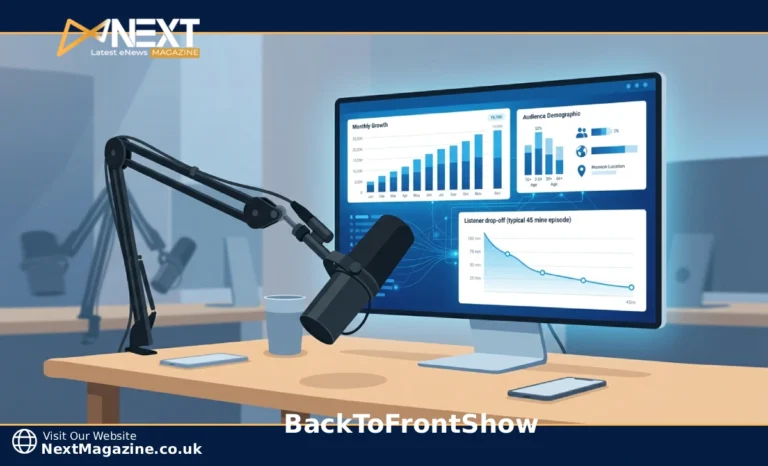
If you’ve been researching podcast analytics tools, you’ve probably already come across BackToFrontShow. At this point, you’re not asking what it is—you’re asking whether it’s worth the money and which plan actually fits your situation.
That’s exactly what this breakdown is for.
BackToFrontShow pricing sits at a level that immediately filters out casual users. These aren’t $20/month subscriptions. So before you schedule a demo or hand over your billing details, it makes sense to understand exactly what you’re paying for, where each plan makes sense, and where it might be overkill.
Let me walk through this clearly—plan by plan.
BackToFrontShow Pricing Overview
BackToFrontShow offers three plans in 2026:
| Plan | Price |
|---|---|
| Basic Plan | $1,200/month |
| Pro Plan | $3,600/month |
| Enterprise Plan | Contact for pricing |
Right away, this tells you something: this platform is built for professional media operations. Podcast networks, content teams, and established shows—not indie creators running a side project. If you’re somewhere in the middle, keep reading, because the decision isn’t always black and white.
One thing most reviews gloss over: there’s no publicly listed information about annual billing discounts, free trials, or what a demo process actually looks like. That matters when you’re weighing a $1,200-per-month commitment. I’ll come back to that.
Basic Plan — $1,200/Month
What You Get
The Basic Plan covers three core areas:
Listener demographic tracking: You get a breakdown of who your audience actually is—age profiles, gender distribution, geographic location. This isn’t just interesting data. It’s the kind of information that changes how you pitch to advertisers. Instead of saying “we have a large audience,” you can say “72% of our listeners are 25–44, majority in the US Northeast.” That’s a different conversation entirely.
Playback location analysis. You can see where in the world people are listening, broken down at a useful level of detail. For shows looking to grow in specific markets or justify international sponsorship rates, this matters.
User engagement monitoring. The Basic Plan tracks social engagement signals—likes, shares, comments—so you can see how actively your audience is interacting, not just how many people pressed play.
What’s Missing at This Level
This is where it’s worth being honest. The Basic Plan does not include listening behavior tracking. That means no data on how far into episodes people actually get, no drop-off analysis, no episode-to-episode popularity comparison.
For a lot of decision-making around content—pacing, segment length, guest selection—that’s the data that would actually help. You won’t have it here.
Who the Basic Plan Actually Makes Sense For
At $1,200 a month, this works if you’re already generating meaningful revenue and need to support advertiser relationships with real audience data. Think shows doing consistent ad deals or sponsorships where demographic proof points change the rates you can command.
A rough way to think about ROI: if detailed audience demographics help you close one additional sponsorship deal or justify a rate increase that adds $2,000–$3,000 per month to your revenue, the math starts to make sense. If you can’t see a clear path to that kind of return, the Basic Plan is a stretch.
It’s not designed for independent creators or shows still building their revenue base. That’s not a criticism—it’s just the reality of where this tier sits.
Pro Plan — $3,600/Month
What You Get
The Pro Plan includes everything in Basic, plus the feature that genuinely separates the two tiers: listening behavior tracking.
Episode popularity monitoring: You can see how individual episodes perform against each other. That means tracking which topics, guests, formats, or episode lengths drive the most consumption across your catalog. Over time, this builds a real picture of what your audience actually responds to—not just what you assume they like.
Average listening time and drop-off analysis. This is the one I’d highlight as most practically useful. You’re not just seeing whether someone started an episode—you’re seeing how far they got. Where did listeners stop? At the 12-minute mark? Right after the sponsor read?
Drop-off data points directly to problems: a weak cold open, an interview that lost energy, a segment that ran too long. Without it, you’re editing and programming based on instinct. With it, you have something concrete to act on.
Episode trends and engagement history. You get historical trend analysis alongside current engagement data. That lets you spot whether a format is growing in traction or gradually losing the audience’s attention over multiple episodes.
Simple ROI Picture for the Pro Plan
Let’s say your show runs pre-roll and mid-roll ads. A sponsor is paying you based on download numbers, but you’re not sure if listeners are actually getting to the mid-roll. Drop-off data answers that. If you can demonstrate strong mid-roll retention, you can negotiate higher rates with confidence. One improved sponsor deal covering $4,000–$5,000 per month starts to make $3,600 look reasonable.
For podcast networks managing multiple shows, the value multiplies further—because you’re applying behavioral insights across a whole portfolio, not just one program.
Who the Pro Plan Is For
The Pro Plan fits operations where content decisions happen regularly and where bad decisions are costly. Networks managing multiple shows, high-revenue programs with active advertiser relationships, and content teams that use data to guide programming on a weekly or monthly basis.
At $3,600/month, the bar is higher. You need to be generating enough that the analytics expense is a small fraction of revenue—and that the behavioral data is actually feeding decisions that improve outcomes.
Enterprise Plan — Contact for Pricing
The Enterprise Plan doesn’t list a fixed price, which is standard for software at this level. Large media organizations have different infrastructure needs, data volumes, and contractual requirements—a flat rate doesn’t serve them well.
What You Get
The public feature breakdown shows the same core capabilities as the Pro tier: demographics, playback location, age and location insights, full listening behavior tracking, including episode popularity, average listening time, trends, and engagement data.
What isn’t publicly detailed is what else comes with Enterprise. Based on how most enterprise software works, this is typically where you find:
- Custom integrations with existing media tech stacks
- Dedicated account management and support SLAs
- Higher data volume capacity
- Custom reporting and white-label options
- Specific data handling agreements or security requirements
The Demo and Onboarding Reality
Something most reviews don’t mention: with enterprise software at this level, the buying process itself takes time. You’ll likely go through a demo, a discovery call, a scoping conversation, and possibly a pilot period before pricing is confirmed. Plan for weeks, not days.
If you’re trying to evaluate whether BackToFrontShow fits your organization, request the demo early in your decision window—not at the last minute.
Who the Enterprise Plan Is For
Large broadcast organizations, major podcast networks, and any media operation whose needs—in terms of data volume, integration complexity, or contractual requirements—go beyond what the Pro Plan’s standard structure offers.
BackToFrontShow Basic vs Pro: The Honest Comparison
If you’re trying to decide between the two paid tiers, here’s the clearest way to frame it:
Basic gives you audience intelligence — who your listeners are and how they engage socially.
Pro gives you content intelligence — how your listeners actually behave inside your episodes.
The jump from $1,200 to $3,600 per month is significant. But if listening behavior data is what would actually change your programming decisions, starting on Basic and wishing you had drop-off data doesn’t save you money—it just delays the upgrade while you operate with incomplete information.
If demographic analytics alone genuinely meet your current needs, Basic is the right starting point. Upgrade when your questions outgrow it.
Is BackToFrontShow Worth It? (And When It Isn’t)
Let’s be direct about this.
It’s worth it if:
- You’re generating consistent revenue from ads, sponsorships, or subscriptions at a scale where $1,200–$3,600/month is a small operational expense
- You’re making content or advertiser decisions frequently enough that better data would meaningfully change those decisions
- You need audience proof points to support or improve commercial relationships
It’s probably not worth it if:
- You’re an independent creator or small show still building your revenue base
- Your analytics needs are covered well enough by free or lower-cost tools
- You can’t clearly articulate how better audience data translates to better revenue outcomes
What About Alternatives?
Most podcasters are using Spotify for Podcasters, Apple Podcasts Connect, or Chartable (now integrated into Spotify’s stack) to get basic download and demographic data. These are free or low-cost, and for many shows, they’re genuinely sufficient.
BackToFrontShow’s differentiation is depth, particularly the listening behavior layer on the Pro Plan. If you’re getting everything you need from free analytics and your content decisions aren’t constrained by data gaps, the case for BackToFrontShow is harder to make.
The honest answer is: most independent podcasters don’t need this yet. The platform makes most sense once free tools are actually holding you back.
Frequently Asked Questions
How much does BackToFrontShow actually cost in 2026?
The Basic Plan is $1,200/month. The Pro Plan is $3,600/month. Enterprise pricing requires a direct conversation with their team. There’s no public free tier or trial listed, though it’s worth asking about pilot access when you reach out.
What’s the real difference between the Basic, Pro, and Enterprise plans?
Basic covers audience demographics and social engagement. Pro adds listening behavior data—episode popularity, average listening time, and drop-off analysis. Enterprise is built for large operations with custom needs and is priced accordingly.
Is BackToFrontShow worth it for small or independent podcasters?
Honestly, probably not yet. At $1,200/month minimum, this platform is designed for professional operations with existing revenue. If you’re still building your audience and monetization, free analytics tools will likely cover your current needs.
Can I try it before committing to $1,200+ a month?
The platform doesn’t publicly advertise a free trial. Your best move is to request a demo directly and ask explicitly about trial or pilot options during that conversation. Don’t skip this step.
