
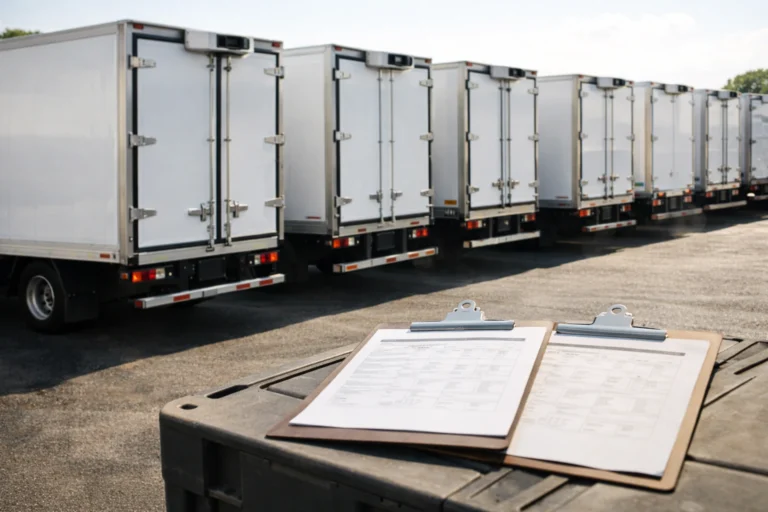
When you are expanding a cold-chain operation, the quote you take today will quietly determine your operating costs for years to come. I cannot count how many build sheets I’ve compared for fleet operators, warranty clauses I’ve weighed, and “apples-to-oranges” comparisons of competing deals on paper that have crossed my desk between truck A and truck B, with the same result: the lowest number in column one on page one is never the cheapest nameplate riding down the road. If those possibilities include custom composite boxes from a refrigerated box body manufacturer, this guide will help you compare quotes in an apples-to-apples way so that when you buy, it’s with knowledge, not guesswork.
Why Refrigerated Market Quotes Are Running Similar but Driving Differently
You should be able to get a quote from most manufacturers with a door length, style, and insulation thickness. The real variances lurk within the assumptions: how the box is joined, what the skins are comprised of, how thermal bridges are handled, what reinforcements are applied around stress points, and how the refrigeration unit is installed. Two “matching” quotes can yield wildly different results in weight, durability, and stability of fuel burning at a given temperature.
A quote is not only a price. It is a value proposition of materials, engineering, quality control, and post-sales support. Your job is to ensure that all the quotes you sew together speak the same language.
Begin With a Common Specification Before Comparing Costs
Before bidding it out to a range of vendors, build one single reference specification and share that with all the bidders. This way, there are fewer surprises, and you’re forced to be clear. The trick is to not make it overly complex and yet still lock in the things that matter with total cost of ownership.
Instead, determine what you want your target internal dimensions to be, payload requirements, what temperature ranges the device will need to operate in, how often it will start and stop (on/off), and whether you have an expected duty cycle. Then ensure you have multi-temp zones, a reinforced floor for pallet jacks, anti-slip surfaces, the door seals or insulating features you choose, and even that side-door route delivery configuration. If one vendor quotes a heavier floor and another quotes a lighter floor, the price difference might be reasonable, but only if you can actually see it.
Compare Construction Details, Not Just Insulation Thickness
When viewed as a system, not just as panels, composite boxes work best. Ask each potential supplier to explain the construction of the panel in normal language: core type, thickness, face/skin material, bonding process, and edge finishing.
Core, Skins, and Bonding Quality
A quote must include what the core is made of, whether polyurethane, XPS, PET foam, or something else, and at what density. Skins may be fiberglass reinforced plastic, gel-coated FRP, aluminum, or coated steel, and each has its influence on corrosion resistance and reparability.
Bonding matters. Structural collapse is a risk if bonding quality isn’t up to standard, whether through delamination, water ingress, or insulation decay.
Thermal Bridges and Sealing Strategy
Energy waste can also be a major hidden expense in a refrigerated body. These thermal jumps around door frames, floor cross-members, and mounting points can result in condensation, ice development, and temperature fluctuation.
Find out what the manufacturer does to minimize bridging and how it seals edges, corners, and penetrations. The good quotes have these specifics, not vague promises.
Weight, Payload, and Fuel Impact Assessment
Weight is money in cold-chain logistics. A lighter box can enhance payload capacity or curb fuel burn, but only if it holds up. When you are comparing quotes, ask for the estimated empty body weight and how it was determined. If a supplier doesn’t have weight targets, that’s a warning sign.
In my experience, the biggest quote regret occurs when a fleet discovers a lower-priced body is heavier than anticipated, or reinforcements were added after the fact as separate change orders. Demand a weight range in writing, and explain that expectation if the presented body exceeds it.
Integration and Airflow Planning of the Cooling Unit
A refrigerated body is only as good as its airflow and insulation continuity. Inquire if the quote covers structural support for the refrigeration unit, insulation around mounting points, and airflow characteristics: enough clearance for evaporators, any ducting choices, and return-air pathways.
If your routes involve multiple drop-offs, repeated door openings can kill efficiency. A better build might include upgrades such as tighter seals, improved threshold design, or optional strip curtains and insulated bulkheads. These should be seen as line items, not hidden under “standard features.”
Warranty, Serviceability, and Downtime Risk
The savviest fleet buyers pay as much attention to the language of a warranty as they do to its cost. Find out what’s covered (delamination, water penetration, insulation performance, door hardware, floor wear), the duration of coverage, and what will void it (unauthorized repairs, some chemicals, impact damage).
Also, look at service networks and repair turnaround. For example, a less expensive body that takes weeks to repair after a minor fender bender can end up being more expensive than the finest build if it gets back on the road fast. Inquire about replacement parts for hinges, seals, latches, and corner profiles.
Lead Time, Scale, and Consistency
If ordering more than one unit, be sure to calculate consistency. Ask about documented build processes, QC checkpoints, and materials batch tracking from the manufacturer’s standpoint. Lead time is not only a schedule, it is also a risk. You may get a quote that looks great, but it won’t work out for you on the timeline they can work with, and suddenly you have to pay for a short-term rental or buy a lost contract.
My mini-rant for the day is this: I always tell customers to ask builders for photos of previous builds in a similar style with an equivalent floor construction, door assemblies, and refrigeration unit mounting. Genuine manufacturers generally have this on hand.
A Real-World Piece of the Puzzle Many Fleets Overlook: Protecting Operational Data
The expansion of a fleet is not only about its hardware. It also involves the data that makes decisions and operations work. I spoke to a logistics operator who was procuring bodies while coping with a server failure in Singapore, and the supply line nearly collapsed because temperature logs, route records, and maintenance files were suddenly out of reach. They ultimately ended up coordinating data recovery Singapore support, and while evaluating vendors, the lesson was a simple one: continuity plan.
If your telematics, temperature monitoring, or compliance records live on local storage, think about your disaster recovery plan. Some fleets have a vetted vendor list for emergencies like hard disk data recovery Singapore, ssd data recovery Singapore, or RAID data recovery singapore because downtime can cost more than a premium box build. Rebel data recovery service Singapore is not covered under a body quote, but it is included in a robust fleet plan.
How to Score Quotes Fairly Without All This Overthinking
A clean way to compare quotes is by comparing them over four outcomes: temperature stability, durability, operating costs, and risk of downtime. If one quote is less but doesn’t specify the materials, sealing, reinforcement, or warranty coverage offered by the refrigerated box body manufacturer, you are not comparing apples to apples.
The best quotes are like a tightly written spec, not a marketing brochure. They explain what you get, how the unit is constructed, and what happens if something goes wrong with support from the refrigerated box body manufacturer behind the build.
In summation, select the quote that defends your cold chain rather than just saving you money.
Once you compare quotes on the same spec, with clear construction details, real-world weight targets, and strong warranty terms from a qualified refrigerated box body manufacturer, it’s easy to see where things go wrong. Any reputable refrigerated box body builder will embrace these questions because it proves you have longevity in mind. In the end, the best custom composite boxes are those that maintain temperature, prevent energy loss and repair costs, and secure your promise of delivery every mile you drive, all year round.
FAQs
What should I get from each manufacturer to compare the quotes?
Ask for a written build spec that includes the panel construction, core density, skin material, type of bonding, edge sealing, floor build-up, and door hardware, in addition to estimated body weight, refrigeration unit reinforcement details, warranty package, and lead time.
Are composite refrigerated bodies superior to aluminum for fleets?
Some composite bodies have aluminum in the rear portion where repairs are easier, and all-composite builds can offer better insulation properties and reduce thermal bridging. Which is best for you depends on your cycling, damage risk, and temperature requirements, so compare construction quality and insulation continuity, not material labels alone.
How do I prevent surprises in the cost after receiving a quote?
Clarify what’s included versus optional (and at what price), confirm reinforcements and floor ratings, get a weight range in writing, and ask how change orders are priced. Be certain the quote you receive reflects your specific operating requirements, not just a generic “standard build.”
What is the biggest red flag in a refrigerated body quote?
Indefinite descriptions like “high-quality insulation” without specifying core type, density, bonding method, or sealing approach. If the supplier is unable to detail how the body prevents thermal leaks and water ingress, long-term performance is unknown.
Do I favor a long warranty or fast service?
Both matter, but service speed tends to hit home faster in real costs. A good warranty is important, but quickly available parts and faster turnaround repairs minimize downtime, lost shipments, and emergency replacement expenses.
